Turkey's Kizilelma UCAV and Leonardo M-346 Complete First Crewed/Uncrewed Teaming Flight Test Under K-SWARM Program
Turkish drone maker Baykar and Italy's Leonardo have successfully completed the first live flight test of their K-SWARM program, validating crewed/uncrewed teaming (CUT-T) between the Kizilelma UCAV and the M-346 Fighter Attack jet. Conducted at Baykar's flight test center in Çorlu, Turkey, Kizilelma autonomously taxied, took off, and joined formation with the M-346, whose crew then commanded the drone through integrated avionics. The milestone places Turkey among a small group of nations pursuing advanced MUM-T capabilities.
Highlights
- Baykar與Leonardo在土耳其Çorlu完成K-SWARM計畫首次實機測試,驗證Kizilelma UCAV與M-346 Fighter Attack的有人/無人協同作戰(CUC-T)能力。
- Kizilelma使用Baykar的「Smart Fleet Autonomy」演算法,自主完成滑行起飛並加入編隊,M-346雙人機組透過整合航電系統接管指揮後,無人機自主執行隊形變換、分離與重新集結。
- Kizilelma為目前少數已實際飛行的戰鬥機型UCAV,搭載近10,000磅推力渦扇發動機,去年首次以UCAV身份發射雷達導引空對空飛彈(Gökdoğan)擊毀目標。
- K-SWARM計畫的長期目標是透過AI讓無人機從遙控飛行逐步過渡至自主作戰,下一測試階段將於未來數月內進行,複雜度更高。
- Kizilelma不受美國ITAR限制,土耳其若與TF Kaan或Hürjet搭配出口,將在歐洲市場具備獨特競爭優勢。
Turkish drone manufacturer Baykar and Italian defense group Leonardo have announced the successful completion of the first live flight test of the K-SWARM concept, validating crewed/uncrewed teaming (CUC-T) between a manned jet and an unmanned combat aerial vehicle (UCAV). The test, involving Baykar's Kizilelma UCAV and Leonardo's M-346 Fighter Attack aircraft, marks a significant milestone in the two companies' joint effort to develop next-generation autonomous air combat capabilities.
Test Details
The flight test was conducted last month at Baykar's flight test center in Çorlu, Turkey, using Leonardo's own M-346 Fighter Attack variant alongside a Kizilelma UCAV. An Italian Air Force T-346A — the trainer variant of the M-346 — served as a chase aircraft.
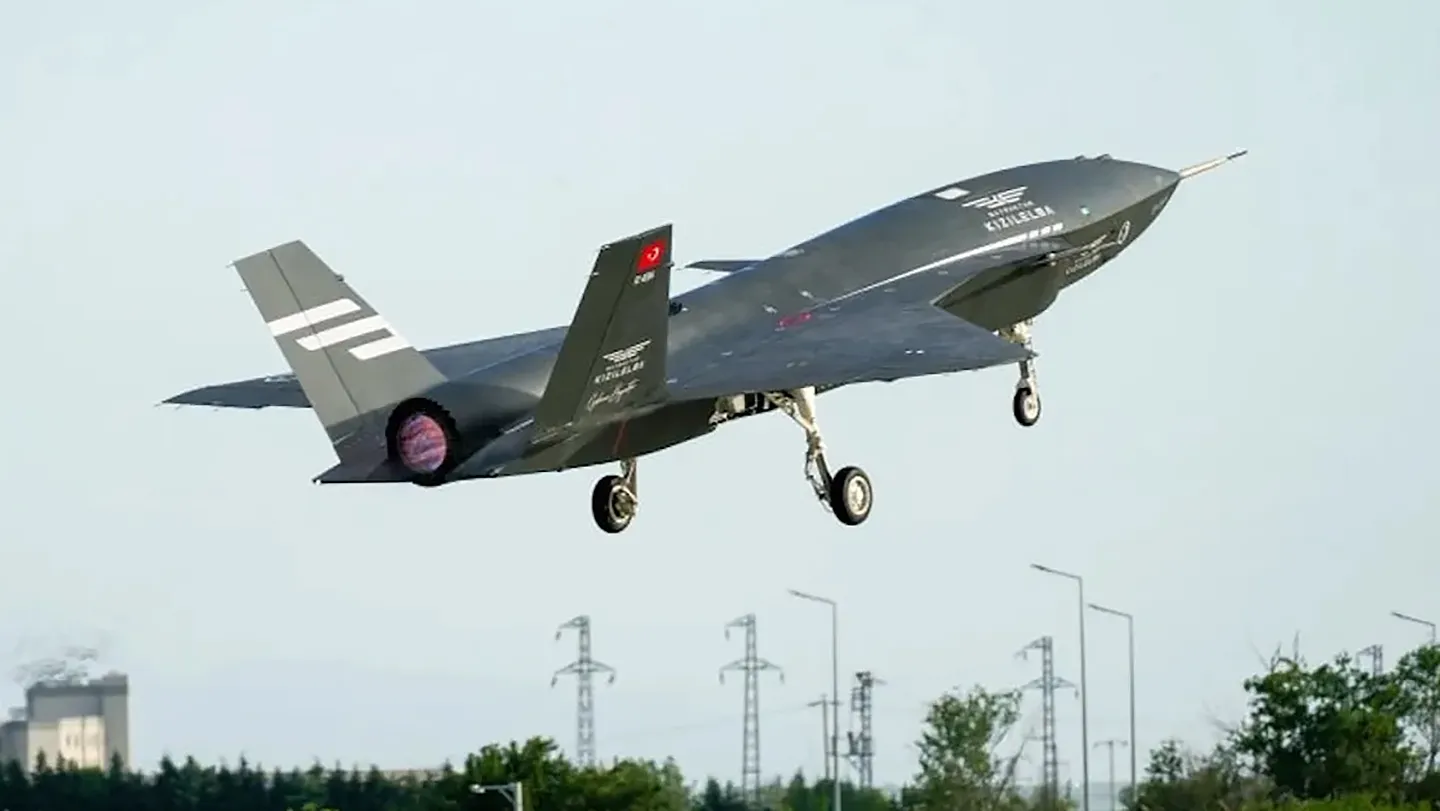
During the test, Kizilelma autonomously taxied and took off before independently joining the M-346 in formation. The two-person M-346 crew then assumed full control of the Kizilelma.
The UCAV executed the mission using Baykar's "Smart Fleet Autonomy" algorithms, developed at the company's hardware-in-the-loop (HIL) laboratory.
Following the handover, the M-346 pilots commanded Kizilelma through a newly developed, fully integrated avionics suite. Through a crewed/uncrewed teaming computing system, Kizilelma autonomously performed a range of maneuvers — including formation changes, separation, and rejoin — requiring only initial commands from the M-346 pilots. All data between the two aircraft was shared via an advanced radio frequency data exchange system.
K-SWARM Program Background
The Çorlu test represents the first live validation phase of the Leonardo–Baykar K-SWARM program, which focuses on developing interoperability between crewed and uncrewed aircraft. The companies refer to this as Crewed/Uncrewed Cooperative Teaming (CUC-T), also known in the industry as Manned-Unmanned Teaming (MUM-T) or Collaborative Combat Aircraft (CCA).
Regardless of terminology, the goal is consistent: to enable future combat pilots to operate alongside loyal wingman drones that can carry out weapons employment, intelligence gathering, communications jamming, or serve as decoys.
Baykar and Leonardo accelerated the path to live testing by first conducting simulated missions in virtual environments — including Leonardo's M-346 Full Mission Simulator at Venegono, Italy, and the Leonardo Product Capability and Concepts Laboratory (PC2LAB) in Turin. This allowed algorithms, tactics, and operational procedures to be validated before moving to real aircraft.
About the Kizilelma UCAV
Kizilelma is one of the few combat-drone programs to have produced actual flying hardware. Development began in 2013, though the concept was not publicly revealed until July 2021. Its first flight took place in December 2022, just weeks after ground testing commenced.
The UCAV is claimed to be capable of supersonic flight (at least in later variants), incorporates a degree of low-observable design, and is tailored for air combat missions typically performed by crewed fighters. Notably, it is positioned to serve as an unmanned loyal wingman to Turkey's next-generation TF Kaan crewed fighter. The production variant is powered by a Ukrainian-made Ivchenko-Progress AI-322F turbofan engine producing nearly 10,000 lb of thrust with afterburner.
Late last year, Turkey announced that a Kizilelma had destroyed a target drone using a domestically developed Gökdoğan radar-guided air-to-air missile — marking the first recorded instance of a UCAV firing a radar-guided air-to-air missile in combat conditions. Days later, Boeing's MQ-28A Ghost Bat replicated the feat in southern Australia, firing an AIM-120 AMRAAM.
Next Steps
The next phase of K-SWARM testing is planned within the coming months, with increased complexity and expanded functionality. Both parties stated that this will require greater situational awareness and the ability for platforms to cooperate "as one" toward mission objectives. While no further details were disclosed, it is worth noting that Kizilelma has already been tested with the Toygun electro-optical targeting system and an active electronically scanned array (AESA) radar.
The long-term goal of the K-SWARM program is to use AI to progressively shift unmanned systems from remotely piloted flight toward autonomous combat operations. This suggests future tests will see Kizilelma performing increasingly complex missions and maneuvers under M-346 pilot direction. Both companies emphasized that a human pilot will retain full control and decision-making authority at all times.
Strategic Significance
A UCAV operating under the command of a crewed tactical jet represents a major milestone for Turkey, placing it among a small group of nations pursuing this advanced capability. Publicly available information suggests that MUM-T operations have so far been largely confined to experimental efforts by the United States and China. Russia has reportedly flown its S-70 Okhotnik UCAV in formation with a Su-57, though the degree of actual teaming has not been confirmed. Last year, the U.S. Air Force demonstrated the MQ-20 Avenger operating under the control of an F-22 Raptor pilot in a simulated mission.
Also noteworthy is the fact that Kizilelma — like other Turkish defense products — is not subject to U.S. International Traffic in Arms Regulations (ITAR), a significant selling point for export customers seeking this class of capability. Should Turkey offer Kizilelma as part of a package alongside the high-end TF Kaan or the lighter Hürjet trainer-fighter, with integrated weapons options, it could occupy a unique position in the European export market.
For Leonardo, the M-346 has already achieved strong sales figures, with the combat-optimized Fighter Attack variant gaining increasing market traction. Through its stake in the Eurofighter consortium, Leonardo may also be eyeing the integration of drone-command capability into that multirole platform.
For both Baykar and Leonardo, demonstrating that Kizilelma can accept commands from the M-346 is a significant achievement. However, to elevate K-SWARM from a technology demonstrator to a genuine operational capability, the critical next step will be extending this teaming to different aircraft types, larger formations, and higher levels of autonomous mission execution.
原文來源: 查看原文
FAQ
Reviewed and published by the LAETimes editorial desk ·


