Drones Force a Redesign of America's Most Iconic Tank — The New M1E3 Abrams Moves All Crew Out of the Turret
Battlefield lessons from Ukraine have shown that even Western-built main battle tanks are vulnerable to cheap drones. The U.S. Army has cancelled the M1A2 SEPv4 upgrade and is instead developing the M1E3 Abrams, featuring an unmanned turret, crew relocated to an armored hull compartment, an integrated Active Protection System (APS) capable of intercepting drones, and a hybrid-electric powertrain — marking the most radical redesign in Abrams history.
Highlights
- The U.S. Army cancelled the M1A2 SEPv4 upgrade program and is replacing it with the M1E3 Abrams, the most extensive redesign in the tank's history, driven by drone warfare lessons from Ukraine.
- The M1E3 features a fully unmanned turret that reduces the crew from four to three, relocating all crew members into an armored hull compartment completely isolated from the ammunition supply.
- The M1E3 integrates the M251 APS — a U.S.-licensed version of Israel's Iron Fist system — directly into the turret structure, with upgraded capability to intercept both anti-tank missiles and drones.
- The M1E3 replaces the legacy gas turbine engine with a CAT C13D six-cylinder diesel engine rated at 1,100 horsepower paired with a 250-hp auxiliary electric motor, reducing fuel consumption and acoustic signature.
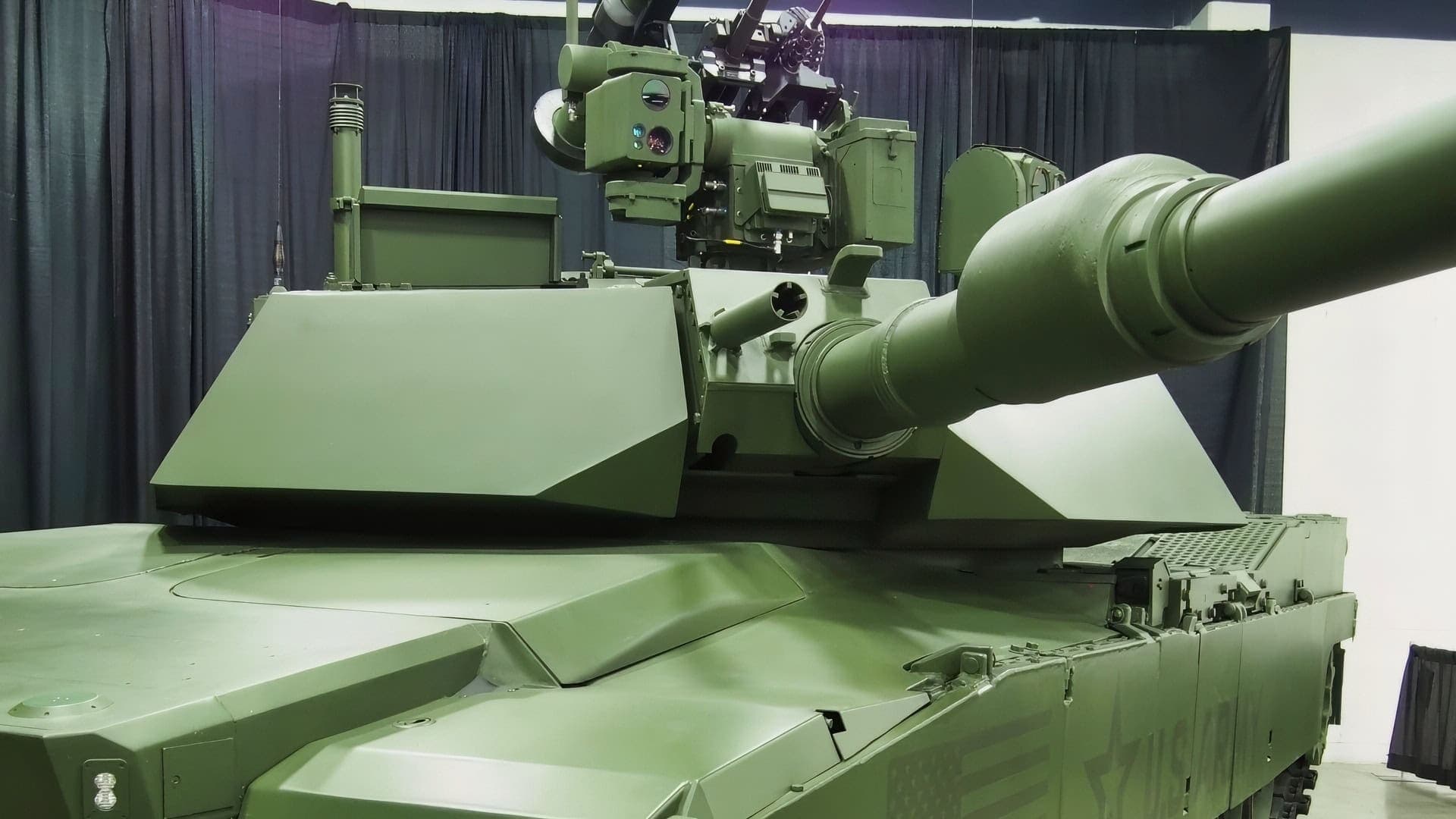
- A proof-of-concept vehicle for the M1E3 was unveiled in January, incorporating multiple sensor upgrades originally developed for the cancelled SEPv4, including an improved FLIR targeting system and a distributed aperture system.
Ukraine's Brutal Wake-Up Call
The war in Ukraine has served as a sobering lesson for militaries around the world. Early assessments tended to attribute heavy armored vehicle losses to the poor quality of Soviet-era equipment or flawed tactics. But when Western-built main battle tanks (MBTs) entered combat in 2023, they too suffered significant losses at the hands of drones and other modern anti-armor weapons.
NATO was forced to confront an uncomfortable truth: most modern tanks were simply not prepared for a battlefield dominated by unmanned aerial systems. That recognition has driven the United States to recalibrate the development of its next-generation MBT. The M1A2 SEPv4 upgrade program has been cancelled, replaced by the M1E3 — a substantially redesigned Abrams built specifically for today's drone-saturated battlefields. But is it enough?
The Core Challenge: Designing the M1E3 Abrams to Survive Drone Threats
The M1E3 is not a revolutionary departure from the Abrams in the conventional sense. The tank retains the core elements that have proven effective for the Abrams family — armor protection, chassis architecture, and primary armament.
However, the new variant does introduce several fundamental design changes. The turret has been made fully unmanned, and the loader position has been eliminated, reducing the crew to three. The central idea behind this change is a significant improvement in crew survivability. By relocating the crew out of the turret, they are also completely isolated from the ammunition, eliminating the risk of crew casualties caused by ammunition cook-off. While most Western MBTs feature blow-off panels on their ammunition compartments, crew members still face considerable danger if ammunition detonates during the loading process — a vulnerability the M1E3's design effectively addresses.
The M1E3 appears to adopt a "hard-kill/soft-kill" dual-layer approach to drone defense. The vehicle is reportedly set to be equipped with the M251 system — the U.S.-licensed version of Israel's Iron Fist Active Protection System (APS) — to counter a range of incoming threats.
Unlike earlier Abrams variants that retrofitted the Trophy APS as an external add-on kit, the M1E3 will integrate the APS directly into the turret structure, eliminating the dead-weight penalties seen on the SEPv3 and SEPv4. The Iron Fist APS has been recently upgraded to intercept not only missiles but also drones — a capability that is critically important on today's battlefield. Some analysts speculate that the vehicle may also carry electronic warfare (EW) systems to mask the tank's electronic signature or jam incoming drones.
General Dynamics' New Vision: A Rebuilt Abrams for Today's Battlefield
The M1E3 also brings meaningful improvements in mobility. The variant officially abandons the Abrams' traditional gas turbine engine in favor of a hybrid-electric powertrain.
The proof-of-concept vehicle unveiled in January features a CAT C13D six-cylinder diesel engine rated at 1,100 horsepower, supplemented by a 250-horsepower auxiliary electric motor. This new powertrain configuration, combined with suspension upgrades, is designed to achieve several objectives: replacing the fuel-hungry gas turbine with a more fuel-efficient diesel engine improves energy efficiency while also reducing the tank's acoustic signature; and a more compact drivetrain paired with a redesigned suspension system frees up additional internal space to accommodate the new armored crew compartment.
The M1E3 also integrates multiple sensor systems to enhance networked warfare capabilities and battlefield situational awareness. Many of the upgrades originally developed for the M1A2 SEPv4 have been carried over to the M1E3, including an improved forward-looking infrared (FLIR) targeting system and a distributed aperture system that allows crew members to "see through" the hull in all directions.
The addition of new sensors and a combat management system ensures that crew members always have access to a continuously updated, comprehensive battlefield picture. The onboard computer will automatically detect and designate targets, and the gunner, commander, or even the driver can operate the main gun if necessary.
While some of these features may not directly address the drone threat, they remain essential for any next-generation MBT.
Rethinking the Tank's Role in Drone-Dominated Warfare
Returning to the original question: does the M1E3 incorporate sufficient defensive systems to survive on today's battlefield? The answer is: no — but also yes.
The critical point is this: no tank, regardless of how many APS or EW systems it carries, can survive alone in the age of drones. In fact, no single tank has ever been designed to survive on its own — tanks were never meant to fight in isolation.
Under U.S. armored warfare doctrine, tanks are one component of a combined-arms team that includes infantry, support vehicles, aircraft, and artillery units. In any well-planned operation, tanks almost never operate alone, and fire support is always on call should the situation deteriorate.
Drones have undoubtedly complicated the equation, but the fundamental principles of combined-arms doctrine remain as valid as ever.
The U.S. Army does not need to overhaul its entire doctrine to counter drones — it needs to integrate unmanned aerial systems (UAS) and counter-UAS (C-UAS) capabilities into the existing doctrinal framework. In that sense, the M1E3 represents the right direction for the U.S. Army at this moment.
The vehicle retains everything that has worked within the Abrams family, incorporates new technology, and leaves ample room for continuous future improvement. Operating alone, the M1E3 would still be vulnerable to drone threats — but tanks were never built to fight alone. They will operate alongside infantry and support vehicles, some of which will be specifically configured for counter-drone missions.
原文來源: 查看原文
FAQ
Reviewed and published by the LAETimes editorial desk ·


