White Sands Milestone: Army Secretary Tests Laser Weapon System, FAA and DoD Sign Counter-Drone Safety Agreement
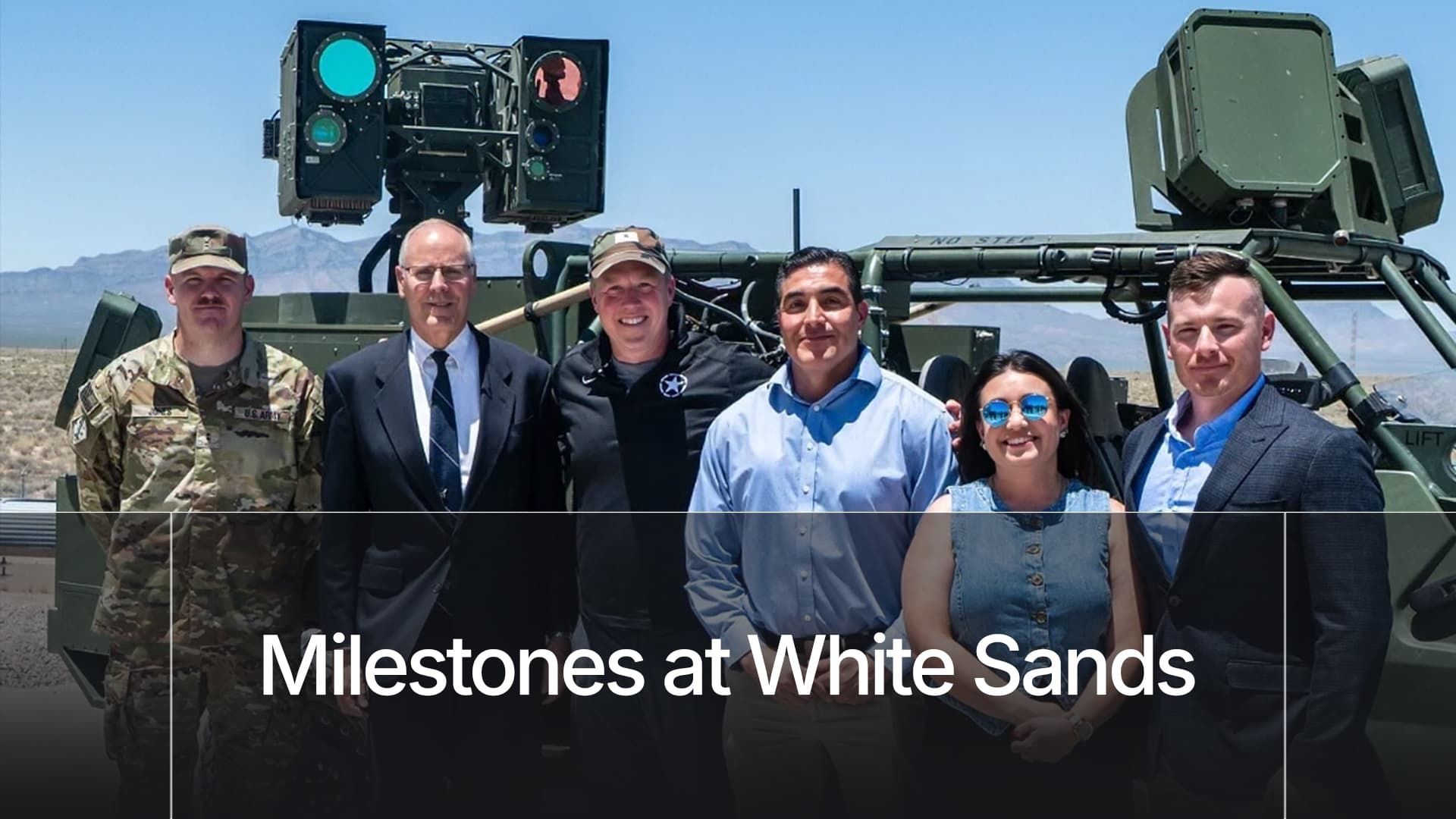
U.S. Army Secretary Dan Driscoll personally operated AeroVironment's LOCUST®-powered AMP-HEL laser weapon system at White Sands Missile Range in New Mexico. On April 10, the FAA and the Department of War (DoW) signed a landmark safety agreement establishing a framework for operating counter-drone laser systems in shared civil airspace — signaling a pivotal shift from research and development toward operational deployment of directed-energy weapons.
Highlights
- U.S. Army Secretary Dan Driscoll personally operated AeroVironment's LOCUST-powered AMP-HEL laser weapon system at White Sands Missile Range in New Mexico.
- On April 10, the FAA and the Department of War (DoW) signed a landmark safety agreement enabling counter-drone laser systems to operate within shared civil airspace.
- The agreement was built on empirical data from JIATF-401 testing of AV laser systems at White Sands, establishing the regulatory framework needed for operational deployment.
- The two milestones together signal a shift in directed-energy weapons from the R&D phase toward large-scale operational and combat deployment.
- AeroVironment (AV), founded by Dr. Paul B. MacCready, Jr., has led U.S. unmanned systems development for over 50 years across air, land, maritime, space, and cyber domains.
Major paradigm shifts in defense rarely announce themselves with fanfare. Instead, they arrive quietly, one milestone at a time.
At White Sands Missile Range in New Mexico, U.S. Army Secretary Dan Driscoll recently took the controls of an AeroVironment (AV) LOCUST®-powered vehicle to personally test the Army's directed-energy capabilities. To some, it was a routine demonstration. To those who have spent years working on laser weapon systems, it represented a genuine turning point.
For AV's LOCUST-powered AMP-HEL system, the event marked another step toward the goal of being "operable, deployable, and scalable" — reinforcing an awareness, both within the Army and among the broader American public, that laser weapons are no longer a future prospect. They are here.
FAA and Department of War Sign Counter-Drone Laser Safety Agreement
Almost simultaneously, another milestone quietly materialized at White Sands, drawing far less attention.
On April 10, the Federal Aviation Administration (FAA) and the Department of War (DoW) signed a landmark safety agreement establishing a pathway for counter-drone laser systems to operate within shared civil airspace. The agreement's foundation was built in part on testing conducted at White Sands by JIATF-401 using AV laser weapon systems — work that provided the empirical basis needed to shape the agreement's framework.
The agreement defines the permitted scope of laser system use, outlines how operators must avoid conflicts with manned aircraft, and establishes standards for the safe and predictable deployment of these systems.
This may sound like administrative procedure. In reality, its significance runs much deeper.
Driscoll's hands-on test with an Xbox-style controller, combined with the signing of the FAA agreement, together point to a broader phenomenon: laser weapons are moving — openly and at increasing scale — from research and development into operational deployment reality.
A Historical Lesson: America Wins Through Application, Not Invention
The United States has always excelled at inventing things. But invention alone has never been the deciding factor.
The internet grew from defense-funded research. The space race produced GPS, satellite communications, and the foundational technologies of the modern economy. In each case, the same pattern held: innovation mattered because America applied it, tested it, refined it, and scaled it.
The trajectory of laser weapons follows the same arc.
For years, the greatest obstacle facing counter-drone laser systems was not the technology itself, but the challenge of operating safely in shared airspace. Because lasers interact directly with the atmosphere, legitimate concerns about aviation safety, sensor interference, and unintended exposure consistently slowed broader operational use.
This is precisely why the FAA agreement carries such weight — it signals a shift in the central question from "Can we make this technology work?" to "Can we safely deploy and scale it?"
The Jenny Lesson
History offers an instructive comparison.
Most people assume American aviation dominance traces back to the Wright Brothers. In fact, progress stalled after the Wright Flyer, and Europe quickly surged ahead. The real turning point was not another invention — it was practical application.
The Curtiss JN-4 "Jenny," a relatively simple aircraft, flew real missions during General John Pershing's punitive expedition against Pancho Villa along the Mexican border. It was imperfect, but it was operationally viable. As a result, the United States developed trained personnel and accumulated institutional experience — laying the groundwork for aviation at scale. By the time World War I arrived, America was not starting from scratch.
The same lesson applies to laser weapons today.
The United States invented the laser and has led directed-energy research for decades, from the Airborne Laser (ABL) and THEL to combat systems like LaWS. Yet large-scale deployment has consistently lagged. Concepts have been validated, but converting them into scalable capability has proven elusive — while competitors continue to close the gap rapidly.
This is what makes the two milestones at White Sands so significant. When senior leadership personally tests a system, and when the regulatory framework begins supporting operational use, the conversation changes. The milestone is no longer scientific feasibility — it is operational adoption.
From Experiment to Production: The Path to Industry Maturity
A clear regulatory framework enables procurement. Procurement drives production. Production improves reliability, reduces costs, strengthens supply chains, and enables scale. This is the established path to industry maturity.
Small drones are becoming cheaper, more capable, and more widely available. Homeland security, airspace protection, military installations, and critical infrastructure increasingly require affordable, scalable counter-drone defenses.
Laser systems matter not because they are novel, but because they are becoming available, trustworthy, and deployable tools.
The White Sands tests and the FAA agreement may ultimately be remembered as the beginning of the transition from experiment to production.
A Window of Opportunity Has Opened
The United States still holds a strong position in directed energy. But history warns us: inventing a technology does not guarantee leadership in its application.
Leadership comes from recognizing critical inflection points and acting on them.
Driscoll's test at White Sands is one such milestone. The FAA agreement is another. Neither guarantees success on its own — but taken together, they send an important signal: the United States may finally be building the conditions for laser systems to move from the laboratory to the battlefield at scale.
The author, Aaron Westman, is an engineer and expert in counter-drone and directed-energy systems, playing a key role in advancing mobile laser weapon integration and operational deployment in support of cross-domain capabilities for precision engagement and multi-layered air defense.
AeroVironment (AV), founded by legendary innovator Dr. Paul B. MacCready, Jr., has been a leader in unmanned systems for over 50 years. The company is one of America's premier autonomous systems companies, operating across air, land, maritime, space, and cyber domains.
原文來源: 查看原文
FAQ
Reviewed and published by the LAETimes editorial desk ·


