MIT Computer Model Cuts Bridge Material Use by Up to 90%, Slashing Carbon Emissions
A research team at MIT has developed a topology optimization-based computer model capable of reducing material use in bridges and buildings by up to 90%. The system supports mixed steel-and-timber designs, balances constructability with carbon reduction goals, and has been validated on the Lockport Bridge near Buffalo, New York. Findings were published in the journal Automation in Construction.
Highlights
- MIT's topology optimization model reduces bridge and building material use by up to 90% while maintaining structural integrity and constructability.
- The framework was developed by Assistant Professor Josephine Carstensen and led by doctoral student Zane Schemmer in MIT's Department of Civil Engineering.
- The system supports hybrid steel-and-timber designs, ensuring each member uses a single material and all joints comply with engineering standards.
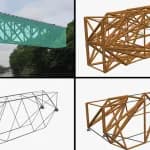
- The model was validated on the Lockport Bridge near Buffalo, New York, producing pure-timber, pure-steel, and hybrid truss design options.
- All experiments ran on a standard MacBook Pro, confirming the method's practical feasibility for real-world engineering firms.
MIT Computer Model Revolutionizes Bridge Design, Cutting Material Use by Up to 90%
A research team at the Massachusetts Institute of Technology (MIT) has developed a new computer model that can reduce the amount of material needed to build bridges and other structures by up to 90%, while making future structural designs significantly more efficient.
The research was led by Dr. Josephine Carstensen, the Gilbert W. Winslow (Class of 1937) Career Development Assistant Professor in the Department of Civil Engineering. The approach centers on topology optimization — a computational technique that determines the optimal placement of material within a given space — and aims to close the gap between optimized digital designs and real-world construction.
Carstensen said the technology has the potential to dramatically cut both construction costs and carbon emissions. "The choice of materials, the constructability of the design, and structural optimization are all interconnected," she said. "You have to be able to address all three at once, and that is what we tried to do here."
A Smarter Way to Design
Topology optimization uses computer algorithms to distribute material as efficiently as possible within a defined space — for example, achieving maximum structural strength at minimum weight. Despite its promise, the technique has historically been confined to academic research and 3D printing applications, with little uptake in bridge and building engineering.
The reason: such designs often produce highly complex, costly geometries — web-like structures that even experienced engineers would find difficult to build.
To overcome this barrier, the MIT team developed a framework that allows users to define real-world constructability constraints at the outset of the design process. Engineers can specify the maximum number of members at each node, minimum connection angles, and minimum member sizes.
The system supports multiple materials and can combine steel and timber within a single design, while ensuring that each structural member is made from only one material and that all joints meet engineering standards. "You can't have a member that is 72% timber and 28% steel," said Zane Schemmer, a doctoral student and lead author of the study.
From Design to Real-World Application
To validate the approach, the research team used the Lockport "Upside-Down Bridge" near Buffalo, New York, as a test case. They generated pure-timber, pure-steel, and hybrid timber-steel truss designs, and tested how different constructability constraints affected the final structure.
The results showed that the strongest design was not necessarily the easiest to build. "We saw that the system knew it could design an all-steel bridge, but that might not be optimal from a carbon standpoint," Schemmer explained. "Or it could design an all-timber bridge, but that might not be strong enough."
Schemmer noted that by strategically mixing materials, the framework can deploy timber where the carbon savings are greatest and reserve steel for areas requiring additional strength. "The two materials can work together — you use timber to save carbon and steel to add strength, and you can find a balance in these structures," he said in a statement.
Although the optimization method is more computationally intensive than some existing approaches, the researchers noted that all experiments were run on a standard MacBook Pro, making it practically viable for engineering firms.
"This approach has historically been avoided in practice, but we now believe it is a practical way to solve problems with variable constraints," Schemmer concluded.
The study has been published in the peer-reviewed journal Automation in Construction.
原文來源: 查看原文
FAQ
Newsletter
Subscribe to our Low-Altitude Industry Newsletter
Daily curated news on low-altitude economy and drone industry, delivered to your inbox.
Reviewed and published by the LAETimes editorial desk ·