Inspired by Puffins: MIT and EPFL Jointly Develop Air-Water Amphibious Flapping-Wing Drone
Engineers from MIT and EPFL have developed a sub-300-gram Flapping-wing Aerial-Aquatic Vehicle (FAAV) inspired by the Atlantic puffin. The robot uses flexible, nanoparticle-coated wings beating at 5 Hz to travel at 1 m/s underwater and 6 m/s in the air. It successfully transitioned from water to flight during field tests on Lake Geneva. The research was published in Science on July 9.
Highlights
- MIT與EPFL聯合開發的FAAV重量不足300克,以每秒5次頻率拍打奈米粒子塗層柔性翅膀,實現空水兩棲飛行。
- FAAV在水中巡航速度為每秒1公尺,在空中可達每秒6公尺,設計靈感來自北極海鸚的雙介質運動機制。
- 機器人在日內瓦湖完成實地測試,成功從水下躍出並升空,無需腳部輔助,關鍵在於以70度仰角接近水面。
- 相關研究已於2025年7月9日刊登於國際頂尖學術期刊《科學》(Science)。
- MIT AURA實驗室計劃開發進階翅膀版本,目標是讓無人機每小時部署一次,取代傳統科考船進行海洋資料採集。
Researchers have long sought to build robotic systems capable of both flying through the air and diving underwater — a challenge the Atlantic puffin handles with ease.
Taking a cue from nature, engineers at MIT and the École Polytechnique Fédérale de Lausanne (EPFL) have jointly developed a novel Flapping-wing Aerial-Aquatic Vehicle (FAAV). Weighing less than 300 grams, the robot features a central fuselage, two flexible wings, and a steerable tail.
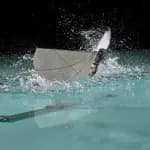
During field tests on Lake Geneva, the vehicle successfully swam beneath the surface, then beat its wings to break through the water and climb into the air.
"Our dream vision is for oceanographers, marine biologists, and members of coastal communities to be able to launch this robot from a boat or from shore. It can fly close to a target area — say, an iceberg, a harbor installation, or above a pod of whales," said Raphael Zufferey, Assistant Professor of Mechanical Engineering at MIT.
"It can dive in to take measurements or collect samples, then fly back to relay data at a fraction of the cost. And then go out and dive again," Zufferey added.
How the FAAV Works
The engineering team initially assumed that a dual-medium robot would require complex, heavy morphing structural components — but nature proved otherwise.
Researchers reviewed biological data on kingfishers, petrels, and puffins, and found that smaller birds maintain the same physical locomotion mechanism in both media, simply adjusting their flapping rate. Puffins flap roughly 10 times per second in air and slow to about 4 times per second when diving underwater.
The team replicated this behavior with considerable precision. The FAAV is driven by a small waterproof electric motor and a mechanical crankshaft, flapping its flexible, nanoparticle-coated wings at a steady 5 Hz.
The key to the vehicle's success lies in wing flexibility: the wings must be soft enough to reduce stroke amplitude in water, yet stiff enough to generate lift in air.
The FAAV cruises at 1 m/s underwater and reaches 6 m/s in the air.
The Challenge of Water-to-Air Transition
Breaching the water surface proved to be the hardest obstacle, requiring enormous thrust during the transition.
To overcome surface tension, the engineers found the robot must approach the surface at a steep 70-degree pitch angle. Too shallow an angle traps the wingtips in the water; too steep, and the vehicle flips backward and crashes.
Notably, the robot accomplishes the water-to-air transition without any legs or feet.
Real puffins and ducks typically use webbed feet to paddle through the surface tension. Zufferey and his team discovered that the robot only needs the right combination of wing area, flapping frequency, and tail pitch angle to lift off successfully — demonstrating that, at least in robotics, leg-paddling is entirely unnecessary for takeoff.
Next Steps: Toward Ocean Science Applications
MIT's AURA Laboratory has already begun the next phase of development. Future iterations will feature advanced wings capable of twisting and changing direction, enabling the drone to cope with strong winds and rough coastal waves.
Currently, ocean data collection depends heavily on large research vessels that cannot safely navigate hazardous shallow reefs or broken ice fields. The FAAV could change that — deployable once per hour rather than once per week, autonomously traveling between a research base and fragile marine ecosystems.
The research was published in the peer-reviewed journal Science on July 9.
原文來源: 查看原文
FAQ
Newsletter
Subscribe to our Low-Altitude Industry Newsletter
Daily curated news on low-altitude economy and drone industry, delivered to your inbox.
Reviewed and published by the LAETimes editorial desk ·


