MQ-25 Stingray Test Aircraft Aboard USS Nimitz for America's 250th Anniversary Celebrations
The U.S. Navy has confirmed that the MQ-25 Stingray unmanned tanker demonstrator prototype T-1 is currently aboard the supercarrier USS Nimitz as part of FLEETEX 250, a multinational exercise coinciding with America's 250th anniversary. Boeing noted the display offers a glimpse of the future carrier air wing. The production MQ-25 has a 75-foot wingspan, and the Navy targets Initial Operational Capability (IOC) as early as next year.
Highlights
- The U.S. Navy confirmed MQ-25 Stingray prototype T-1 is aboard USS Nimitz as part of FLEETEX 250, a 20-nation multinational exercise marking America's 250th anniversary.
- The production MQ-25 has a 75-foot wingspan—significantly larger than the F/A-18E Super Hornet's 45-foot span—making it one of the largest aircraft in the carrier air wing.
- The Navy's IOC target for the MQ-25 has slipped from 2024 to sometime in 2027, with the first production-representative aircraft completing its maiden flight only in April 2025.
- The Navy has installed unmanned aircraft control stations aboard USS George H.W. Bush, Carl Vinson, Theodore Roosevelt, and Ronald Reagan in preparation for MQ-25 operations.
- Navy officials have set a goal for unmanned aircraft to constitute more than 60% of the future carrier air wing, with the MQ-25 serving as the program's trailblazer.
MQ-25 Stingray Demonstrator Aboard USS Nimitz for America's 250th Anniversary Celebrations
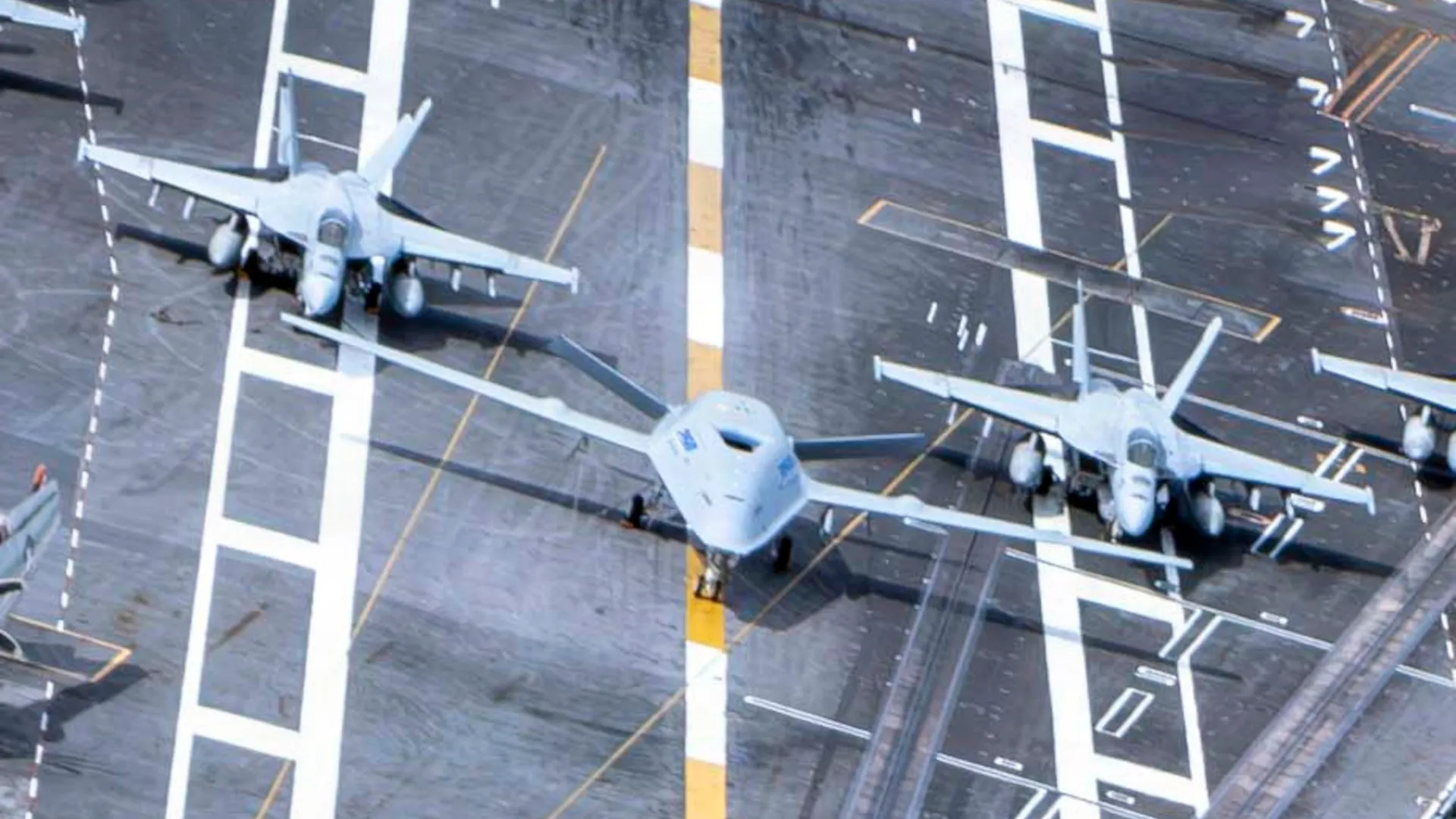
The U.S. Navy has confirmed to The War Zone (TWZ) that the MQ-25 Stingray unmanned aerial refueling tanker demonstrator—designated T-1—is currently on the flight deck of the supercarrier USS Nimitz. Photos of the carrier that recently circulated online sparked speculation that the aircraft was the first production-representative MQ-25, which completed its maiden flight in April, making its carrier debut. The Navy subsequently clarified that the aircraft is, in fact, the T-1 prototype. Nevertheless, the images vividly illustrate the sheer size of the Navy's first advanced carrier-based unmanned aircraft, particularly when parked alongside other carrier air wing types.
"We do have a Boeing-owned T-1 prototype currently aboard," a Navy spokesperson confirmed to TWZ.
T-1 Prototype: A Decade of Testing
T-1 has been flying since 2019 and has participated extensively in ground and flight testing in support of the Stingray program. In December 2021, the prototype conducted deck handling trials aboard USS George H.W. Bush, another Nimitz-class carrier. Notably, T-1 has never performed an arrested landing or catapult launch from a carrier; it was transported aboard Nimitz for this occasion.
"To celebrate America's 250th birthday, the MQ-25A T-1 prototype is aboard USS Nimitz, offering a glimpse at the future of the Navy's carrier air wing," Boeing wrote on X. "The 'Boeing Backs America' marking on the aircraft reflects our support for American aviation."
FLEETEX 250
USS Nimitz is currently operating in the Atlantic Ocean as part of FLEETEX 250, a large-scale multinational exercise running in conjunction with multiple events marking the United States' 250th anniversary. The exercise involves 20 nations alongside the United States, including Belgium, Brazil, Canada, Cameroon, Côte d'Ivoire, Cyprus, Denmark, France, Germany, Mexico, Morocco, the Netherlands, Norway, Peru, Senegal, Spain, Turkey, and the United Kingdom. On June 25, Nimitz led a 25-ship multinational formation for aerial photography drills.
Size Comparison: Dominating the Deck
In the photographs, T-1 is parked alongside four F/A-18E Super Hornets and two C-2A Greyhound carrier onboard delivery aircraft. The aircraft has received new "250" anniversary markings in blue on both sides of its fuselage.
The production MQ-25 has a wingspan of 75 feet, folding down to 31.3 feet with wings folded, and a fuselage length of 51 feet. By comparison, the F/A-18E Super Hornet has a wingspan of nearly 45 feet and is just over 60 feet long; the C-2A Greyhound spans 80 feet 7 inches with wings spread and is 56 feet 10 inches in length. Even by carrier aviation standards, the MQ-25 is a large aircraft.
Integration Challenges Remain
The images also underscore the significant work still required to integrate the production MQ-25 into routine carrier operations. Carrier deck space is extremely limited and the operating environment differs fundamentally from land-based airfields. During X-47B testing, the Navy employed a wearable glove-style controller for deck handling; T-1 trials have also used various forms of portable control devices. How to safely and efficiently maneuver the MQ-25 on a busy flight deck remains an open challenge.
Flight testing also remains incomplete, including verifying that the unmanned aircraft can safely conduct arrested landings and catapult launches from a carrier and integrating it with shipboard control systems. The MQ-25 will introduce entirely new tactics, techniques, and procedures to the carrier air wing, and will lay the groundwork for future unmanned aviation development.
Strategic Significance: Penetrating A2/AD Defenses
The MQ-25's primary mission is to extend the range of other carrier air wing aircraft—a critical capability as the Navy confronts the People's Liberation Army's (PLA) expanding anti-access/area-denial (A2/AD) network.
The Stingray will also relieve manned F/A-18F Super Hornets of organic tanking duties, freeing those jets for other combat missions while reducing airframe wear. The MQ-25 also incorporates an intelligence, surveillance, and reconnaissance (ISR) capability via a sensor turret located beneath the nose; its large size and long-range potential could also eventually make it a candidate for conversion into a long-range strike platform.
Program Delays and the Road Ahead
The MQ-25 program has nonetheless faced serious delays and cost overruns in recent years. An initial operational capability originally planned for 2024 has slipped, and the first production-representative aircraft only completed its maiden flight in April of this year despite strong push from the Navy and Boeing. The Navy has now revised its IOC target to sometime in 2027.
As for USS Nimitz itself, the carrier's service life has been extended to March of next year, making this display potentially the only occasion on which the ship will ever carry any MQ-25. The Navy has already installed its first unmanned aircraft control station aboard USS George H.W. Bush, with installations following aboard USS Carl Vinson, USS Theodore Roosevelt, and USS Ronald Reagan, forming an initial cluster of Nimitz-class carriers equipped to operate the MQ-25.
Toward an Unmanned Carrier Air Wing
The Navy views the MQ-25 as a trailblazer for the future unmanned carrier air wing, with plans that also include a carrier-based variant of the Collaborative Combat Aircraft (CCA) unmanned platform. Navy officials have stated that the goal is for unmanned aircraft to eventually make up more than 60 percent of the future carrier air wing.
T-1's appearance on the deck of USS Nimitz—both literally and symbolically—signals the sweeping transformation that is coming to U.S. Navy carrier aviation.
Contact the reporter: joe@twz.com
Originally published by The War Zone (TWZ).
原文來源: 查看原文
FAQ
Reviewed and published by the LAETimes editorial desk ·