PACAF Evaluates Boeing MQ-28 Ghost Bat Drone at Valiant Shield 2026 Exercise
US Pacific Air Forces (PACAF) has announced that the Boeing MQ-28 Ghost Bat Collaborative Combat Aircraft (CCA) is being integrated with US and allied forces during the Valiant Shield 2026 exercise this month. Flying alongside manned platforms, the MQ-28 will conduct defensive and offensive counter-air missions, marking a significant milestone in CCA operational development in the Indo-Pacific.
Highlights
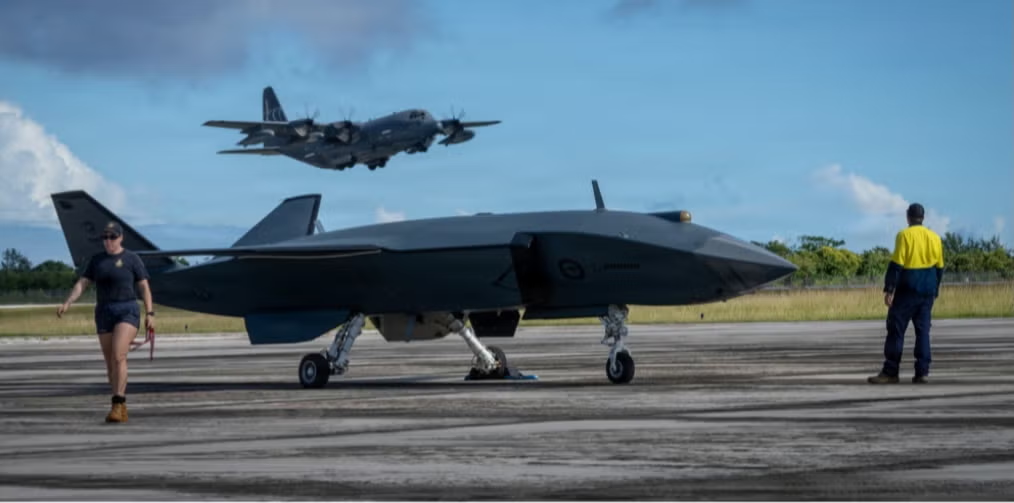
- On June 21, 2026, a Boeing MQ-28 Ghost Bat production-representative test aircraft flew alongside an HC-130J Combat King II during Valiant Shield 2026 at Rota, Northern Mariana Islands.
- PACAF described the flight as a significant milestone in CCA operational development and human-machine teaming in the Indo-Pacific theater.
- Boeing validated the MQ-28's low radar cross-section (RCS) performance this month, confirming the platform's ability to reduce its detectability in contested environments.
- The US Air Force's FY2027 budget requests $1.1 billion to start CCA production and nearly $1.4 billion for R&D, targeting a fleet of 150+ CCAs by 2029 and approximately 1,000 total.
- GA-ASI's FQ-42A Dark Merlin and Anduril's FQ-44A Fury have been selected for CCA EMD, with Increment 2 of the programme expected to launch in 2026.
While the US Air Force continues to fund General Atomics Aeronautical Systems (GA-ASI) and Anduril Industries in developing Collaborative Combat Aircraft (CCA), Pacific Air Forces (PACAF) has announced it is integrating the Boeing MQ-28 Ghost Bat with US and allied forces during this month's Valiant Shield exercise.
On June 21, a production-representative test aircraft of the MQ-28 Ghost Bat — manufactured by Boeing Defence Australia — took off alongside an HC-130J Combat King II from the 79th Rescue Squadron during Valiant Shield 2026, held at Rota in the Commonwealth of the Northern Mariana Islands.
A Significant Milestone
PACAF stated: "This marks a significant milestone in CCA operational development and the advancement of human-machine teaming in the Indo-Pacific theater. During the exercise, the uncrewed MQ-28 will fly in concert with manned combat platforms, providing the joint force with a critical opportunity to refine next-generation air power tactics, techniques, and procedures. The CCA will perform a range of missions during Valiant Shield 26, including defensive and offensive counter-air tasks."
Boeing declined to comment specifically on the aircraft's use in the exercise, stating only that it "hopes to have more information to share in the near future."
Low Radar Cross-Section Validated
Also this month, Boeing announced it had successfully validated the low radar cross-section (RCS) performance of the Ghost Bat, developed by its Australian subsidiary.
"The MQ-28's RCS reduces the range at which adversary radar can detect and engage the MQ-28, enhancing the platform's survivability in contested environments," Boeing said. "The successful RCS testing confirms the effectiveness of MQ-28's design, production, and material selection in minimising radar detection."
In March of this year, Boeing announced a partnership with Rheinmetall to deliver the Ghost Bat to Germany as a CCA by 2029 at the latest.
Development of the MQ-28 began in 2017, and the aircraft completed its maiden flight in 2021. Boeing has also confirmed that the MQ-28 has launched an Advanced Medium-Range Air-to-Air Missile (AMRAAM) at a target drone, and has previously operated alongside other Ghost Bats, an E-7A Wedgetail airborne early warning aircraft, and an F/A-18F Super Hornet.
CCA Programme Context
This month, the US Air Force selected the GA-ASI FQ-42A Dark Merlin and the Anduril FQ-44A Fury to proceed into CCA Engineering and Manufacturing Development (EMD), with Increment 2 of the programme expected to launch later this year.
Procurement Scale and Budget
The Air Force's Fiscal Year 2027 (FY27) budget request includes $1.1 billion to initiate CCA production, though the service has declined to specify how many units that funding would procure. An additional nearly $1.4 billion in FY27 funding has been allocated for CCA research and development.
The Air Force estimates it will field more than 150 CCAs by 2029, with a total acquisition objective of approximately 1,000 aircraft — a figure that could rise substantially. The EMD programme covers the first three production lots needed to meet the 150-aircraft target.
Increment 1 CCAs have an operational radius exceeding 700 nautical miles, though this range may prove insufficient for operations across the vast distances of the Indo-Pacific. The Air Force has indicated that CCA refuelling options are classified.
Two years ago, the Air Force estimated a "exquisite" CCA would carry a fly-away cost of approximately $25–30 million per aircraft, though projections have suggested a potential shift toward a CCA mix dominated by expendable systems priced at $5–10 million each. At the higher end of $30 million per unit, FY27 funding would support the purchase of roughly 36 CCAs.
Secretary of the Air Force Troy Meink has stated that CCAs will not fall into the expendable cost bracket.
Post-Exercise Analysis
Following the conclusion of this month's Valiant Shield exercise, the Air Force and its allies will analyse the Ghost Bat's contribution "as a force multiplier extending the range, situational awareness, and survivability of manned platforms in contested environments."
PACAF emphasised: "The Department of the Air Force maintains a firm commitment to the ethical development of these systems, ensuring humans remain in control of all critical decisions. These platforms are designed to increase sortie generation with reduced maintenance and manpower burdens, ultimately making our overall force more lethal."
Portions of this article were originally published in sister publication Defense Daily.
原文來源: 查看原文
FAQ
Newsletter
Subscribe to our Low-Altitude Industry Newsletter
Daily curated news on low-altitude economy and drone industry, delivered to your inbox.
Reviewed and published by the LAETimes editorial desk ·


