Boeing Reveals Armed MQ-28 Ghost Bat with AMRAAM Missiles, Marking Major Leap in Autonomous Air Combat
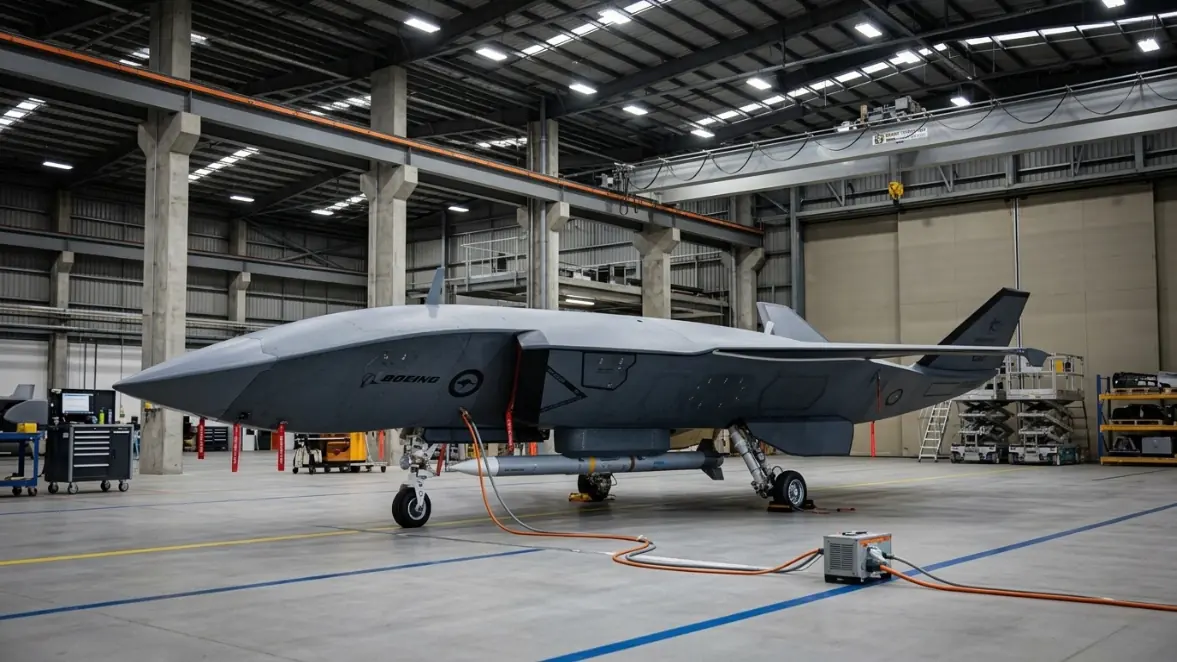
Boeing has unveiled the latest armed configuration of its MQ-28 Ghost Bat combat drone at St. Louis, publicly showcasing the aircraft fitted with AIM-120 Advanced Medium-Range Air-to-Air Missiles (AMRAAM) for the first time. The reveal marks a significant milestone in autonomous air combat development, signaling the drone's transition from reconnaissance to active aerial engagement.
Highlights
- Boeing publicly unveiled the MQ-28 Ghost Bat fitted with AIM-120 AMRAAM air-to-air missiles for the first time at St. Louis.
- The MQ-28 Ghost Bat was originally developed for the Royal Australian Air Force's Loyal Wingman program and is designed to collaborate with F/A-18 and F-35 fighters.
- AMRAAM integration gives the MQ-28 beyond-visual-range (BVR) engagement capability, elevating it from a sensor/decoy platform to an independent armed combat system.
- The reveal signals a fundamental shift in drone roles — from reconnaissance and intelligence-gathering to active autonomous air-to-air combat.
- Boeing's announcement reflects a global trend of leading aerospace and defense firms accelerating the weaponization of autonomous unmanned combat systems.
Boeing Reveals Armed MQ-28 Ghost Bat Fitted with AMRAAM Missiles
ST. LOUIS — Boeing has officially unveiled the latest armed configuration of its MQ-28 Ghost Bat drone, publicly displaying the combat unmanned aircraft equipped with AIM-120 Advanced Medium-Range Air-to-Air Missiles (AMRAAM) for the first time. The development is widely regarded as a landmark step in the evolution of autonomous air combat capability.
From Reconnaissance to Combat: A Fundamental Role Shift
The MQ-28 Ghost Bat's latest appearance makes clear that the role of unmanned aircraft is undergoing a fundamental transformation. Drones have long been associated primarily with surveillance and intelligence-gathering missions, but the platform is now moving decisively toward direct participation in air combat operations. With its AMRAAM-armed configuration, the MQ-28 gains active engagement capability, enabling it to play a far more assertive role in air-to-air combat environments.
About the MQ-28 Ghost Bat
Originally developed for the Royal Australian Air Force's Loyal Wingman program, the MQ-28 Ghost Bat is designed to operate collaboratively alongside crewed fighter aircraft, enhancing overall combat effectiveness. The aircraft features a high degree of autonomous flight capability and is intended to work alongside platforms such as the F/A-18 and F-35, functioning as an AI-assisted aerial partner.
Strategic Significance of AMRAAM Integration
The AMRAAM (AIM-120 Advanced Medium-Range Air-to-Air Missile) is an active radar-guided missile widely used across NATO forces, capable of beyond-visual-range (BVR) engagements. By integrating AMRAAM onto the MQ-28, the unmanned loyal wingman is no longer limited to the role of sensor platform or decoy. It becomes an armed system capable of independently executing air superiority suppression missions, significantly amplifying the overall strike potential of manned-unmanned teaming formations.
The Future of Autonomous Air Combat
Boeing's announcement reflects a broader trend among the world's leading aerospace and defense companies, which are aggressively advancing the weaponization of unmanned combat systems. As AI technology and autonomous control systems continue to mature, drones capable of independent engagement are steadily transitioning from concept to operational deployment — with far-reaching implications for the future character of air warfare.
Source: Defense Feeds, St. Louis
原文來源: 查看原文
FAQ
Reviewed and published by the LAETimes editorial desk ·