Taiwan Receives First MQ-9B Sea Guardian Drones to Monitor PLA Naval Activity; India Still Awaiting Delivery
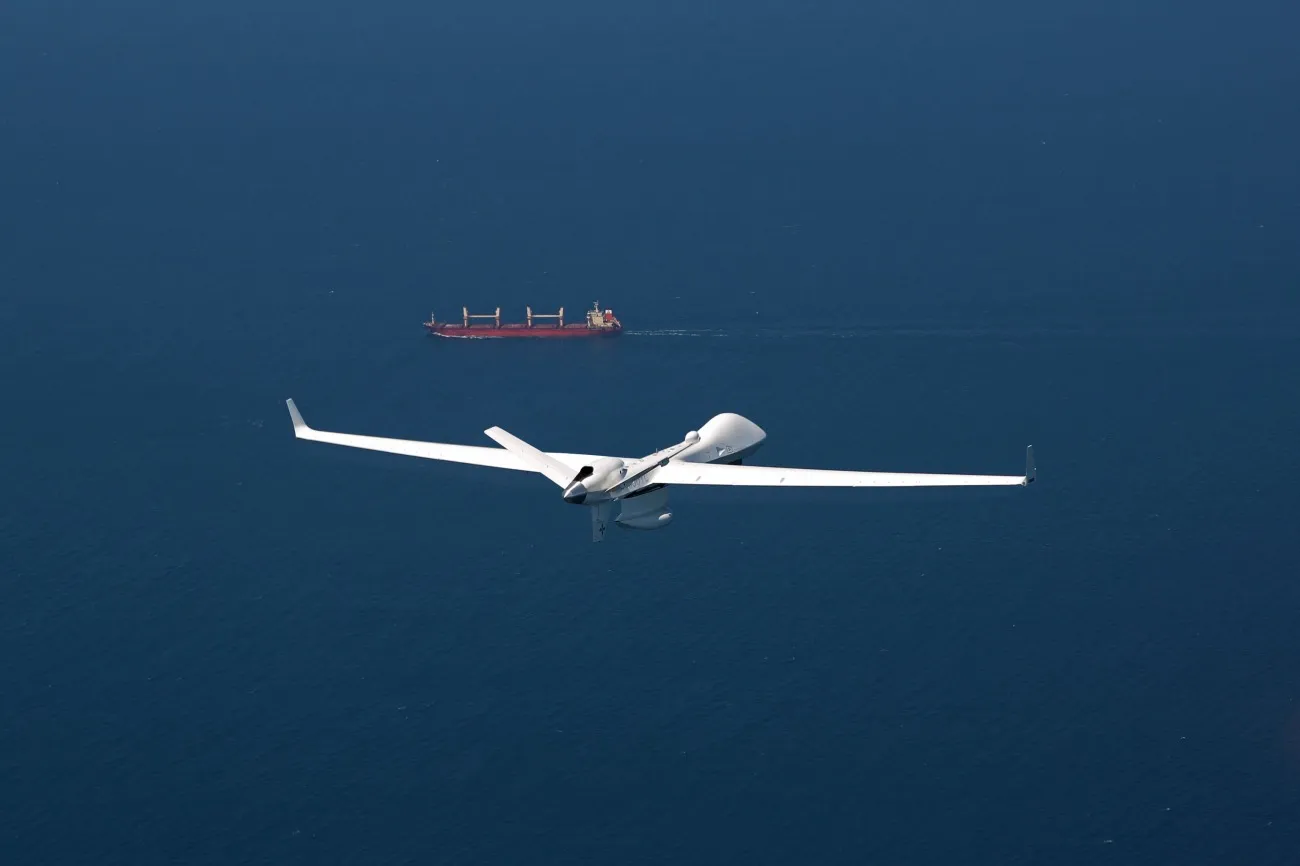
Taiwan took delivery of the first two of four MQ-9B Sea Guardian drones on March 17, 2026, and has begun assembly and testing to monitor Chinese military activity in the Taiwan Strait. The remaining two aircraft are expected by 2027. India, which faces similar concerns over Chinese military expansion, has signed a $3.3 billion deal for 31 MQ-9Bs, with deliveries scheduled between January 2029 and September 2030.
Highlights
- Taiwan received its first two MQ-9B Sea Guardian drones from General Atomics on March 17, 2026, with the remaining two of the four-aircraft order due before 2027.
- The ROCAF will use the MQ-9B primarily for surveillance of PLA military activity in the Taiwan Strait, rather than in a strike role.
- The MQ-9B offers over 40 hours of endurance and sensors capable of detecting surface vessels and low-signature targets at ranges of 150–300 kilometers.
- India has signed a $3.3 billion agreement for 31 MQ-9B HALE drones, with deliveries scheduled between January 2029 and September 2030 for use in the Indian Ocean Region and along the LAC.
- Military analyst Aadil Brar noted that interoperability with U.S. and Indo-Pacific partner systems is a key strategic benefit of Taiwan operating the MQ-9B platform.
Taiwan has received its first MQ-9B Sea Guardian drones from the United States and has begun testing them to monitor Chinese military activity in the Taiwan Strait, according to reports.
Taiwanese media reported that the Republic of China (Taiwan) took delivery on March 17, 2026 of the first two aircraft from a four-unit order for the MQ-9B Sea Guardian. The Republic of China Air Force (ROCAF) has begun assembly and testing of the unmanned aircraft, which are manufactured by General Atomics Aeronautical Systems (GA-ASI).
The ROCAF stated that the acquisition meets its requirement for a long-endurance, all-weather surveillance platform capable of providing real-time intelligence on People's Liberation Army (PLA) military movements and air and maritime activity around Taiwan.
Taiwan's Gray-Zone Threat Environment
China regards Taiwan as a breakaway province and has pledged to reunify it by any means necessary, including force. In recent years, Beijing has significantly intensified its military presence around the island—PLA aircraft routinely penetrate Taiwan's Air Defense Identification Zone (ADIZ) and naval vessels regularly cross the Taiwan Strait median line, actions that form part of China's broader "gray-zone" strategy. A recent report in The Wall Street Journal noted that Beijing has maintained an almost continuous naval presence around Taiwan since the early 2020s, seeking to pressure Taipei into submission.
In addition to these gray-zone activities—designed to test and erode Taiwan's defenses—China regularly conducts publicized military exercises simulating a blockade of Taiwan and practicing amphibious assault operations. Taiwanese officials have warned that Beijing could use such drills as cover for an actual amphibious invasion.
Against this backdrop, the MQ-9B Sea Guardian will help Taiwan track PLA military movements.
Tactical Capabilities and Strategic Value of the MQ-9B
The MQ-9B is a derivative of the MQ-9 Reaper, which the U.S. military has deployed extensively in recent years, including during Operation Epic Fury. U.S. Air Force Chief of Staff Gen. Kenneth S. Wilsbach praised the Reaper as the most critical platform in the Iran campaign: "There is no other platform that has prosecuted as many strikes against Iran as the MQ-9. It's an unmanned platform that generates tremendous value and doesn't put our people at risk."
However, Taiwanese security analysts say the drone's primary role in Taiwan will be battlefield surveillance rather than strike missions—a different emphasis from its employment in U.S. operations.
Taiwan ordered four MQ-9B SkyGuardian drones in 2020 as part of a large-scale U.S. arms package that also included a range of advanced weapons. According to recent reports cited by officials, the remaining two aircraft will be delivered before 2027.
Key tactical advantages of the MQ-9B include:
- Extended endurance: With a flight endurance exceeding 40 hours, the aircraft can maintain continuous patrols over critical areas including the Taiwan Strait, Bashi Channel, eastern waters, and northern and southern approaches—providing persistent coverage that manned platforms such as the P-3C Orion cannot sustain due to cost and crew fatigue constraints.
- Advanced sensor suite: Equipped with electro-optical/infrared (EO/IR) sensors, a Lynx multi-mode radar, and synthetic aperture radar (SAR), the MQ-9B can detect and track surface vessels, low-signature targets, and aircraft at ranges of 150–300 kilometers, supporting detection of PLA Navy deployments, China Coast Guard "gray-zone" militia vessels, and aerial intrusions.
- Stand-off reconnaissance: During periods of heightened tension or routine harassment, the platform can conduct high-value tactical reconnaissance at safe stand-off distances, helping analysts distinguish routine gray-zone pressure from indicators of a blockade or invasion preparation.
- Anti-submarine capability: The aircraft can deploy sonobuoys to help counter PLA submarine threats and, in an invasion scenario, provide over-the-horizon targeting data for Taiwan's anti-ship missiles, coastal defense systems, and joint forces.
On the topic of allied interoperability, military analyst Aadil Brar wrote on X: "The real payoff is interoperability. Flying the same system as the U.S. military means Taiwan can share battlefield intelligence in real time with Washington, Tokyo, and Indo-Pacific partners. Four aircraft have limited coverage, but they do fill an important maritime surveillance gap."
India's MQ-9B Procurement: The China Factor
India, which is equally vigilant toward China, is also acquiring the MQ-9B—but unlike Taiwan, New Delhi has yet to receive any of the aircraft.
India has signed a $3.3 billion agreement with the United States for 31 MQ-9B High-Altitude Long-Endurance (HALE) drones manufactured by General Atomics. The Indian Navy will receive 15 aircraft, while the Army and Air Force will receive eight each, enhancing surveillance capabilities along the northern and western borders.
The armed MQ-9Bs are expected to serve as force multipliers for the Indian Navy, providing wide-area maritime domain awareness, accelerating threat response times, and improving overall maritime security posture. The drones will primarily be deployed in the Indian Ocean Region (IOR) to support ongoing anti-piracy operations and to monitor the growing activity of Chinese submarines in waters India considers within its strategic sphere.
The MQ-9B also offers communications relay capabilities that can extend naval network coverage, support search and rescue (SAR) operations, and integrate with MH-60R helicopters to provide real-time targeting data on submarine threats.
For the Indian Army, the MQ-9B offers significant operational value. The platform can operate above 40,000 feet and is capable of short-field takeoff and landing on runways as short as 4,000 feet using its Automatic Take-off and Landing Capability (ATLC) system, making it well-suited for operations in remote areas—particularly near the India-China border.
Retired Indian Air Force Air Marshal RGK Kapoor commented: "The Indian armed forces need to operate across diverse terrain—deserts, oceans, and Himalayan heights—creating an urgent need for multi-layered surveillance. This gap was clearly exposed during the Eastern Ladakh standoff, where altitudes exceeded 17,000 feet and existing Medium-Altitude Long-Endurance (MALE) UAVs, operating at approximately 25,000–30,000 feet, had significant sensor limitations in monitoring activity across the Line of Actual Control (LAC)."
Notably, during the 2020 India-China border crisis, Indian Navy-leased MQ-9Bs flew thousands of kilometers from their home base to provide real-time battlefield situational awareness to Indian troops holding positions on difficult high-altitude terrain. That performance—which led the Navy to conduct land surveillance missions along the LAC at the Army's request—established the platform's strong reputation within the Indian military and ultimately drove the procurement decision.
Retired Indian Army Major General Ravinder Sanan previously told The Eurasian Times that acquiring the Sea Guardian would be "a game-changing step for national security."
Unlike Taiwan, which has already received half of its ordered aircraft, India will take delivery of its MQ-9Bs in phased tranches between January 2029 and September 2030. Nevertheless, both nations share a common objective: using the Sea Guardian to keep a close watch on Beijing's military movements.
原文來源: 查看原文
FAQ
Reviewed and published by the LAETimes editorial desk ·