NASA Announces New Moonbase Missions: Three Companies Selected, Combined Contracts Worth Nearly $600 Million
NASA announced on June 30, 2026, that Astrobotic, Firefly Aerospace, and Intuitive Machines have been selected to carry out four new lunar missions under the Commercial Lunar Payload Services (CLPS) program. The combined contract value is nearly $600 million, with all missions expected to launch before the end of 2028, delivering scientific instruments to the Moon's surface in support of NASA's long-term Moonbase initiative.
Highlights
- NASA awarded nearly $600 million in total contracts on June 30, 2026, to Astrobotic, Firefly Aerospace, and Intuitive Machines for four lunar payload delivery missions under the CLPS program.
- Astrobotic received the largest share at $297.9 million for two missions, while Firefly Aerospace received $144.2 million and Intuitive Machines received $148.3 million, each for one mission.
- All four missions are expected to launch before the end of 2028, using upgraded versions of lander designs that have already flown in previous missions.
- Each mission will carry three shared NASA instruments: SCALPSS (stereo plume camera), LRA (laser retroreflector array), and LETS (radiation spectrometer), to build a globally distributed lunar data network.
- NASA simultaneously announced plans for the PROMISE rover—an engineering development version of the Mars Perseverance rover—and multiple forthcoming solicitations including a lunar south pole optical imager and a communications relay satellite constellation.
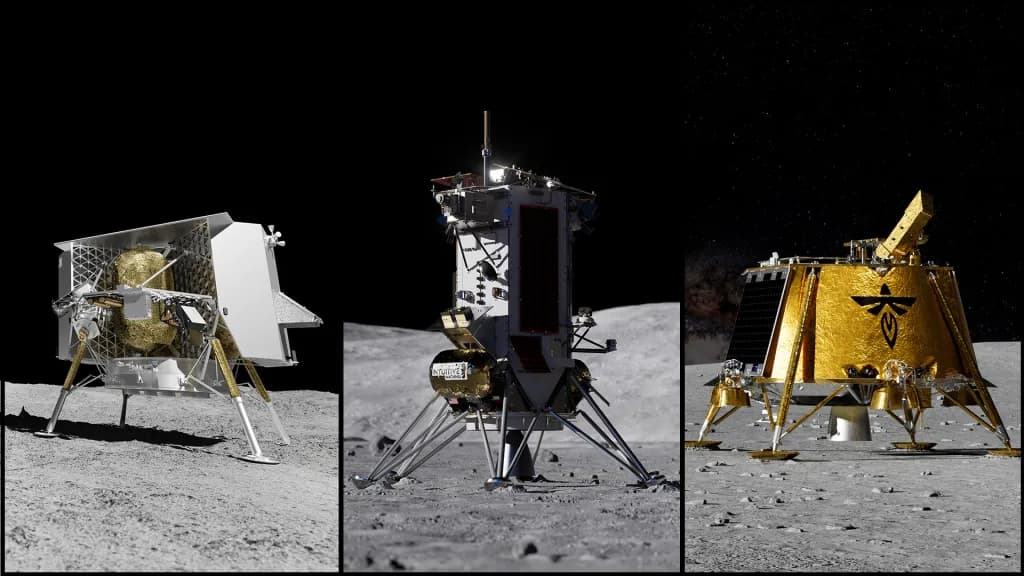
Three commercial lunar landers on the Moon's surface (Source: Astrobotic, Intuitive Machines, Firefly)
Digital renderings of commercial lunar landers from Astrobotic, Intuitive Machines, and Firefly on the Moon's surface. NASA announced on June 30, 2026, that these landers will deliver additional science instruments and technology demonstrations for the Moonbase program. Image credit: Astrobotic, Intuitive Machines, Firefly
NASA announced on Tuesday, June 30, 2026, that it has selected three companies to carry out four new lunar missions, all expected to be completed before the end of 2028, as part of the agency's Moonbase program. Astrobotic, Firefly Aerospace, and Intuitive Machines will deliver NASA scientific payloads to the lunar surface, helping to establish humanity's first outpost beyond Earth.
Contract Values and Allocations
Lori Glaze, Deputy Associate Administrator for NASA's Human Exploration and Operations Mission Directorate, stated: "These new contract awards to our commercial partners, totaling nearly $600 million, will send more missions with science payloads to the Moon, demonstrating our commitment to accelerating a long-term presence on the lunar surface and giving us more opportunities to develop the capabilities needed to live and work on the Moon."
The contract values awarded to each company are as follows:
- Astrobotic: $297.9 million total for two payload delivery missions
- Firefly Aerospace: $144.2 million for one delivery mission
- Intuitive Machines: $148.3 million for one delivery mission
All three companies will use upgraded versions of lander designs that have already flown, in order to increase mission cadence for NASA.
Ryan Stephan, acting director of the Moonbase Commercial Payload Landers program, said: "We are building a testbed for Moonbase operations. Increasing the frequency of contract awards and launch opportunities allows us to learn quickly, iterate, and continuously improve."
Common Payload Scientific Instruments
Each mission will carry three NASA scientific instruments to the lunar surface:
1. SCALPSS — Stereo Camera for Lunar Plume-Surface Studies
This instrument suite consists of four cameras that use stereo photogrammetry to capture three-dimensional images of engine plume interactions with lunar dust during landing. By collecting data across different engine sizes, propellant types, and landing sites, the high-resolution stereo imagery will help build models that predict lunar dust erosion and ejecta characteristics—critical information for the future dense deployment of larger and heavier spacecraft and equipment on the lunar surface.
2. LRA — Laser Retroreflector Array
A small, cookie-sized passive device mounted on a dome-shaped aluminum frame holding eight corner-cube quartz prisms, the LRA requires no power or maintenance. It reflects laser beams fired by orbiting spacecraft or vehicles in the process of landing, helping them determine orbital position or navigate to the surface. Already flown on previous CLPS landers and international lunar landers, the LRA will continue to build a permanent network of position markers on the Moon for future exploration.
3. LETS — Linear Energy Transfer Spectrometer
LETS is a radiation monitor that uses a miniaturized advanced silicon detector to measure the energy carried by incoming space radiation, helping scientists better understand the radiation environment across different lunar flight trajectories and surface locations. The instrument provides detailed data on both radiation intensity and type—information essential for NASA to design safer missions, protect astronaut health, and plan for long-duration exploration.
Joel Kearns, Deputy Associate Administrator for Exploration in NASA's Science Mission Directorate, said: "By deploying the same science instruments on multiple landers, we gain a more comprehensive understanding of hazards during landing and build a globally distributed network of environmental data and position markers on the Moon. It's like placing weather stations at different locations around Earth. These three payloads have proven their reliability in flight, and their data is vital to supporting the safe human exploration of the lunar surface."
PROMISE Rover and Future Opportunities
NASA also announced plans to send the Polar Rover for Observations, Mapping, and Integrated Science Experiments (PROMISE) to the Moon. PROMISE is an engineering development version of the Mars Perseverance rover, designed to characterize the lunar surface and subsurface and assess resource potential.
In addition, NASA plans to issue solicitations in the coming months for:
- A lunar lander carrying power and avionics technology demonstrations
- A lander carrying an additional science payload
- A lunar south pole optical imager
- A lunar communications and navigation relay satellite constellation to improve connectivity between Moonbase elements and Earth
- An open call for Moonbase technology demonstrations
Moonbase Program Outlook
NASA has currently planned 17 lunar surface delivery missions to be carried out by multiple providers. Moonbase is NASA's long-term lunar exploration and infrastructure program, aimed at achieving a sustained human presence on the Moon and expanding scientific and commercial activities on the lunar surface. As part of a golden age of innovation and exploration, NASA will send astronauts on increasingly complex missions deeper into the Moon, in service of scientific discovery and economic benefit, while continuing to lay the groundwork for the first crewed mission to Mars.
Media contacts: Rachel Kraft / Molly Wasser / María José Viñas, NASA Headquarters, Washington, Tel: +1 202-358-1600
For more information, visit the NASA Moonbase official website
原文來源: 查看原文
FAQ
Reviewed and published by the LAETimes editorial desk ·