Forget NGAD, GCAP, or FCAS: Sweden Is Questioning Whether the Fighter Jet Is Already Obsolete
As the Franco-German FCAS programme collapsed in June 2026 after nine years and upwards of €100 billion spent without producing a single prototype, Sweden's Saab finds its long-dismissed drone-centric approach to future air combat suddenly vindicated—and in high demand. Airbus has publicly courted Saab as a partner for a next-generation fighter, while Germany weighs its post-FCAS options.
Highlights
- The Franco-German FCAS Next Generation Fighter programme was formally terminated on 8 June 2026 after nine years and estimated costs of €80–100 billion, without a single prototype or technology demonstrator ever flying.
- FCAS collapsed due to an irreconcilable work-share dispute between Airbus and Dassault Aviation over prime contractor leadership, not because of technical failure.
- Saab's F-series concept places three categories of unmanned platform—subsonic sub-5t, supersonic over-5t, and low-cost sub-1t drones—at the core of the future air combat system, with a crewed fighter as an optional node.
- Airbus has publicly courted Saab as a partner for sixth-generation fighter development, viewing it as more cooperative than Dassault, while Germany evaluates joining GCAP or procuring additional F-35s.
- GCAP is approximately 75% through its demonstrator build schedule and targets a 2027 first flight, currently the only credible sixth-generation heavy air superiority programme with near-term export potential.
Saab Bet That the Gripen's Successor Might Not Need a Pilot—Then Europe's €100 Billion Fighter Programme Collapsed Without Building a Single Prototype
Every Western air force is wrestling with the same question: what comes after the fifth-generation stealth fighter? Sweden's Saab spent years arriving at an answer that set it apart from the rest of the field. While the UK, Japan, and the Franco-German consortium raced to design bigger, faster, and stealthier crewed aircraft as the centrepiece of future air power, Saab quietly pursued what many regarded as near-heresy: perhaps the crewed fighter should not be the centrepiece at all. The successor to its JAS 39 Gripen, in Saab's vision, could be a networked ecosystem built around unmanned platforms, with a crewed aircraft as just one node among many. For years, that thinking was dismissed as an outlier. Then the conventional approach suffered a spectacular failure—and the entire debate shifted.
FCAS: The €100 Billion Fighter That Never Left the Ground
To understand why Saab's wager now looks prescient, it helps to revisit what just happened to the alternative. The Future Combat Air System (FCAS) was launched in 2017 by French President Emmanuel Macron and German Chancellor Angela Merkel—the most ambitious defence programme in European history, intended to replace the Rafale and Eurofighter Typhoon and anchor European air power for decades. Valued at between €80 billion and €100 billion, FCAS incorporated a networked concept combining a crewed next-generation fighter with unmanned platforms and sensors. Nine years later, it had produced nothing.
On 8 June 2026, German Chancellor Friedrich Merz confirmed what analysts had been predicting for months: the centrepiece of FCAS—the Next Generation Fighter (NGF)—was formally terminated. No prototype had been built; no technology demonstrator had ever flown. That distinction matters. The 8 June decision explicitly ended the crewed aircraft while preserving the programme's Combat Cloud networking architecture and portions of its unmanned vehicle work, which will continue under a revised Franco-German framework. The crewed fighter died; the networked, unmanned half survived—and that is precisely the half on which Saab had always placed its bet.
The cause of failure was almost embarrassingly mundane. FCAS did not collapse because of a technical dead end. It collapsed because of a work-share dispute between Airbus and France's Dassault Aviation over who would lead the programme. Dassault, maker of the Rafale, insisted on the prime contractor role and refused parity with Airbus, arguing it alone possessed the end-to-end expertise to build a fighter from scratch. The two sides also diverged on requirements: France needed an aircraft capable of nuclear strike delivery and carrier compatibility; Germany had no such need. Mediation efforts launched after a Macron-Merz dinner in April 2026 failed, with the conclusion that jointly building a crewed fighter was no longer viable. German Defence Minister Boris Pistorius said afterwards that the outcome had been visible for some time. Europe's flagship combat aircraft programme was defeated by corporate politics, and it left nothing behind.
Saab's Contrarian Bet: Maybe the Fighter Isn't the Point
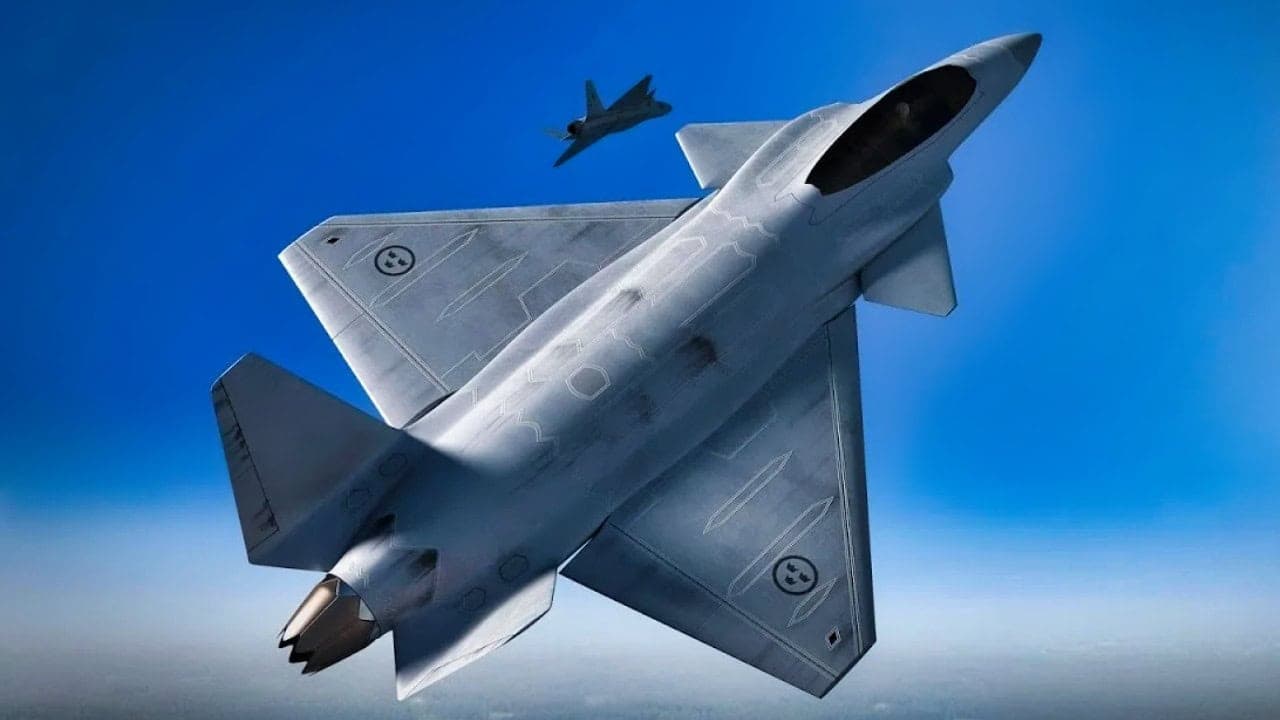
Saab's future air combat thinking, developed under Sweden's Framtida Luftfartssystem (KFS) concept, started from a fundamentally different premise. Rather than treating a crewed fighter as a fixed core with drones bolted on in support, Saab designed a family of aircraft it calls the F-series: one crewed fighter and three categories of unmanned platform—a sub-5-tonne subsonic drone, a supersonic drone above 5 tonnes, and a low-cost drone under 1 tonne. The telling detail is where the unmanned platforms sit in the architecture. In Saab's concept, they are the core of the system, not accessories to the crewed jet—the inverse of the design priority in the UK's and Franco-German programmes, where the crewed aircraft has always been the protagonist.
Saab has gone further than any competitor on one specific point: the company has explicitly preserved the option for Sweden to forgo a crewed fighter entirely, fielding only the various drone categories as its future air combat ecosystem. For a country with a proud tradition of indigenous fighter development, this is a genuinely radical position. Saab pairs that stance with its characteristic cost-driven engineering philosophy.
The F-series envisions component commonality between crewed and unmanned platforms—including commonality between the existing, non-stealthy Gripen E and a new stealthy supersonic unmanned vehicle—an approach designed to reduce development costs and timelines by reusing existing work. Saab has already completed flight tests of autonomous decision-making technology, demonstrating an AI agent developed by Helsing conducting beyond-visual-range decisions in flight, and plans to fly a technology demonstrator as early as 2027.
This echoes the instinct that produced the Gripen itself—a light, single-engine fighter whose cost per flight hour is a fraction of comparable Western competitors. Saab's engineers built a reputation for rapid prototyping and low-cost design, using digital twin modelling to compress development timelines, and the F-series applies that discipline to the sixth-generation problem. Where FCAS sought a maximum-performance crewed aircraft and spent its energy arguing over how to build it, Saab sought flexibility and affordability—and kept moving.
Why Sweden Chose Its Own Path
Saab's independent trajectory was a deliberate choice made years before FCAS imploded. Sweden was initially a partner in the UK's Team Tempest programme, alongside Britain and Italy. When that effort merged with Japan's fighter programme in December 2022 to become the Global Combat Air Programme (GCAP), Stockholm chose not to follow. Sweden instead launched an independent reassessment of its strategic requirements, shaped by the war in Ukraine, NATO accession, and increased defence budgets. The decision reflected a deep-seated Swedish priority: preserving a domestic capability to develop fighter aircraft independently—an industrial and strategic asset Sweden has guarded since the Viggen and the Gripen.
That independence gave Sweden what its competitors lacked: time and flexibility. The Swedish future fighter effort, backed by a contract with the Swedish Defence Materiel Administration (FMV), operates on a deliberately unhurried timeline—targeting deployment of a Gripen successor around 2050, with a concept evaluation decision expected around 2030. Stockholm has explicitly kept options open, allowing Saab to explore multiple paths rather than committing to a single direction. The Swedish Air Force has acknowledged that while the Gripen performs well, it will struggle against sixth-generation crewed fighters entering service in the 2030s—modernisation pressure is real, but Sweden has refused to let that pressure force premature or costly commitments. In retrospect, the contrast with FCAS is sharp: Paris and Berlin locked themselves into a fixed crewed-fighter design and spent nine years arguing about it, while Sweden spent that same period evaluating what it actually wanted.
Europe Comes Calling
FCAS's collapse transformed Saab from an outlier into a sought-after partner. With the Next Generation Fighter dead, Europe fragmented. Dassault will independently develop France's sixth-generation aircraft, partly funded by committed payments from the Rafale F5 upgrade programme. Airbus assembled a consortium of German defence and aerospace companies it calls Team Gen 6, declared itself ready to take on sixth-generation development responsibilities, and publicly recruited Saab—with Berlin viewing Saab as a far more cooperative industrial partner than Dassault had ever been. Germany is now evaluating whether to develop a new aircraft with Sweden and Spain, join GCAP, or simply procure additional US-built F-35s to fill the gap.
Airbus's appetite for Saab has been unusually candid. The head of its defence division publicly praised Sweden and Saab as candidate partners with deep expertise in fighter design and production, framing the decision in terms of continental sovereignty—explicitly stating a preference against Europe again purchasing its sixth-generation fighters from the United States, as it did with the fifth generation. That comment captures why Saab matters at this moment. The space in Europe for domestically developed fighter aircraft has narrowed significantly, and Sweden is one of a small number of Western nations that has maintained an unbroken tradition of indigenous tactical aircraft development. Analysts now see at least three paths to European sixth-generation capability: one led by Airbus potentially incorporating Saab, one pursued independently by France, and one centred on GCAP. Sweden's flexible, efficiency-first approach makes it an attractive partner precisely because it does not carry Dassault's insistence on prime contractor dominance.
The broader shift in air combat thinking is also moving in Saab's direction. As unmanned platforms absorb a growing share of combat tasks, analysts increasingly describe the future crewed fighter as a command node rather than an independent combat aircraft—an almost exact match for the optional role the crewed node plays in Saab's architecture. 'The aircraft matters less than the network and drones around it'—once a distinctly Swedish position—is becoming industry consensus.
An Honest Assessment of the Counterarguments
None of this means Saab has solved the sixth-generation problem, and serious objections to its approach remain. The F-series concept is still just that—a concept. A drone-centric air combat ecosystem has no operational validation, and the bet that autonomous platforms can replace most of what crewed fighters do is a genuine gamble. If crewed aircraft remain indispensable in high-end contested environments, that bet could lose.
Saab's approximate 2050 timeline is also significantly slower than its competitors. GCAP is approximately 75% through its demonstrator build schedule, targeting a first flight in 2027 with new UK funding committed, making it currently the only credible sixth-generation heavy air superiority aircraft with export market potential. Sweden's hope of keeping the programme financially viable without export orders is a tall order given the costs of simultaneously developing stealthy crewed and unmanned aircraft, and the history of the Gripen itself illustrates how difficult it is to win export orders against US competition.
It is also important not to overstate Saab's position. The company has not committed to abandoning the crewed fighter; it has retained the crewed aircraft as one option while exploring alternatives. The honest description is that Saab has kept more options open than anyone else—not that it has chosen drones over pilots. That flexibility is itself the core of the approach, and the reason the approach has survived a moment that destroyed more rigid competitors.
What June 2026 demonstrated is not that Saab's specific concept is correct. It demonstrated that the conventional path—an expensive, politically negotiated, crewed-fighter-first mega-programme—can fail completely, leaving an entire continent with nothing after nine years and €100 billion.
Saab's bet is that a cheaper, more flexible, drone-centric approach that refuses to over-commit is a safer route to credible air power through the middle of this century. That bet has not yet won. But the most expensive alternative just collapsed without producing a single aircraft, and the manufacturer that spent years questioning whether the fighter jet is even the point has become the partner everyone in Europe wants.
原文來源: 查看原文
FAQ
Reviewed and published by the LAETimes editorial desk ·


