DJI Launches O4 Ground Station: Extended Connectivity for DJI Dock 3 Up to 40 km
DJI officially released the O4 Ground Station on June 16, 2026, a fixed transmission node designed for DJI Dock 3 operations in areas with weak or no cellular coverage. Gateway Mode extends coverage up to 30 km via internet routing to FlightHub 2, while Relay Mode enables off-grid signal transmission up to 40 km when paired with the Matrice 400. Rated IP67 and compatible with solar power, the device targets public safety, inspection, and surveying teams requiring 24/7 unattended operations.
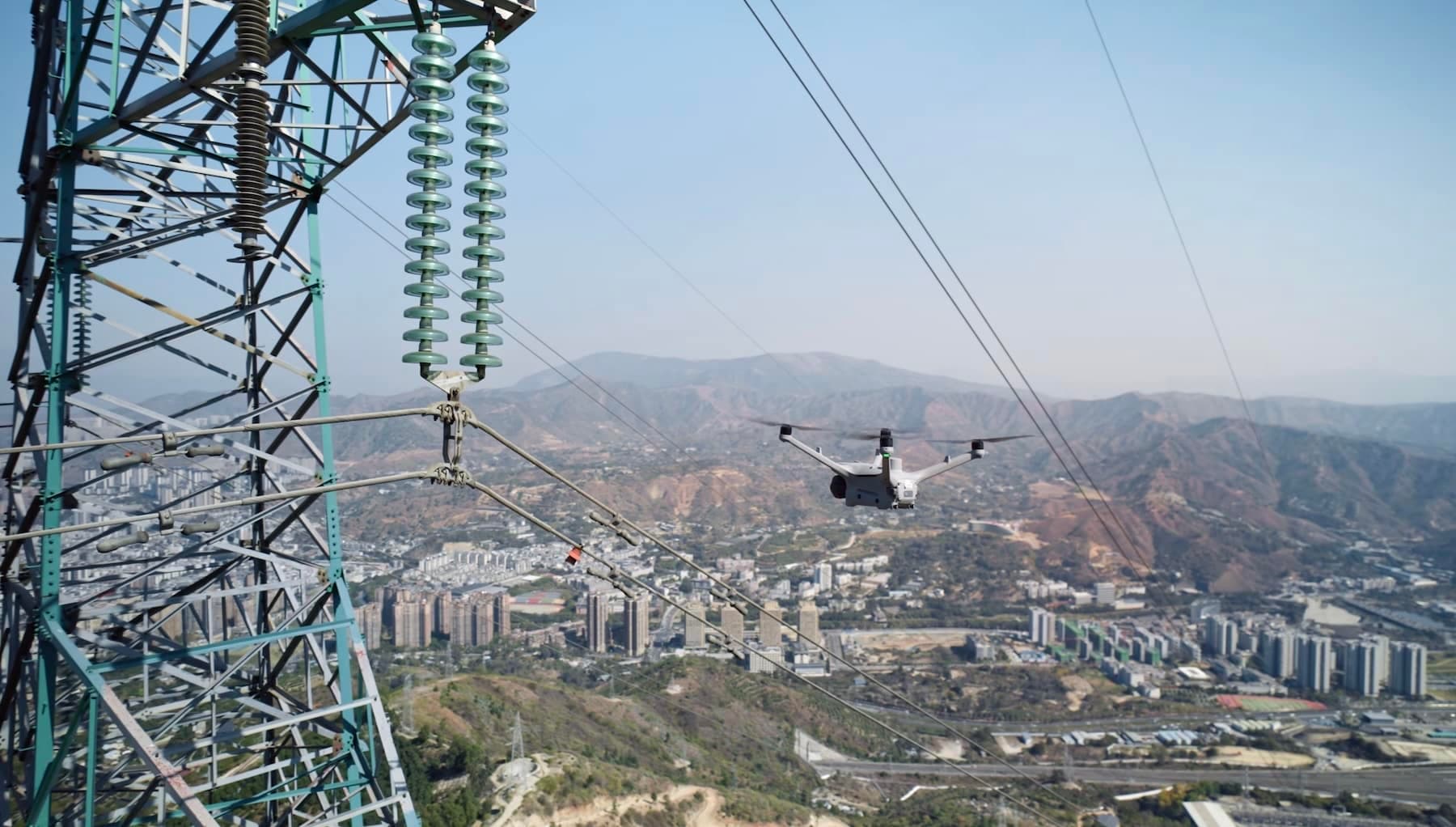
Highlights
- DJI released the O4 Ground Station on June 16, 2026, as a fixed transmission node designed specifically for DJI Dock 3 systems operating in low- or no-cellular environments.
- Gateway Mode connects to FlightHub 2 via internet and extends Dock 3 coverage up to 30 km; Relay Mode operates fully off-grid and reaches up to 40 km when paired with the Matrice 400.
- The device carries an IP67 rating, supports solar power input, and draws only 7 watts in standby — enabling 24/7 unattended operations in remote or harsh terrain.
- A 12-antenna array with Sub-2G, 2.4 GHz, 5.2 GHz, and 5.8 GHz automatic band-switching reduces RF interference, while an onboard RTK module tracks 19 frequencies across five satellite constellations for centimeter-level positioning.
- Relay Mode is unavailable in countries where the 5 GHz band is prohibited, including Japan and Kazakhstan; U.S. operators face unresolved questions about deploying fixed DJI infrastructure given the company's ongoing FCC Covered List appeal at the Ninth Circuit.
DJI officially released the DJI O4 Ground Station on June 16, 2026 — a fixed transmission node engineered to maintain stable connectivity for DJI Dock 3 drone systems in environments where cellular signal is weak or entirely absent.
The hardware directly targets the most common failure mode in long-range missions: the moment video link drops and the operator loses situational awareness. Rather than routing around dead zones, the O4 Ground Station is designed to eliminate them from the coverage map altogether.
Two Operating Modes: Gateway and Relay
The device operates in two distinct modes. Gateway Mode connects directly to FlightHub 2 via the internet, achieving coverage of up to 30 km (approximately 18.6 miles) when paired with Dock 3. Relay Mode requires no internet connection whatsoever, enabling video signal transmission across valleys and signal-obstructed terrain, reaching up to 40 km (approximately 24.9 miles) when used with the DJI Matrice 400.
The 40 km figure has been a headline specification for the Matrice 400 since its launch. The key difference here: the relay burden is no longer carried by a second airborne drone, but by a fixed ground-based node.
The device's IP67 rating, solar power compatibility, and a standby power draw of just 7 watts clearly signal its intended audience — public safety, inspection, and surveying teams that require 24/7 unattended operations across challenging terrain.
Gateway Mode: Decoupling Ground Stations from Specific Dock Locations
Gateway Mode connects the O4 Ground Station to FlightHub 2 via Ethernet or a DJI Cellular Dongle 2, meaning the ground station no longer needs to be co-located with a specific Dock 3 unit. This is a structural shift worth understanding. Previous deployments constrained transmission range to the physical location of the Dock itself. By routing signals over the internet, operators can position the ground station wherever coverage is needed, extending reach up to 30 km.
This mode integrates two FlightHub 2 features:
- Signal Map: Reads post-flight data to mark weak-signal zones on a map, enabling evidence-based decisions on ground station placement rather than guesswork.
- Virtual Cockpit: Allows operators to manually take control of the drone within FlightHub 2, overriding a pre-programmed flight path mid-mission.
Operators running Drone-as-First-Responder (DFR) programs will recognize this framework — it mirrors the architecture used in El Paso, Texas, where 22 Dock units are networked on FlightHub 2 On-Premises.
Image credit: DJI Enterprise
Relay Mode: Off-Grid Coverage Inheriting D-RTK 3 Functionality
Relay Mode inherits the relay station functionality from the D-RTK 3 Relay Fixed Deployment Version. In offline environments, operators position the ground station at an elevated point, allowing drone video signals to bounce across obstacles. Controllers or Docks within range automatically scan and connect to the station — no network coverage required at any point in the relay chain.
When paired with the Matrice 400, relay range reaches 40 km. Supported aircraft for Relay Mode include the Dock 3, Matrice 400, Matrice 4E, Matrice 4T, Matrice 4D, Matrice 4TD, and FlyCart 100. DJI notes that relay functionality is unavailable in countries where the 5 GHz band is not permitted, specifically naming Japan and Kazakhstan — an operational constraint, not a marketing qualifier. By contrast, Gateway Mode currently supports Dock 3 only.
Multi-device rotation allows a single ground station to serve different drones sequentially. Controllers or Docks within range scan and connect automatically, enabling one station to switch between aircraft across a fleet — improving overall hardware utilization. This single-operator, multi-aircraft logic aligns with directions regulators are increasingly approving, including the FAA framework permitting a single pilot to operate up to four Skydio drones simultaneously. For users who previously entered this ecosystem via the Matrice 400's airborne relay capability, relay duties now shift to fixed ground infrastructure — no longer consuming flight battery.
Image credit: DJI Enterprise
12-Antenna Array and Sub-2G Band for Urban RF Interference
The O4 Ground Station uses a 12-antenna array combining built-in and external antennas with both horizontal and vertical polarization for omnidirectional, high-gain coverage. Sub-2G band support improves signal penetration through dense obstacles, while an automatic multi-band selection system switches between Sub-2G, 2.4 GHz, 5.2 GHz, 5.8 GHz, and additional bands to avoid interference.
This frequency-hopping logic is especially relevant in urban environments, where fixed-channel quality degrades rapidly due to RF congestion. For positioning, the device integrates a high-gain RTK module capable of tracking 19 frequencies across five global satellite constellations, delivering centimeter-level accuracy even in urban canyons or under dense canopy — consistent with the RTK precision the Matrice 400 relies on for stable flight near glass-curtain buildings.
O4 Ground Station: A Sensor Hub for IP Cameras and ADS-B
The O4 Ground Station's role extends beyond drone video relay. Multi-protocol ports allow standard IP cameras to feed footage directly into FlightHub 2, where it appears alongside drone imagery within a unified management interface — making the ground station a combined communications and sensing node.
DJI is simultaneously introducing MQTT-based ESDK 2.0, lowering the development barrier for third-party hardware integration. Operators can connect Remote ID or ADS-B receivers to monitor airspace around Dock 3. When FlightHub 2 detects a nearby aircraft, the system triggers an alert for the drone to clear the area; a drone can be dispatched with a single tap to verify the signal source, with logs generated automatically.
This airspace-awareness capability is particularly relevant for municipal or commercial Dock 3 programs running around the clock — for example, a ski resort in Austria that runs automated Dock 3 inspection flights at 2:00 a.m. daily with no personnel on site. Software and power self-recovery mechanisms support 24/7 remote operations and reduce the frequency of maintenance callouts. Smart low-power mode cuts standby draw to 7 watts when no drone is connected. Off-grid deployments can be powered via DJI Power solar solutions or third-party photovoltaic systems.
Supported Aircraft Differences Reveal Deployment Priorities
The divergence in supported aircraft between the two modes is one of the most telling specifications in this product launch. Gateway Mode supports Dock 3 only; Relay Mode covers a broader range of Matrice 4 series aircraft and FlyCart. This clearly indicates DJI's expected initial deployment scenario: automated Dock 3 programs extending coverage through internet routing, with broader fleet integration following via off-grid relay use cases.
DroneXL Perspective
The relay concept is not new to this hardware family. When DJI launched the Matrice 400 in June 2025, airborne relay — where one drone flies high to relay signals for another navigating obstructed terrain — was a central selling point. But the cost was always obvious: the relay drone is an aircraft performing no productive mission, and its battery is a countdown timer. The O4 Ground Station moves that relay duty to fixed infrastructure running at 7 watts standby. That is the genuine advancement here, and it is a logical evolution.
To be direct: the 30 km and 40 km figures describe maximum ranges under unobstructed, ideal conditions. DJI's coverage specifications consistently carry the standard disclaimer of "no obstructions, no interference" — a caveat DroneXL has noted in every coverage-distance report since the Matrice 400 launch in June 2025. The existence of Signal Map and the 12-antenna array itself acknowledges that real-world deployment conditions are rarely ideal. Readers planning deployments should treat these numbers as upper bounds, not expected values, and should complete DJI's recommended Signal Map evaluation steps.
One question this launch leaves unanswered from a regulatory standpoint: Relay Mode already carries frequency-band restrictions, with DJI specifically naming Japan and Kazakhstan. For U.S. operators, the larger unresolved question is how a fixed DJI transmission node integrates with DJI's current position on the FCC Covered List — a matter currently under appeal at the Ninth Circuit Court of Appeals. DJI does not address this in the launch materials, nor is the product page the appropriate venue to do so. Whether agencies using federal grant funding can deploy permanent infrastructure of this type within a Dock 3 program is a procurement question that no spec sheet can answer — and it will be the most important issue to watch as this hardware enters the U.S. market.
Source: DJI Enterprise. DroneXL uses automated tools to assist with research and data queries; all reporting and editorial commentary is written by Haye Kesteloo.
原文來源: 查看原文
FAQ
Reviewed and published by the LAETimes editorial desk ·


