Philip Bloom Exposes Insta360 Luna Ultra Auto ISO Image Degradation Bug; DJI Osmo Pocket 4 Unaffected
Renowned cinematographer Philip Bloom has identified a serious image quality flaw in the Insta360 Luna Ultra: in any auto ISO mode, the camera applies digital gain then uses aggressive noise reduction, destroying fine detail in a way that is invisible on the camera's small screen. Insta360 has told Bloom a firmware fix is coming but offered no timeline. By contrast, the DJI Osmo Pocket 4 handles auto exposure cleanly and reliably.
Highlights
- Insta360 Luna Ultra applies digital gain then aggressive noise reduction in any auto ISO mode, silently destroying fine detail in a way invisible on the camera's built-in screen.
- Using manual ISO on the Luna Ultra eliminates the problem entirely, as manual mode uses analog gain; Bloom describes the underlying I-Log image quality as excellent.
- DJI Osmo Pocket 4 handles auto exposure cleanly — underexposing slightly rather than applying hidden processing — making it the more reliable tool for commercial shoots.
- The DJI Osmo Pocket 4P features a new 1-inch LOFIC sensor, an f/1.8 approximately 60mm telephoto lens, and DJI-claimed 17-stop dynamic range via D-Log 2, with a China pre-order price of CNY 3,799 (approx. USD 525) versus the Luna Ultra's USD 769.99 U.S. retail price.
- DJI's FCC Covered List status blocks official Pocket 4 and Pocket 4P sales in the United States, leaving the Luna Ultra without a directly comparable competitor in American retail despite its documented auto ISO flaw.
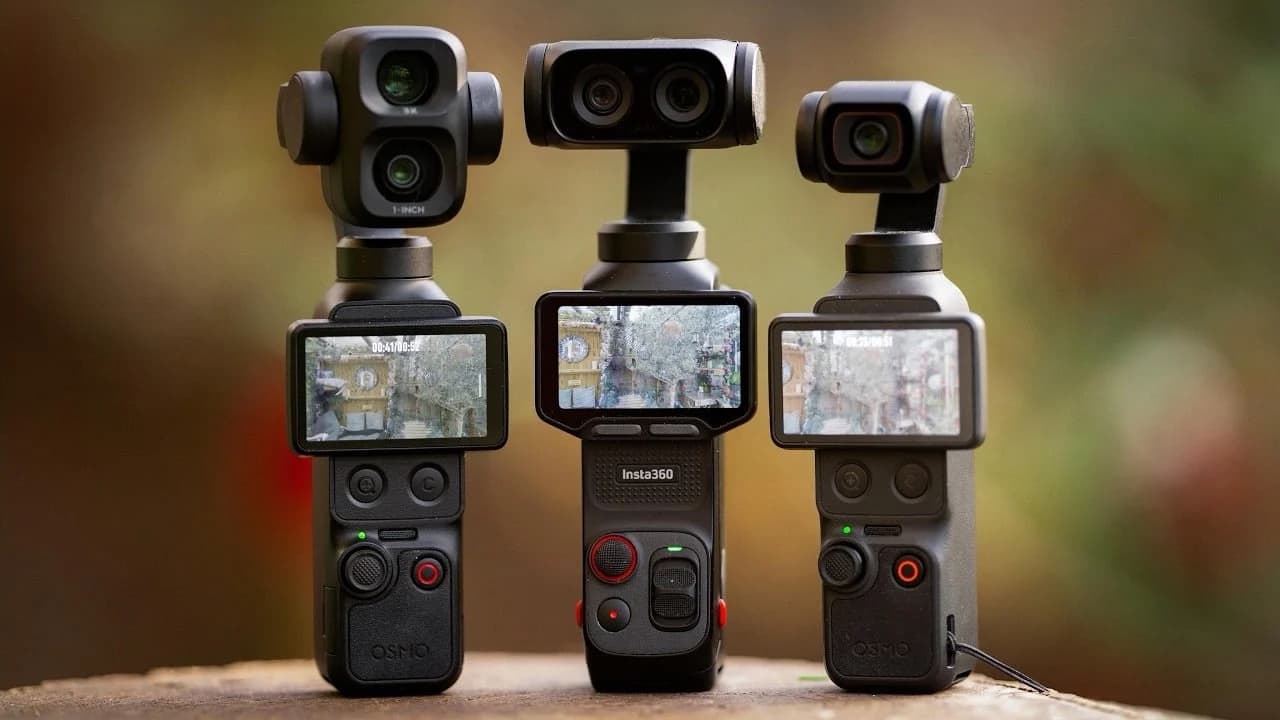
Renowned cinematographer Philip Bloom has identified a serious image quality flaw in the Insta360 Luna Ultra that does not affect the DJI Osmo Pocket 4: when the Luna Ultra operates in any auto ISO mode, it boosts exposure using digital gain and then applies aggressive noise reduction to eliminate the resulting noise, completely destroying fine detail in the process. Once that detail is gone it cannot be recovered — and the problem typically goes unnoticed until footage is pulled from the memory card. Bloom, who received review units of three cameras in his capacity as a working cinematographer, says Insta360 has informed him a firmware fix is forthcoming but has provided no timeline.
The discovery reframes what most media have treated as a straightforward spec competition. On paper, the Luna Ultra is the more ambitious camera, featuring dual lenses, 8K recording capability, and a detachable screen. In Bloom's hands, however, the lower-priced, more compact, single-lens Pocket 4 proved to be the predictable performer under auto exposure — a form of reliability that matters far more on commercial shoots than resolution figures printed on a box.
The video is not a full head-to-head review but rather a working filmmaker's assessment of whether the single-lens Pocket 4 remains relevant now that dual-lens competition has arrived, combined with an early look at the Luna Ultra and a heavily NDA-restricted first impression of the DJI dual-lens Osmo Pocket 4P.
Luna Ultra's Auto ISO Smearing Is a Workflow Trap, Not a Visual Blemish
The issue occurs whenever the Luna Ultra uses any form of auto ISO — across standard color profiles and I-Log, in both 8K and 4K, and across both lenses. Bloom traced the mechanism: when the camera reaches its auto ISO ceiling and still cannot hit its target exposure, it applies digital gain rather than allowing the image to underexpose. The noise introduced by that digital push is then aggressively cleaned up by the camera's processing engine, and fine detail disappears along with it.
Setting the same ISO value manually eliminates the problem entirely, because manual ISO uses analog gain — which Bloom says looks excellent. What makes the flaw dangerous is that the image degradation is completely invisible on the camera's small screen. A shooter can walk away from what appears to be a clean take and only discover the smeared footage in post. For creators delivering to clients or submitting to stock libraries, this is the worst kind of defect: silent, and only revealed after the damage is done.
By contrast, the Pocket 4 and Pocket 4P handle auto exposure and auto ISO cleanly. When the exposure target cannot be met, the image simply comes out slightly underexposed — no hidden processing, no surprises. Insta360 told Bloom the company has no plans to add DJI-style in-camera sharpness and noise-reduction fine-tuning controls (Bloom sets both to -2 on DJI cameras to suppress over-processing). He publicly stated he hopes Insta360 will reconsider, noting that the Luna Ultra's underlying I-Log image under proper manual exposure is genuinely beautiful.
Pocket 4 Takes One Step Forward and One Step Back on Slow Motion
The Pocket 4 retains the Pocket 3's 1-inch sensor and adds full D-Log (replacing D-Log M), 2x lossless zoom (now switchable during recording without stopping), two physical shortcut buttons below the screen, a brighter display, longer battery life, faster charging, and 107 GB of internal storage. DJI rates the camera at 14 stops of dynamic range. The 2x mode delivers an approximately 40mm equivalent field of view and performs well in good light, though Bloom notes that both brands' use of the word "lossless" is marketing language — 4K resolution is preserved but fine detail still suffers some loss.
Slow motion is more complicated. The Pocket 4 can now shoot 4K at up to 240fps with only a slight crop and acceptable image quality. The problem is that high frame rate footage is locked to standard color mode, and even with sharpness and noise reduction dialed fully down, Bloom found the results over-sharpened and over-processed. The Pocket 3 allowed him to shoot 4K/120fps in D-Log M; the Pocket 4 does not. Cutting heavily processed 240fps material against his D-Log footage is, in his words, very difficult. He calls it one step forward and one step back.
A shared frustration across all three cameras is that none allows ISO or shutter speed to be changed via a swipe gesture while recording in manual exposure mode. A shooter must stop recording, adjust settings, and potentially miss the shot. Switching autofocus modes also requires navigating menus mid-shoot. Bloom wants both brands to open up more physical button customization and specifically criticizes DJI for refusing to let users reassign the function of the left-side button.
DJI's NDA Forces a Half-Review of the Pocket 4P Outside Asia
Bloom finds himself in the same awkward position as other creators who received Pocket 4P review units: the camera has launched in Southeast Asia, where local creators have published full reviews and specifications, but without a global release date he is constrained by his NDA and his non-sponsored relationship with DJI to show limited footage and discuss only already-public information. The Pocket 4P features a new 1-inch primary sensor — Bloom believes it to be an Omnivision unit rather than the Sony sensors DJI has historically used — paired with an f/1.8 approximately 60mm equivalent telephoto lens using a 1/1.28-inch sensor.
The new primary sensor employs LOFIC technology to retain more highlight detail, underpinning DJI's claim of 17 stops of dynamic range in the new D-Log 2 mode. Bloom cannot verify that figure, but after comparing the 4P's D-Log 2 against the Pocket 4's D-Log, he confirms the former offers noticeably wider dynamic range. Frustratingly, D-Log 2 is only available on the primary lens; the 3x telephoto lens cannot be used in that mode at all, requiring a menu dive to switch back to standard D-Log every time a telephoto shot is needed. DroneXL's own comparative research tracking the Pocket 4P, Pocket 4, and Luna Ultra across sensor, color mode, and pricing differences identifies the dynamic range gap as DJI's clearest advantage.
Looking at DJI's Southeast Asian retail pricing, Bloom notes that DJI is priced significantly below Insta360, particularly in kit configurations, and expects the gap to narrow but persist in global markets. This aligns with known figures: the Luna Ultra retails at USD 769.99 in the United States, while the Pocket 4P is available for pre-order in China at CNY 3,799 (approximately USD 525 at current exchange rates). The two companies are also currently suing each other in U.S. courts over whether the Luna line copies the DJI Osmo Pocket's design — a suit filed by DJI around the time the Luna Ultra entered the U.S. market.
Luna Ultra Wins on Focal Length, Screen Versatility, and One Decisive Advantage
Setting aside the smearing issue, Bloom considers the Luna Ultra a genuinely impressive camera that marks several firsts for Insta360: the brand's first gimbal camera with autofocus and its first capable of 10-bit log recording. He praises the 3x telephoto lens, the 15 cm minimum focus distance (which opens up macro possibilities), the screen's customizable buttons operable in any orientation, a vertical 4K shooting mode that correctly rewrites metadata for proper playback, and the hard protective case included in the box — something he repeatedly urges DJI to match, as DJI has replaced its protective sleeve with what he calls a cheap plastic gimbal clamp.
On color, Bloom awards the Luna Ultra a point that most DJI-focused reviews overlook: shooting in I-Log with processing pulled down, the camera's built-in color profiles render more naturally than those of DJI's pocket cameras. The Pocket line's standard color mode is over-processed enough that D-Log or D-Log 2 is effectively required for clean images. He believes DJI could address this with a single firmware update reducing the over-sharpening.
The Luna Ultra's greatest advantage has nothing to do with optics: it is not banned from sale in the United States. Bloom states plainly that this is why the Pocket 4 and Pocket 4P have no official U.S. retail channel. He notes that a U.S.-registered brand called Xtra is selling modified DJI-designed cameras, including one that closely resembles the Pocket 4P. DroneXL has previously covered this near-copy — the Muse 2 Pro — as a workaround for blocked U.S. buyers.
DroneXL's Take
One fact should make industry observers uncomfortable, and it has nothing to do with sensor size. Philip Bloom is a working cinematographer with no incentive to favor either brand, yet he spent a lengthy video documenting a real flaw in Insta360's camera and explaining why the DJI Pocket 4 is the more dependable tool under auto exposure. The irony is that most Americans cannot legally buy the better-performing camera. Their choices are the Luna Ultra — smearing flaw included — grey-market imports that void warranties, or a replica from a brand no one had heard of a month ago.
This is exactly what the FCC Covered List is doing what we have long argued it does. The policy targets drones and national security; the casualty here is an American creator standing in front of a pocket gimbal camera, blocked from a cheaper and better-handling option for reasons entirely unrelated to that camera. Insta360 did not win this segment of the U.S. market by out-engineering DJI on auto ISO. Bloom's own footage makes the opposite case. It won because Washington handed it a distribution channel the market leader cannot use. That is not competitive merit — it is regulatory arbitrage, as DroneXL has argued since the standard Pocket 4 launched in April.
That does not absolve Insta360 of responsibility. Shipping a camera that silently destroys detail under auto ISO and telling reviewers a fix is coming with no date attached is the same pattern seen repeatedly in this product category. Bloom's reference to the still-unresolved Nikon ZR is not accidental. Promise firmware, ship with the problem, and hope early reviews accumulate goodwill before buyers pull smeared footage off their cards. Watch closely whether Insta360 actually delivers a fix before DJI's Pocket 4P clears its U.S. legal and regulatory hurdles — because if the 4P ever arrives in the American market with clean auto exposure and 17 stops of dynamic range, the Luna Ultra's home-field advantage will evaporate quickly. For U.S. buyers right now, the best camera in the segment is the one DJI cannot sell them, and that should trouble everyone who cares about this space.
Source: Philip Bloom YouTube channel.
原文來源: 查看原文
FAQ
Newsletter
Subscribe to our Low-Altitude Industry Newsletter
Daily curated news on low-altitude economy and drone industry, delivered to your inbox.
Reviewed and published by the LAETimes editorial desk ·