Building the Market It Now Serves: How Phoenix LiDAR Invented Drone-Based LiDAR Workflows
Phoenix LiDAR Systems founder Grayson Omans reflects on the company's journey from a garage startup to a drone-borne LiDAR market creator, following its acquisition by Revolution Geo Systems. The story traces how Phoenix—alongside co-founder Ben Adler and president Rob Dannenberg—developed not just hardware, but the end-to-end workflows and market credibility that defined an entire airborne LiDAR category.
Highlights
- Phoenix LiDAR Systems was acquired by Revolution Geo Systems; founder Grayson Omans retains a product strategy role while transferring day-to-day leadership.
- The company was bootstrapped with approximately $100,000 USD and initially operated out of Omans's family home in California.
- A pivotal early demo at the San Diego Chargers stadium with Velodyne LiDAR's Wolfgang Juchmann—using the HDL-32 sensor—converted skeptics and earned a standing ovation in San Jose despite the aircraft crashing into a bush mid-demonstration.
- Co-founder and CTO Ben Adler had independently built an octocopter-based LiDAR system in Hamburg before joining Phoenix, bringing critical systems-level expertise to the venture.
- Phoenix determined that the true product was not the LiDAR payload itself but end-to-end workflow coherence—integrating navigation, communications, hardware, and data processing into a system customers could trust.
Building the Market It Now Serves: How Phoenix LiDAR Invented Drone-Based LiDAR Workflows
When Grayson Omans, founder and CEO of Phoenix LiDAR Systems, talks about the company entering its next chapter following its acquisition by Revolution Geo Systems, he doesn't sound like someone reciting a carefully prepared farewell. He sounds like someone who spent years under the weight of building a company and is finally ready to hand off the parts he least enjoyed. "I didn't just hand them the keys," he said. "I threw the keys at them."
The quip is funny, but revealing. In one line it captures exhaustion, trust, relief, and the deeper logic of the deal: this isn't an exit, it's a refocus. Omans is clear that he will remain deeply involved in product strategy and the problems he still wants to solve, while the day-to-day leadership burden passes to others.
That distinction matters, because the acquisition itself is not really the story. The story is why Phoenix was worth acquiring. The company's trajectory was framed explicitly as a foundational account of the role Phoenix played in building a market—and that framing is accurate. Phoenix didn't just manufacture sensors and payloads for an emerging category; it helped invent the category by demonstrating what integrated LiDAR could do in practice—how to fly it, how to process the data, how to build trust, and ultimately how to scale across platforms as customer needs expanded. This is not a startup survival story. It is a market-creation story.
That story is best understood through the interplay of three central figures. Omans is the gap-spotter, a product thinker who saw the opportunity before it had any commercial viability. Co-founder and CTO Ben Adler is the systems builder, someone who was already deep inside the problem technically before Phoenix existed as a business. Phoenix LiDAR Systems President Rob Dannenberg is the market witness turned scale executor—someone who first understood Phoenix from the outside and later helped translate the company's support culture and workflow discipline into a broader operational philosophy. Together they illustrate how market categories are actually built: not through a single heroic insight, but through repeated collisions between vision, engineering, and customer reality.
The Starting Point: Seeing Inevitability Before Viability
Phoenix's origin stems from what initially sounds like a trivial trigger. Omans was working in product management at Bosch in Irvine, California, a role he describes as where he learned to "fill gaps, find gaps, discover needs." Then a sushi chef told him his brother had a drone capable of carrying a DSLR camera. Omans's first reaction was disbelief—cameras were expensive, drones crashed, the idea seemed reckless. But when he saw the platform could actually carry a payload stably, his thinking leapt far beyond aerial photography. He concluded that Hollywood would crowd out and commoditize the cinematography market, while LiDAR was a different proposition entirely. If high-value optical payloads could now be flown reliably, smaller airborne LiDAR wasn't a fantasy—it was an arriving market.
That leap matters because it reveals what Omans was actually doing: responding to a technology inflection point with a product manager's instinct. He describes the opportunity as "inevitable"—a key word. Phoenix was born not from abstract enthusiasm for drones, but from a conviction that airborne LiDAR would miniaturize, democratize, and unlock a new set of commercial workflows. The catch, as Omans also acknowledges, is that inevitability and viability are not the same thing. "Making a prototype is easy," he said. "Making something commercially viable is incredibly hard." It would take Phoenix a decade to fully understand how deep that gap was.
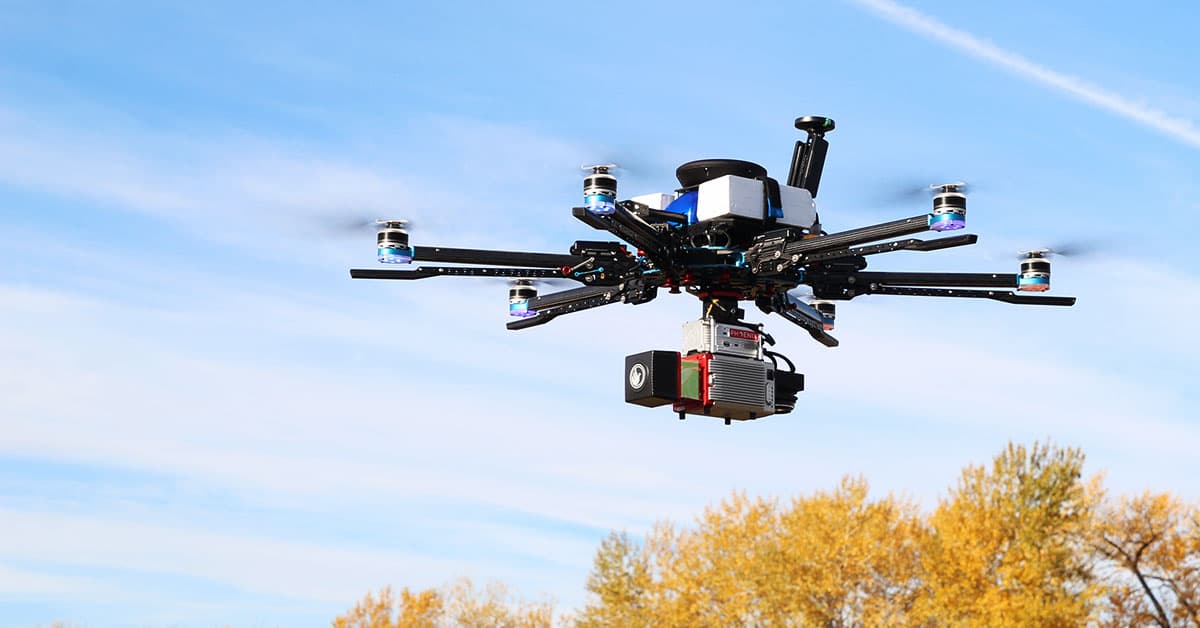
Adler arrived at the same future from the opposite direction. Based in Hamburg, he had been working in robotics and computer science, dealing with localization, path planning, navigation, and the messy limitations of early sensor systems. He had already built an octocopter fitted with a small scanner and a navigation system that required hand-soldered assembly. By his own account, the machine was rough in nearly every dimension: high latency, unstable hover, erratic navigation, hardware interfering with GPS. The platform looked improvised, and his username—"kernel panic"—became an apt emblem of the period. But the significance of that time wasn't the product it produced; it was that Adler had already done the hard thinking required to understand what it means to generate a point cloud from a flying robotic platform. Omans saw the market gap. Adler understood the technical pain buried inside it.
Phoenix's actual founding moment wasn't a formal launch—it was an email. Omans came across Adler's YouTube video in late 2012 and reached out. Adler almost didn't reply. He recalled sitting in front of a drafted response, realizing that once he sent it, there was "no going back." That small hesitation says something about how seriously both men took the opportunity. Omans had seen inevitability before viability; Adler had already lived through viability before practicality. Phoenix was born at that intersection—when foresight met technical stubbornness, and both parties recognized the idea was large enough to become a company.
The Demo Years: Turning the Impossible into Public Credibility
The years that followed were not elegant. Phoenix was bootstrapped and improvised, often running on willpower rather than polish. Omans partly funded Phoenix's early phase through operating Brushless Gimbals while the company found its footing. The business ran out of his home, with employees working in his living room and spilling into what was supposed to become his son Liam's bedroom. His pregnant wife eventually told him to move the whole operation out. That image matters because it strips away any illusion that Phoenix emerged from a sophisticated innovation pipeline. It was a company assembled under pressure, with roughly $100,000 USD riding on demo equipment and almost no buffer against failure.
In the middle of that chaos, the early demo years weren't just generating war stories—they were the period during which Phoenix began teaching the market what it was. Nowhere is this clearer than in the demonstration at the San Diego Chargers stadium, conducted alongside Wolfgang Juchmann, then Director of Sales and Marketing at Velodyne LiDAR, using the HDL-32 sensor. This is Phoenix's most important early story because it contains nearly everything that defined the company's early life.
Velodyne was a significant force in that period. The company at the time was still associated in some circles with a different technology enthusiasm: high-end audio. Its reputation was partly built on subwoofers that used real-time feedback to dramatically reduce distortion, making it a benchmark for home theater enthusiasts. That lineage is worth noting because it reveals what Velodyne was before LiDAR entered the picture—not a trend-chasing electronics brand, but an engineering-driven company with a habit of pushing precision and control into places the market hadn't yet caught up to. When Velodyne's multi-beam sensors became central to the emerging autonomous vehicle ecosystem, the company had already established itself as a genuine innovator. This makes Omans's outreach more meaningful: Phoenix wasn't approaching a generic parts supplier. It was asking one of the most technically influential sensor companies of the era to take seriously what still sounded like a reckless proposal—putting an extremely expensive LiDAR sensor on a drone.
That context makes Juchmann's presence more significant. Velodyne at the time was pushing hard into automotive, and its sensors were increasingly tied to the future of autonomous driving programs and advanced mobility. Drone-borne LiDAR was not an obvious commercial priority. So Juchmann showing up at Phoenix's early demo wasn't casual—it was curiosity and careful skepticism from a company actually sitting at the center of the emerging LiDAR market. Juchmann brought Velodyne equipment himself because, as Omans put it, he was "extremely uncomfortable" letting a young company take it into the field. The aircraft was homebrew, the integration was fragile, and the timing was bad. "It was just a complete disaster," Omans recalled. When the system failed, Juchmann left to a nearby gas station. In his absence, the demo finally worked. Phoenix flew one pass, flew into a bush, retrieved the vehicle, bent the LiDAR back into position, and still captured enough data to make the case.
When Juchmann later presented the results publicly, the audience reaction was immediate. "Everyone's jaw dropped," Omans said, describing Juchmann receiving a standing ovation in San Jose. That moment wasn't just a crazy early demo—it was Phoenix converting the impossible into public credibility in front of one of the market's most important participants. Supplier skepticism, fragile integration, physical failure, recovery, public validation, and market reaction all happened in the same sequence. The point cloud data didn't just validate a prototype; it gave the industry its first ability to imagine a fundamentally different workflow—drone-borne LiDAR covering complex environments fast enough to make economic sense.
From Payload to System: Discovering That the Workflow Is the Product
If the Chargers stadium story was about making the impossible look possible, the months of hand-wiring in makeshift rooms were about discovering what Phoenix was actually building. On the surface, that period reads like a sequence of technical failures: Linux drivers that wouldn't work, PCB designs that failed in practice, auto-routed circuit boards that became short-circuit mazes, hardware that smoked before a demo, and ribbon cables that Adler had to wire by hand. Omans burned through a round of engineers who, as he put it, looked good on paper but "couldn't do anything." Navigation assumptions also cost the company—Phoenix heavily promoted real-time solutions because they looked like magic in the field, but that promise rested on fragile communication links, intermittent correction signals, and an underestimation of how difficult post-processing really was.
As a list, those stories read like startup pain. As a pattern, they mark the period when Phoenix recognized it wasn't building a payload—it was building a system. The real engineering work wasn't just flying LiDAR; it was integrating navigation, communications, drivers, circuit boards, and data logic into something coherent enough that customers could actually trust it. Adler's contribution here was pivotal. He wasn't just resolving isolated technical failures; he was helping Phoenix build the internal logic that would later define the company's software and workflow architecture. The product wasn't a box bolted to an aircraft. The product was workflow coherence—an end-to-end chain from mission planning through data capture to data a customer could actually use. In those improvised rooms, Phoenix was quietly defining what "integration" had to mean in the category it was helping to invent.
Making Value Visible: Teaching Customers to See
The same logic carried into subsequent field demonstrations. Some of the messiest stories from those years are also the most important, because they reveal how Phoenix learned to make value legible rather than just technically correct. One demonstration in an Anaheim parking garage next to a Hooters had a customer wanting the system to resolve chain-link fence clearly enough to count as passing. The customer wasn't wearing his glasses, which may have helped. The point isn't the anecdote—it's that Phoenix was discovering in public the gap between an enticing concept and an actionable system.
One of the key breakthroughs wasn't a sensor—it was a way of displaying value. Phoenix discovered early that real-time point clouds carried extraordinary persuasive power. People enjoyed watching the aircraft, but when the point cloud rendered live on a screen, the meaning of the system became almost immediately obvious. Omans described this as "magic," and from a sales perspective, it was. In a later demonstration, a point cloud mapping the aircraft's turn in real time produced a reaction that approached genuine awe. Once people could see the platform and the data simultaneously, the entire value proposition became simple. This wasn't just a technical performance—it was a communication design that let the market quickly understand what Phoenix had built.
This article is adapted from original reporting by xyHt. Images courtesy of Phoenix LiDAR.
原文來源: 查看原文
FAQ
Reviewed and published by the LAETimes editorial desk ·