France Issues CCA RFI with Explicit Carrier Launch and Recovery Requirements
France's defence procurement agency DGA formally released a Request for Information on June 4, 2026, seeking industry input on next-generation Collaborative Combat UAV (CCA) systems, including loyal wingman and MUM-T platforms. The RFI notably includes questions on catapult launch and carrier landing weights, closely aligned with France's next-generation aircraft carrier programme (PANG). Responses are due by August 21, 2026.
Highlights
- France's DGA issued the CCA RFI on June 4, 2026, with an industry response deadline of August 21, 2026.
- The RFI explicitly requests data on catapult launch weight and maximum carrier landing weight, directly linking the programme to the PANG next-generation carrier programme.
- The France Libre carrier is scheduled to replace the Charles de Gaulle in 2038, providing the operational context for carrier-capable CCA development.
- The RFI targets loyal wingman and MUM-T platforms capable of SEAD, ISR, and A2/AD penetration missions alongside Rafale M and future NGF fighters.
- An official English-language courtesy translation signals that the DGA is open to input from international defence contractors, not only French domestic suppliers.
France's Direction Générale de l'Armement (DGA) officially released a Request for Information (RFI) on June 4, 2026, covering future Collaborative Combat UAV (CCA) systems. The document marks the formal opening of France's market exploration phase, aimed at defining the operational requirements, technical specifications, and industrial landscape for next-generation loyal wingman and Manned-Unmanned Teaming (MUM-T) platforms.
Although the RFI addresses multi-domain airborne collaborative combat broadly, details released by the French Ministry of Armed Forces point to highly strategic naval applications. As reported by Naval News, the requirements outlined in the document are directly relevant to the Marine Nationale's future capabilities — specifically carrier-based aviation and sea-based power projection.
Carrier Launch and Recovery Requirements
The clearest indicator of the RFI's naval dimension lies within the platform characteristics section of the technical questionnaire. The DGA explicitly requests industry data on "maximum take-off weight for catapult launch" and "maximum landing weight for landing on an aircraft carrier (if applicable)."
This language strongly suggests that the DGA is actively evaluating unmanned collaborative combat platforms capable of integration into a future carrier air wing. The timeline aligns closely with France's next-generation aircraft carrier programme (PANG) — the France Libre is scheduled to replace the Charles de Gaulle in 2038 — while also leaving room for potential transitional carrier-based unmanned aircraft demonstration activities.
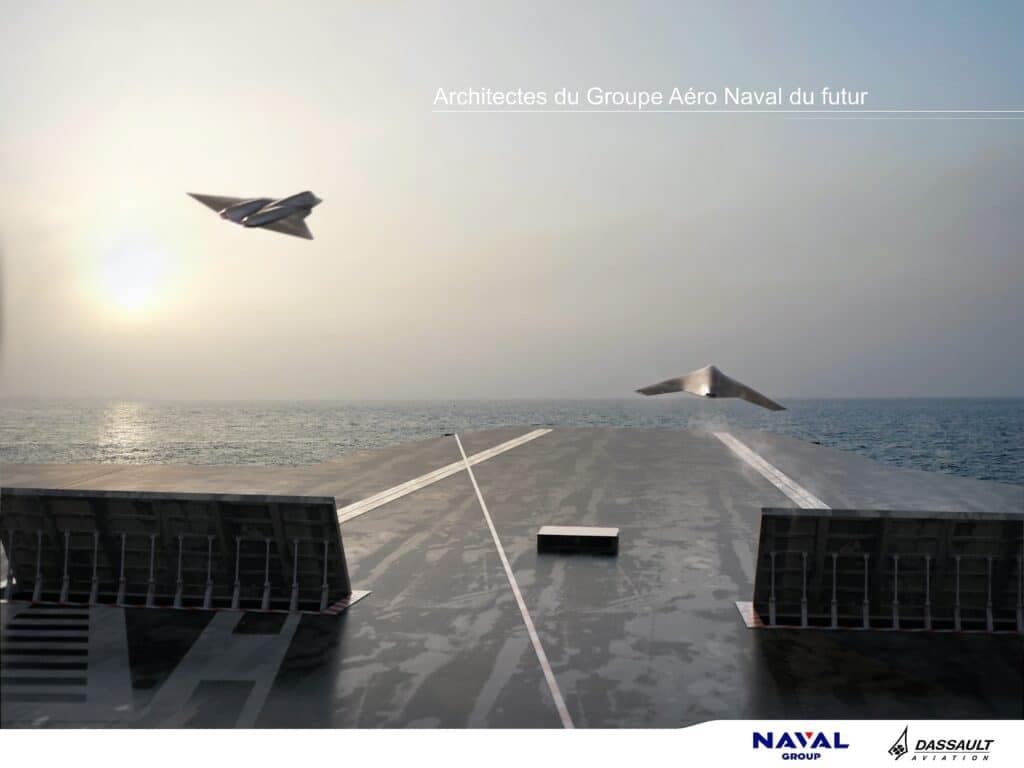
Illustrative image: A future PA-Ng concept carrier, as depicted by Dassault Aviation and Naval Group, showing an Electromagnetic Aircraft Launch System (EMALS) simultaneously launching a Next Generation Fighter (NGF) and an unmanned combat air vehicle (UCAV).
Operational Architecture: Maritime MUM-T
The operational requirements detailed in the RFI focus on advanced flight and mission autonomy systems, as well as flexibility in command and control (C2). Contractors must explain how these drones can be controlled simultaneously from ground control stations and directly from manned aircraft.
For the Marine Nationale, this clearly points toward the development of a maritime MUM-T architecture. Future carrier-launched collaborative drones are expected to serve as force multipliers for the Rafale M Standard F5 — and potentially for the Next Generation Fighter (NGF), originally being co-developed with Germany and Spain under the Future Combat Air System (FCAS/SCAF) programme. They would be expected to undertake high-risk missions such as penetrating Anti-Access/Area Denial (A2/AD) environments, Suppression of Enemy Air Defenses (SEAD), and conducting advanced Intelligence, Surveillance, and Reconnaissance (ISR) operations ahead of strike groups.
The RFI also emphasises sophisticated mission payload capabilities, querying industry on electro-optical, infrared, radar, and electronic warfare sensors, as well as dedicated weapons payload integration — capabilities critical for securing contested maritime airspace and conducting anti-surface warfare.
Industrial Framework and Timeline
The DGA has set a strict schedule and industrial framework for this RFI. Interested defence contractors and consortia must submit complete technical and industrial response reports by August 21, 2026. Respondents may choose to address all or part of the requirements, an approach designed to encourage both small and medium-sized defence enterprises and major prime contractors to participate.
Notably, this RFI is not strictly limited to France's domestic industry. While the programme's ultimate objective is to protect and strengthen the French sovereign Defence Industrial and Technological Base (BITD), the RFI itself is open to broader international participation. A clear indicator of this is the DGA's simultaneous release of an official English-language "courtesy translation" of the RFI — a move that typically signals the procuring authority's intention to gather market intelligence from foreign and international defence contractors, not solely from domestic suppliers.
原文來源: 查看原文
FAQ
Reviewed and published by the LAETimes editorial desk ·