Zelensky: Russia Stripping Air Defenses Nationwide to Fortify Moscow with S-500 and S-400 Systems
Ukrainian President Volodymyr Zelensky stated on June 24 that Russia is redeploying S-400, S-500, and Pantsir air defense systems from across the country to protect Moscow, Valdai, and the Kerch Bridge. He claimed hundreds of launchers have been concentrated around Moscow, while other Russian cities are left with only a handful per direction. The claims come amid a historic surge in long-range Ukrainian drone strikes.
Highlights
- Ukrainian President Zelensky stated on June 24 that Russia has concentrated hundreds of S-400, S-500, and Pantsir launchers in the Moscow region alone.
- Nearly 90 air defense launchers have been redeployed to Valdai — home to Putin's private residence — from other parts of Russia, with a dedicated unit being formed there.
- Ukraine conducted its largest-ever drone attack on Moscow this month, severely damaging the Moscow Oil Refinery 15 km from the Kremlin; the plant is expected to be offline for about six months.
- On June 23, Ukrainian Special Operations Forces destroyed a key railway bridge over the North Crimean Canal, describing it as the first such bridge eliminated.
- The S-500 Prometheus can engage targets at up to 600 km range and 200 km altitude, and can simultaneously intercept up to 10 targets with a reaction time of 3–4 seconds.
Russia is reportedly massing advanced air defense assets from across the country at strategic locations — including the capital Moscow and the Kerch Bridge — in response to a sharp escalation in long-range Ukrainian drone attacks.
Ukrainian President Volodymyr Zelensky said in a video statement on June 24 that Russia is turning Moscow into a fortified air-defense hub built around S-400 and S-500 systems. "In the Moscow region alone, they have concentrated hundreds of launchers from S-400, S-500, and Pantsir systems," he said in the video posted to X.
Zelensky claimed the Kremlin is pulling air defense assets away from other regions and redeploying them to Moscow, Valdai, and the Kerch Bridge.
"Nearly 90 launchers have been redeployed to Valdai from other parts of Russia, and a dedicated air defense unit is being formed there to ensure the personal safety of Russia's top leadership."
Zelensky said other Russian cities now have only a few launchers per direction, arguing the redeployment shows Russia is willing to strip the defense of most of its territory to prioritize Moscow and a handful of high-value sites.
"Across Russia and around other cities, there are only a few launchers left per direction. These are their priorities — they are protecting their own power, which is the root cause of this war. More than 60 Russian regions are facing fuel shortages, and gasoline and diesel prices are rising sharply — where they can be purchased at all," he said.
The claims have not been independently verified. Russia's Ministry of Defense had not commented on the statements at the time of publication.
Nevertheless, Russia has been visibly reinforcing air defenses around Moscow and other areas frequently targeted by Ukrainian strikes — including mounting Pantsir systems on high-rise rooftops, as previously reported by The Eurasian Times.
Ukraine's Drone Campaign Reaches Historic Scale
Zelensky's latest claims about the mass redeployment of S-400 and S-500 launchers to Moscow and the Kerch Bridge come as Russian forces are struggling to cope with successive waves of long-range Ukrainian strikes against critical energy infrastructure, military installations, and logistics hubs.
Earlier this month, Ukraine launched its largest-ever drone attack on Moscow, targeting the Moscow Oil Refinery — the city's largest fuel supplier — located just 15 kilometers from the Kremlin. The strike caused severe damage to the facility and was described as one of the most significant blows Russia has suffered in the war. Residents near the refinery reported "black rain" in the aftermath.
The large-scale drone offensive marked an unprecedented push of the conflict deep into Russian territory, forcing authorities to close multiple airports. According to a Reuters report citing two sources, the refinery is expected to remain offline for approximately six months.
In recent months, as the conflict has intensified, Ukraine has stepped up strikes against Russian energy infrastructure — including oil refineries and fuel storage facilities in Tyumen (Siberia), Krasnodar Krai, Voronezh, Volgograd, and Crimea — causing sharp spikes in fuel prices.
Kerch Bridge Remains Under Sustained Pressure
Ukraine has also maintained sustained pressure on Russia's logistics lifeline to Crimea, targeting the Kerch Bridge corridor, oil terminals, ferries, and related infrastructure.
On June 21, Ukrainian forces struck energy and military targets on both sides of the Crimean Bridge, including radar systems, natural gas compressors, and an oil terminal. The strikes were confirmed by drone forces commander Robert Brovdi (call sign "Madyar"). Images and video circulating on social media showed a fuel storage facility on fire in the Crimean city of Kerch.
On June 23, Ukrainian forces announced the destruction of a key railway bridge over the North Crimean Canal, describing it as the first such bridge eliminated. "It is part of a transport corridor for goods, resources, and military supplies in two critical directions: from Russia through Crimea to supply forces on the southern front," Ukraine's Special Operations Forces (SOF) stated.
The Kerch Bridge is a vital conduit for both military supplies and civilian goods. Its destruction would effectively isolate Crimea. The Kremlin also regards the bridge as a core symbol of its territorial integrity and has repeatedly taken significant measures to defend it.
Valdai: Home to Putin's Residence
According to Zelensky, another area Russia is heavily defending is Valdai. No confirmed strikes on the city have been reported recently, but Valdai is home to Putin's private residence — a heavily guarded compound on the shores of Lake Valdai, approximately 360–400 kilometers northwest of Moscow. Earlier this month, anti-drone netting resembling battlefield protective screens was installed over a truck parking area along the M-10 highway in the Valdai district, roughly 9 kilometers from Putin's residence.
Russia's Most Advanced Air Defense Systems Guarding Moscow
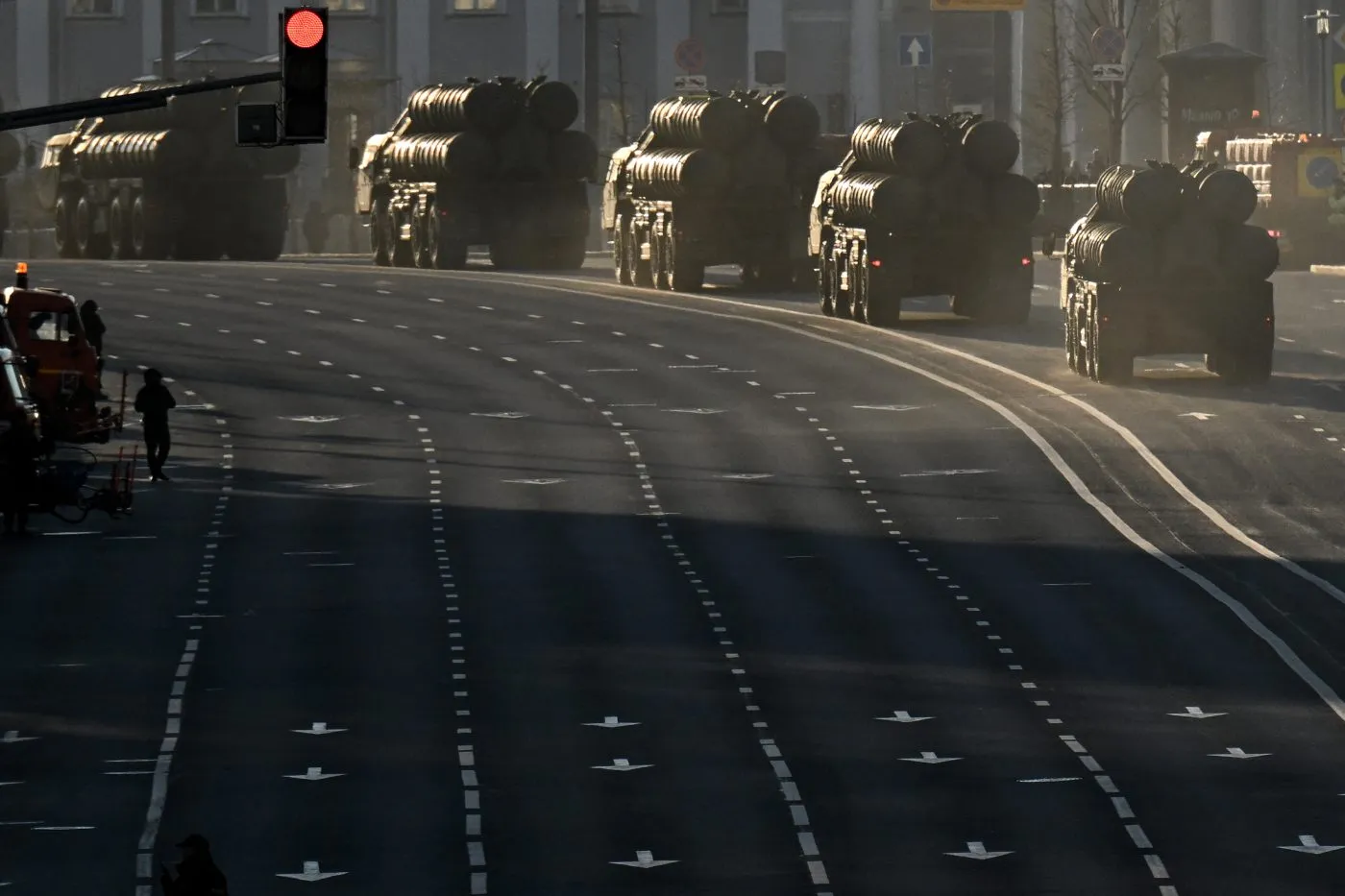
S-400 Triumf
The S-400 Triumf is a highly advanced Russian ground-based, mobile, long-range surface-to-air missile (SAM) system designed to engage a wide range of threats, including manned aircraft, UAVs, cruise missiles, and ballistic missiles.
The S-400 can fire multiple missile types with varying ranges: the 9M96 (40 km), the 9M96E2 (120 km), the 48N6 series (150–250 km), and the formidable 40N6 with a range of 380–400 km.
The system features advanced radars, including the 91N6E "Big Bird" search radar capable of detecting targets at 600 km, and the 92N6E "Grave Stone" engagement radar, providing 360-degree coverage. It can simultaneously track hundreds of targets and engage dozens at once.
All components — launchers, radars, and command vehicles — are road-mobile and can be deployed within 5–10 minutes. As part of an Integrated Air Defense System (IADS), the S-400 shares data with short-range systems such as the Pantsir, forming a layered defense network.
The S-400 has seen extensive combat use in the Ukraine war to intercept Ukrainian missiles and drones. Notably, during the India-Pakistan conflict in May 2025, the Indian Air Force reported that the S-400 downed a Pakistan Air Force Saab Erieye-2000 AWACS aircraft at a range of over 300 km.
S-500 Prometheus
The S-500 Prometheus is Russia's next-generation surface-to-air and anti-ballistic missile system, developed by Almaz-Antey as a successor and complement to the S-400. Beyond conventional air defense, it is designed to engage high-altitude and near-space threats, including ballistic missiles, hypersonic weapons, low-orbit satellites, and advanced stealth aircraft.
The S-500 is claimed to have an engagement range of up to 600 km against air and ballistic targets, with an intercept altitude of 180–200 km — giving it an exo-atmospheric intercept capability. Russian officials have positioned it as a "near-space shield" capable of countering emerging threats that lower-tier systems cannot effectively address.
The system is reportedly capable of detecting ballistic missiles at up to 2,000 km and air targets at up to 800 km.
The S-500 employs multiple advanced radars — including the 91N6E(M), 96L6-TsP, 76T6, and 77T6 — and uses the new 77N6-N/N1 series interceptors, which employ a hit-to-kill mechanism, a significant advancement over the blast-fragmentation warheads used by predecessor systems such as the S-400 and S-300.
With its advanced radar capability and signal processing, the S-500 is claimed to detect and track stealth aircraft, significantly degrading their ability to evade detection in defended airspace.
The S-500 can engage up to 10 targets simultaneously, with a reaction time of just 3–4 seconds — faster than the S-400.
Like the S-400, the system is road-mobile and rapidly deployable, and is designed to operate alongside S-400 and Pantsir systems as part of a multi-layered missile defense network. Notably, reports last year indicated that Russia deployed an entire S-500 regiment to protect the Kerch Bridge.
When the S-400 and S-500 are deployed together at any location, the result is a near-impenetrable defensive fortress.
Originally published by The Eurasian Times.
原文來源: 查看原文
FAQ
Reviewed and published by the LAETimes editorial desk ·