U.S. Military Deploys Saronic Corsair Kamikaze USVs in Combat for the First Time, Striking Iranian Naval Base at Bandar Abbas
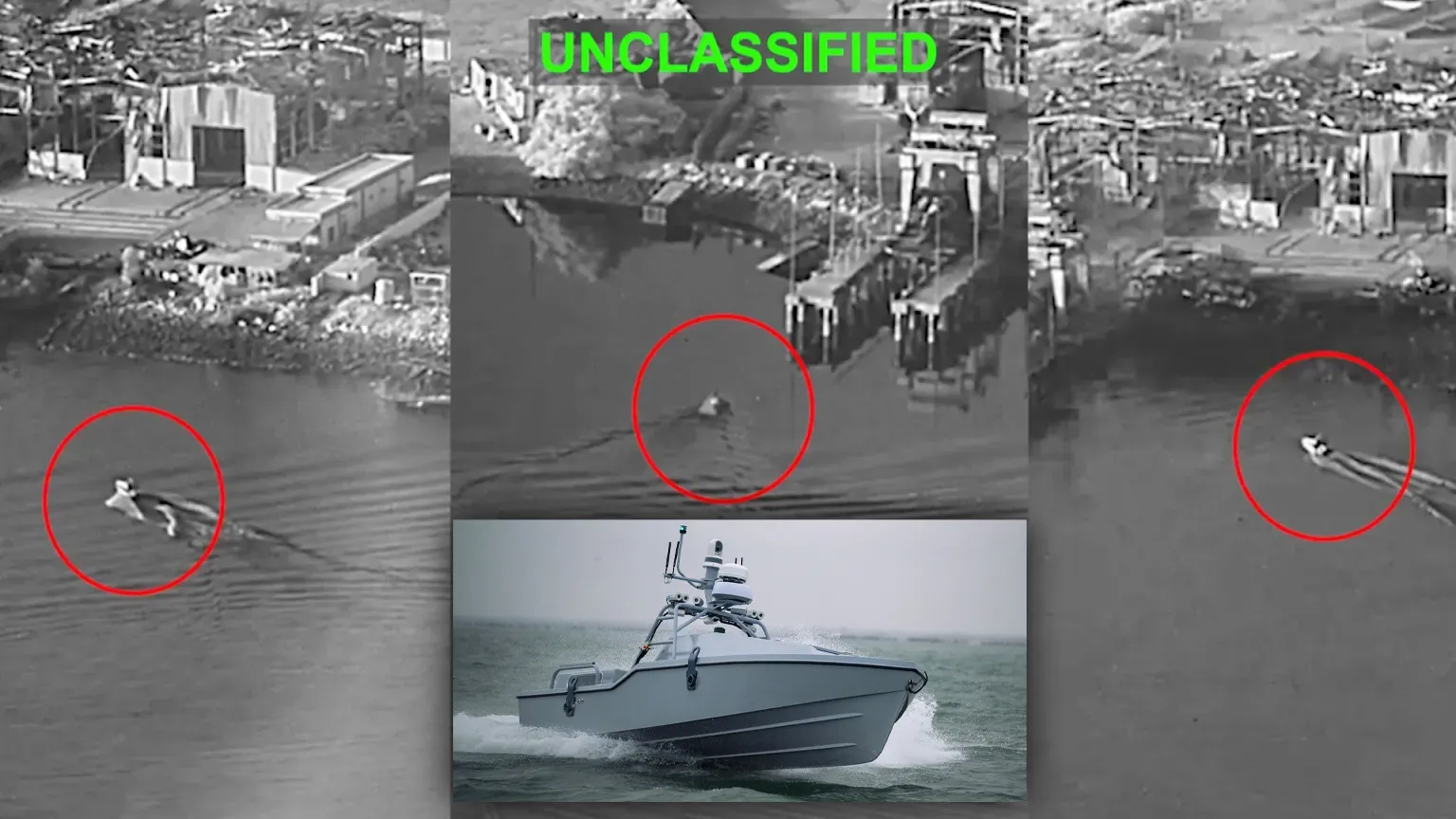
U.S. Central Command (CENTCOM) confirmed that on July 12, three Saronic Corsair uncrewed surface vessels (USVs) struck a submarine and ship maintenance facility at Iran's Bandar Abbas Naval Base — marking the first time the U.S. military has used maritime drones to conduct a kinetic strike in combat. The operation took place amid escalating U.S.-Iran tensions over control of the Strait of Hormuz.
Highlights
- On July 12, three Saronic Corsair one-way attack USVs struck a submarine and ship maintenance facility at Iran's Bandar Abbas Naval Base — the first U.S. combat use of maritime drones for a kinetic strike.
- The Corsair USVs are operated by Task Force 59 under U.S. Fifth Fleet, which began deploying them to the Middle East theater in late March 2025.
- CENTCOM stated the strikes 'degraded Iran's ability to continue attacking commercial shipping' and footage appears to show a Ghadir-class midget submarine being targeted.
- Saronic co-founder Rob Lehman said the mission elevates autonomous systems from 'fringe tech demonstration' to 'genuinely credible capability,' potentially accelerating USV adoption across the industry.
- CENTCOM announced the reinstatement of a maritime blockade on Iranian ports effective July 14, following an initial blockade from April 13 to June 18 during which 140+ vessels were redirected and 9 non-compliant vessels were disabled.
U.S. Military Uses Kamikaze USVs in Combat for the First Time
In a historic first for the U.S. military, uncrewed surface vessels (USVs) have been employed as offensive strike weapons in active combat. According to a statement from U.S. Central Command (CENTCOM), the deployment of Saronic Corsair USVs occurred on July 12 as part of a broader series of strikes against "dozens" of Iranian targets. The operation unfolded against the backdrop of ongoing U.S.-Iran clashes over control of the Strait of Hormuz — a strategic waterway that President Donald Trump has declared the United States intends to dominate — along with efforts to reinstate a maritime blockade on Iranian ports. Meanwhile, Iran has continued attacking multiple Arab nations as a fragile ceasefire agreement shows signs of collapse.
CENTCOM Official Statement
CENTCOM posted on X on Monday morning: "Yesterday, CENTCOM forces used multiple one-way attack uncrewed surface vessels to successfully strike a submarine and ship maintenance facility in Iran. Three Corsair uncrewed surface vessels struck the port at Bandar Abbas Naval Station, marking the first use of maritime drones in a U.S. combat operation. Last night's strikes degraded Iran's ability to continue attacking commercial shipping."
From Rescue to Strike: The Corsair's Combat Evolution
This mission represents the latest step in the U.S. Navy's operational use of USVs. Last month, a Saronic Corsair USV assisted in the recovery of the crew of a U.S. Army AH-64 Apache helicopter that had been shot down over the Gulf of Oman by Iranian forces — the first time a USV had been used for personnel recovery in a search-and-rescue operation, a development with significant implications for future missions.
CENTCOM spokesperson U.S. Navy Captain Tim Hawkins told The War Zone (TWZ) at the time: "The uncrewed surface vessel that assisted in the rescue of the Apache crew off the coast of Oman last night was a U.S. Navy Corsair USV operated by Task Force 59 under U.S. Fifth Fleet. That task force began deploying these vehicles to the theater in late March of this year."
Task Force 59, established in 2021, serves as an experimentation unit tasked with integrating new uncrewed and artificial intelligence (AI) capabilities into day-to-day naval operations in the Middle East. It now appears the task force is beginning to put those capabilities to broader operational use.
Saronic Co-Founder Responds
Saronic co-founder Rob Lehman, in a recent interview with TWZ, declined to share any details about this specific mission or other operations the Corsair has conducted in the region, but said the success would send ripples across the USV industry.
"I think the real impact on the industry is that autonomous systems are now viewed as a genuinely credible capability, rather than a fringe tech demonstration desperately trying to prove that the technology can work in these kinds of operations," Lehman said. "I hope that — not just for Saronic but for all of our commercial partners — this becomes a catalyst for accelerating the delivery of more of these capabilities into the hands of warfighters."
Precedents: Ukraine's Black Sea Campaign and the Houthis
As TWZ has reported extensively, Ukraine has used USVs to devastating effect against Russia's Black Sea Fleet. Vessels such as the Magura series have played a key role in forcing Russian naval assets to withdraw from occupied Crimea to bases on Russian home soil.
In fact, Yemen's Houthi forces pioneered the combat use of kamikaze USVs years earlier. TWZ first reported on this capability in January 2017, when a Houthi USV loaded with explosives rammed a Saudi Arabian frigate. Prior to that, Iran had developed various rudimentary kamikaze USVs, capabilities that subsequently proliferated to its Houthi proxies and were first employed in Red Sea operations.
Trump Declares Control Over the Strait of Hormuz
The U.S. and Iran signed a 14-point memorandum of understanding (MoU) on June 17, providing a 60-day ceasefire extension to finalize agreements covering the end of hostilities in the Lebanese theater, preventing Iran from pursuing nuclear weapons, lifting U.S. sanctions, and restoring passage through the Strait of Hormuz. However, control of the strait has since emerged as the primary flashpoint.
Speaking to Fox News, Trump stated: "We hit them hard last night. Every time they send drones, we hit them back hard. But we had a deal — a negotiated deal — and they broke it. They always break deals. We've made ten deals with these people, so we just keep hitting hard and we're keeping the strait, we're probably going to take it over."
Trump added: "We will be the guardians of the strait — maybe call it the Guardian Angels of the strait." He also argued that the United States should be compensated for this role and announced on his Truth Social platform that a 20% cargo fee would be levied on vessels transiting the waterway.
Blockade Reinstated
(Update: 2:38 PM ET)
CENTCOM issued an updated statement regarding the blockade: "On order of the Commander in Chief, CENTCOM forces will reinstate the blockade on maritime shipping entering and exiting Iranian ports beginning at 4:00 PM ET on July 14. CENTCOM forces will enforce the blockade on vessels traveling to or from Iranian ports and coastal areas. U.S. forces continue to support the transit of all vessels through regional waters that do not violate the blockade."
"This reinstatement follows an initial blockade implemented from April 13 to June 18. During that two-month period, CENTCOM forces redirected more than 140 compliant vessels, disabled 9 non-compliant vessels, and allowed more than 50 commercial vessels carrying humanitarian aid to pass through the blockade."
Saronic Official Statement
(Update: 1:01 PM ET)
Saronic released the following statement: "The U.S. military has confirmed that the Saronic Corsair was used by U.S. Central Command in operations against Iran. According to CENTCOM, three military-variant Corsair uncrewed surface vessels struck a submarine and ship maintenance facility at Bandar Abbas Naval Station, marking the first use of maritime drones in a U.S. combat operation. We are proud that our technology supported this mission and helped degrade threats to commercial shipping. Saronic remains committed to delivering autonomous maritime systems that enhance the security of the United States and its allies."
Ghadir-Class Midget Submarine Sunk
(Update: 12:26 PM ET)
Footage released by CENTCOM this morning appears to show a Corsair USV attacking what looks like a Ghadir-class diesel-electric midget submarine.
Given the frequency of U.S. airstrikes on Bandar Abbas — Iran's principal naval base — throughout this conflict, questions remain about how many such vessels Iran still has in service. As previously reported by TWZ, U.S. forces apparently sank another Ghadir-class submarine in March using AGM-114 Hellfire missiles. Prior to the current conflict, estimates of Iran's Ghadir-class inventory generally ranged between 16 and 20 vessels.
The Significance of a New Precedent
The U.S. military's use of USVs for kinetic strike missions sets a new precedent not only for operations in the CENTCOM area of responsibility, but also carries far-reaching implications for other potential conflict zones, including the Pacific theater. It is worth noting, however, that these kamikaze USVs were not deployed in the early stages of the conflict — when maritime and coastal targets were more abundant — suggesting that the Pentagon still has ground to make up in fielding certain weapons systems developed overseas, or at least in deciding when and how to authorize their operational use.
原文來源: 查看原文
FAQ
Reviewed and published by the LAETimes editorial desk ·