Iran's Shahed Drone Family Keeps Growing: New Report Reveals Full Lineup of All Variants
A new report by CSIS's Missile Threat Project documents the full spectrum of Iran's Shahed drone family, from low-cost one-way attack drones costing as little as $20,000–$50,000 per unit to reusable UCAVs and high-altitude ISR platforms. Deployed by Russia, Houthi forces, and Iranian proxies across multiple conflicts, the Shahed series has fundamentally reshaped modern warfare through saturation attack tactics.
Highlights
- The CSIS Missile Threat Project has documented more than a dozen Shahed drone variants, ranging from one-way attack loitering munitions to reusable UCAVs and HALE ISR platforms with ranges up to 4,000 km.
- Shahed one-way attack drones cost just $20,000–$50,000 per unit to produce, forcing defenders to expend multi-million-dollar interceptor missiles in response, creating severe cost asymmetry.
- Russia has deployed Shahed-136/131 drones—designated Geran-2—against Ukrainian infrastructure in mass saturation attacks since September 2022, while Iran launched three major Shahed operations between April 2024 and 2025.
- On March 27, 2026, a Shahed-136 reportedly destroyed a U.S. Air Force E-3 Sentry AWACS aircraft at Prince Sultan Air Base in Saudi Arabia.
- The Shahed design has inspired copycat programs worldwide, including the U.S. LUCAS system, China's Sunflower-200, Taiwan's 'Papa Delta' (雷虎) drone, Turkey's Skydagger, and Egypt's Jabbar-150.
Iran's Shahed drone series has drawn intense global attention in recent conflicts, combining low unit costs with saturation attack capabilities. Russia's deployment against Ukraine and large-scale use by Iran and its proxy forces have demonstrated the real-world effectiveness of swarm tactics using low-cost unmanned attack systems.
The Shahed family first gained international notice in 2019, when Iran-backed Houthi forces in Yemen used them to strike Saudi Arabia. However, it was from mid-September 2022 onward—when Russia began launching mass attacks against Ukrainian critical infrastructure using the Shahed-136 and Shahed-131—that the platform truly entered the global spotlight. Russia designated its domestic-produced version the Geran-2 (Geranium-2).
Shahed one-way attack drones are widely referred to as "poor man's cruise missiles," with a per-unit production cost of just $20,000 to $50,000. Their simple, robust construction makes them well suited to large-scale swarm operations. Critically, defending forces are often compelled to expend interceptor missiles worth millions of dollars to neutralize these cheap expendables—creating a severely asymmetric financial burden on defenders.
Iran's Three Major Shahed Deployments
Over the past two years, Iran has conducted three large-scale Shahed operations: Operation True Promise against Israel in April 2024; the "12-Day War" in June 2025; and an even larger regional conflict across the wider Middle East in 2025.
The Shahed series is manufactured using basic commercial-off-the-shelf components—piston or jet engines, fiberglass airframes, and minimal electronics—enabling rapid, large-scale production.
The CSIS Missile Threat Project, a program run by the Washington-based Center for Strategic and International Studies (CSIS), has compiled a comprehensive database covering Iran's Shahed family alongside its ballistic and cruise missile inventories.
The Full Shahed Variant List
According to CSIS: "Iran possesses one of the largest and most diverse unmanned aerial system (UAS) arsenals in the world. The Shahed family is capable of one-way attacks, reconnaissance, and weapons delivery. Iran actively supplies Shahed drones to Russia and to Axis of Resistance proxies, including the Houthis, Hezbollah, and Iraqi militias."
One-Way Attack Drones (Kamikaze / Loitering Munitions)
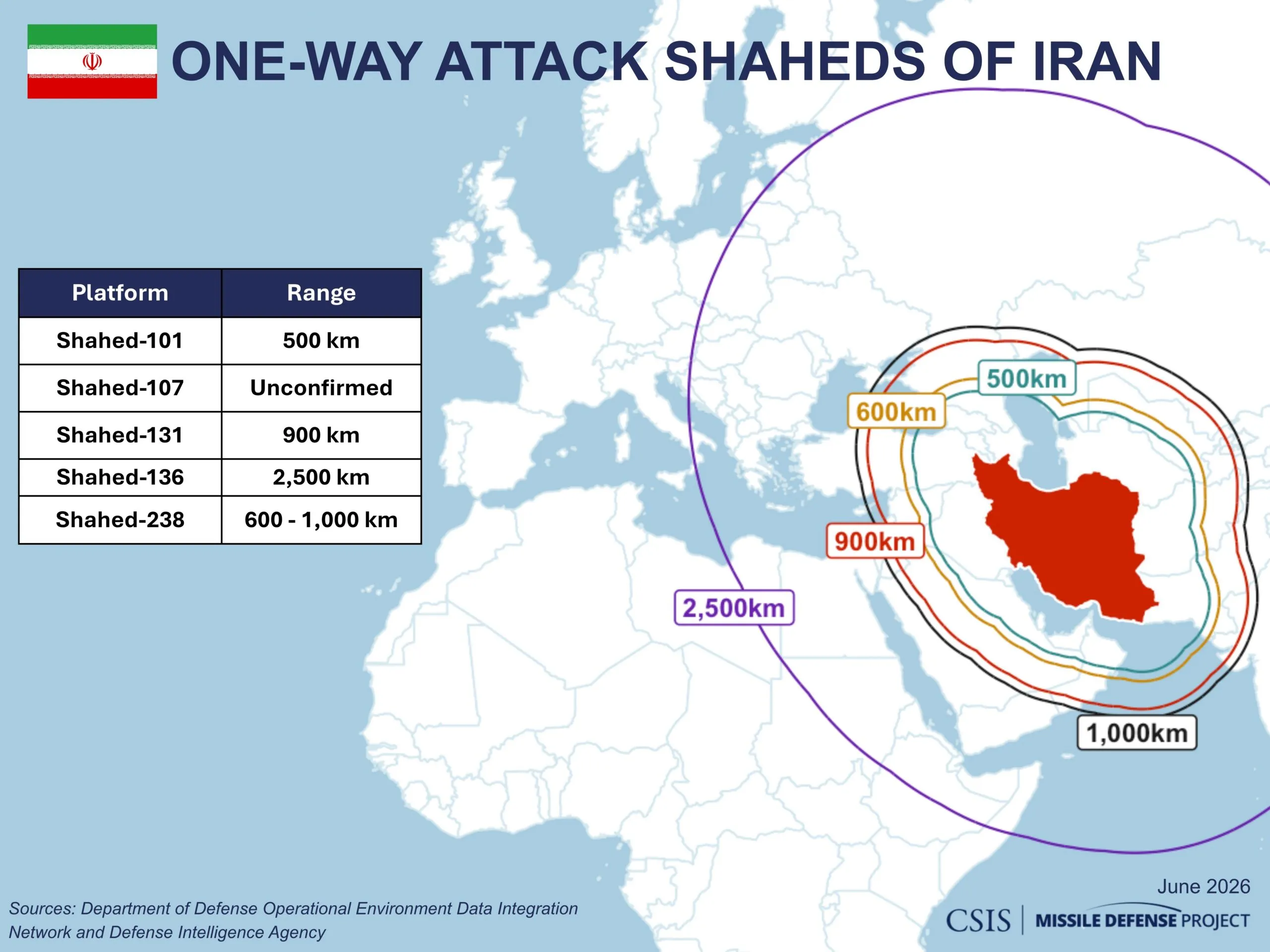
- Shahed-131: Range of 900 km
- Shahed-136: Range of 2,500 km
- Shahed-238: Range of 600–1,000 km — a high-speed jet-powered variant powered by a Czech-made PBS TJ150 turbojet engine, cruising at 500–600 km/h, far exceeding the ~185 km/h of older variants; Russia's version is designated Geran-3
- Shahed-101: Range of 500 km — a smaller, low-cost model optimized for front-line strikes
- Shahed-107: Range unconfirmed — suited to medium-range missions
- Shahed-141: Flying-wing tailless design inspired by the U.S. RQ-170 Sentinel stealth drone captured by Iran in 2011; reportedly observed on the Ukrainian battlefield as recently as April this year
Unmanned Combat Aerial Vehicles (UCAVs)
Unlike one-way kamikaze drones, UCAVs are reusable armed platforms capable of returning to base after completing a mission.
- Shahed-129: Range of approximately 1,700 km
- Shahed-161: Jet-powered flying-wing tactical UCAV with a combat radius of 150 km, service ceiling of 7,600 m, and capacity for two 50 kg bombs
- Shahed-139: A medium-altitude long-endurance (MALE) platform visually resembling the U.S. MQ-1 Predator, with an estimated range of ~2,000 km. In February 2026, a U.S. Navy F-35C shot down a Shahed-139 that was approaching the aircraft carrier USS Abraham Lincoln
- Shahed-191 ("Saegheh"): A flying-wing jet-powered stealth UCAV with an internal weapons bay and enhanced radar-evading characteristics
- Shahed-181: Believed to be a smaller variant of the Saegheh, using a piston-engine flying-wing configuration
- Shahed-171 ("Simorgh"): A jet-powered stealth drone reverse-engineered from the U.S. RQ-170 Sentinel, capable of both reconnaissance and strike missions; one example was reportedly destroyed in early 2026 during U.S. airstrikes on Iran
Intelligence, Surveillance, and Reconnaissance (ISR) Variants
- Shahed-147: A high-altitude long-endurance (HALE) surveillance drone with a range of 1,000 km, equipped with a synthetic aperture radar (SAR); publicly unveiled in November 2023 and subsequently deployed by Russia over Ukraine
- Shahed-197: Reverse-engineered from the U.S. RQ-170 that crashed in Iran in 2011; endurance of 20 hours, operational range of 2,000 km; was intercepted by an Israeli F-35I Adir
- Shahed-149 ("Gaza"): A HALE platform analogous to the U.S. MQ-9 Reaper, with 35 hours of endurance, 500 kg payload capacity, support for 8–13 guided munitions, and a range of 4,000 km
- Shahed-121 / Shahed-123: Early, smaller tactical reconnaissance platforms; in January 2016, a Shahed-121 overflew the aircraft carrier USS Harry S. Truman while operating in international waters in the Persian Gulf
- Shahed-125: An early Iranian ISR derivative modeled on the U.S. RQ-7 Shadow tactical drone
- Shahed-178: An ambiguously classified platform with both ISR and strike capabilities
How the Shahed Is Rewriting the Rules of Modern Warfare
Iran has launched thousands of Shahed drones at U.S. military assets and allied bases in recent conflicts, aiming to overwhelm air defense systems through saturation attacks. One particularly significant reported incident occurred on March 27, 2026, when a Shahed-136 allegedly destroyed a U.S. Air Force E-3 Sentry airborne warning and control system (AWACS) aircraft at Prince Sultan Air Base in Saudi Arabia—a significant blow to U.S. capabilities in the region.
The Shahed's operational impact has triggered a global military ripple effect:
- Russia has established domestic Geran-2 production lines.
- The United States reverse-engineered the Shahed-136 to develop LUCAS (Low-Cost Unmanned Combat Aerial System)—which, in an ironic twist, was later used in strikes against Iran itself.
- China tested a suspected Shahed-136 clone, designated Sunflower-200 (向日葵-200), in 2023.
- Taiwan is reportedly developing a drone codenamed "Papa Delta" (雷虎), whose configuration closely resembles the Shahed.
- Turkey's Skydagger and Turkish Aerospace Industries (TUSAŞ), as well as Egypt's Jabbar-150, have all drawn on the Shahed design in their own development programs.
Taken together, the rise of the Shahed family has fundamentally transformed modern warfare, establishing low-cost drones as an indispensable weapon in conflicts around the world.
原文來源: 查看原文
FAQ
Reviewed and published by the LAETimes editorial desk ·