Nashville Police Deploy Skydio Drones Without Council Approval, Sparking Controversy Over Due Process and Racial Equity
Nashville's Metro Police launched a Drone as First Responder pilot program with three Skydio drones over the Madison Precinct before obtaining formal city council approval. Council members and community organizers are challenging the legal exemption cited by police, raising concerns about procedural legitimacy and racial equity in the chosen test area.
Highlights
- Nashville Metro Police launched a DFR pilot with three Skydio drones on May 26, 2025, before obtaining formal city council approval.
- The 30–45 day trial covers a two-mile radius around the Madison Precinct, a low-income, majority-minority neighborhood in North Nashville.
- Skydio loaned all three drones at no cost; operators control them remotely from police headquarters via 911 dispatch integration.
- Police cite a legal exemption for temporary criminal investigation and emergency technology, but council members say the city surveillance ordinance was bypassed.
- Safeguards include an eight-page use policy, public flight dashboard, seven-day footage deletion, and bans on weapons, facial recognition, and immigration data sharing.
Nashville Police Take Flight Before Council Sign-Off
The Metro Nashville Police Department (MNPD) launched three Skydio drones over the Madison Precinct before the city council formally approved the program — and the initiative is now under heavy fire. Police claim a legal exemption allows them to bypass the review process, but council members and community organizers say that interpretation amounts to exploiting a loophole. The drones are already airborne, and that's precisely why this controversy matters.
What Nashville Actually Launched
The MNPD officially kicked off its Drone as First Responder (DFR) pilot program on Tuesday, May 26, 2025. The trial is set to run for 30 to 45 flight days within a two-mile (approximately 3.2 km) radius of the Madison Precinct in North Nashville.
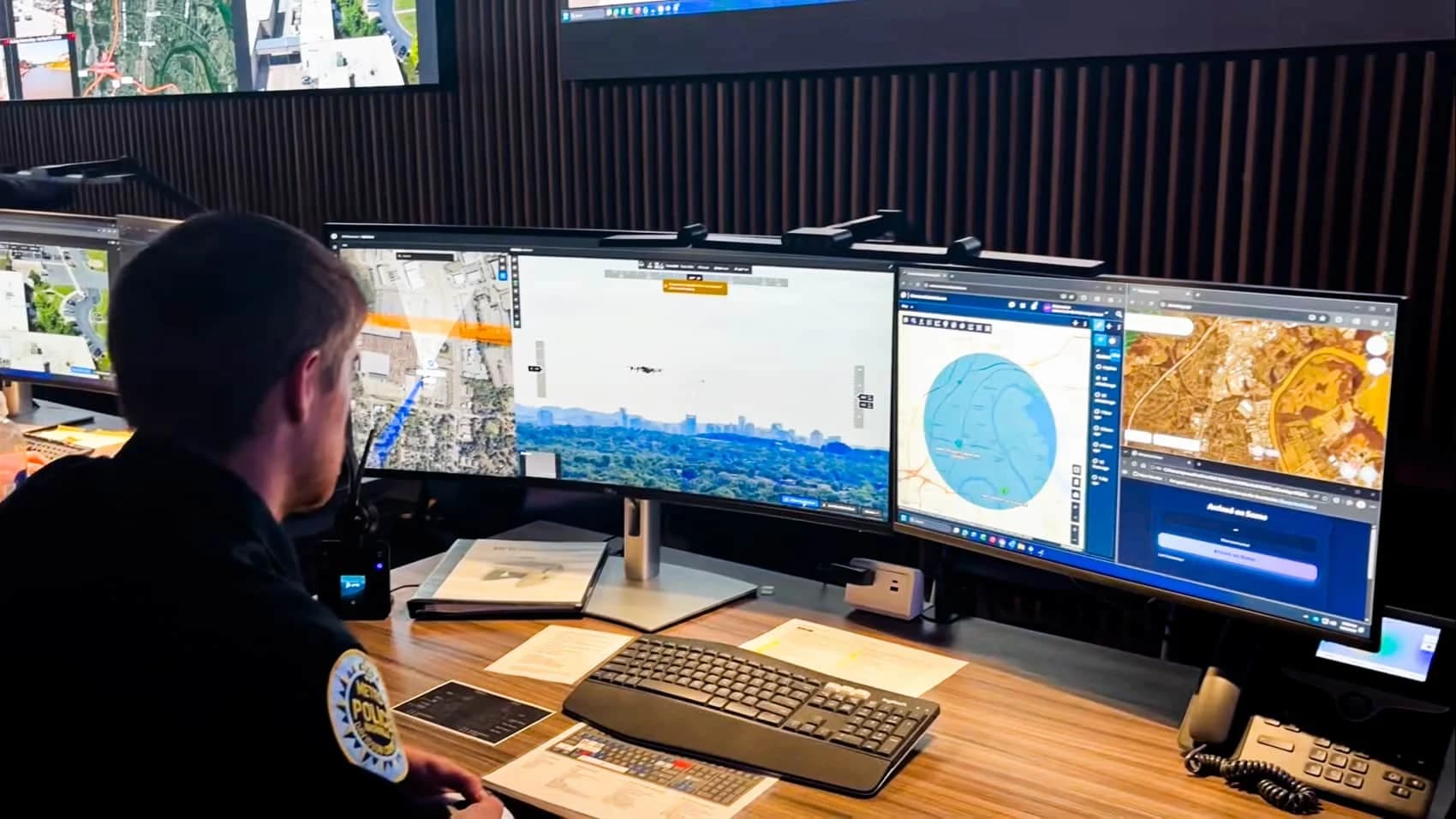
All three drones are mounted on the precinct rooftop and were loaned by Skydio at no cost to the city. Operators remotely control the aircraft from a "Community Safety Center" at police headquarters several miles away, with dispatch data from the 911 center feeding directly into the flight system.
Police have clearly defined when the drones can be deployed, limiting use to four scenarios: emergency service calls, active criminal investigations, missing person searches, and major traffic incidents. Routine patrol surveillance is explicitly excluded. The program has reportedly already assisted in an arrest related to a domestic violence case.
The Approval Process Dispute
Here's where the controversy intensifies. According to reporting by WPLN, Nashville city code explicitly requires council approval before surveillance technology goes live — a step that was not completed in this case.
Mayor Freddie O'Connell defended the move on two fronts: first, by framing it as a "limited test," emphasizing that "this is a pilot program with a very limited scope"; second, by citing the metro legal counsel's interpretation that the trial "did not trigger the surveillance provisions of the ordinance." The exemption invoked covers "technology used temporarily for criminal investigations or emergency situations."
Not everyone is persuaded. District 7 Council Member Emily Benedict said she was never consulted, stating plainly, "No one contacted me," and stressing, "This is surveillance technology — it's not allowed without approval." While five council members were briefed on the pilot, a briefing is not a vote — and that distinction is at the heart of the debate.
The Test Location Is a Flashpoint in Itself
The choice of test site is itself a sensitive issue. Police selected a low-income, majority-minority community for the trial, and critics argue that pattern deserves scrutiny.
Community organizer Kelly Chieng directly challenged the legal reasoning, pointing out that stretching a criminal investigation exemption to cover dispatching drones to traffic accident scenes simply "doesn't hold up." Without public hearings, residents in the test area had no formal opportunity to voice their opinions before drones began flying over their streets.
This is the deeper tension that surfaces in nearly every DFR deployment: technology lands faster than the public processes designed to govern it, and the first communities to be overflown are often the last to be consulted.
Hardware and Safeguards
Nashville has not officially confirmed which Skydio model is being flown. The most likely candidate is the Skydio X10, the company's flagship DFR platform and the same model already in use at nearby Vanderbilt University, though police have not publicly specified.
Policy safeguards are more clearly defined than the hardware details. The department has published an eight-page use policy and built an online dashboard that publicly logs every flight mission and its corresponding service call for public review. Footage not flagged as evidence is permanently deleted after seven days.
Police have also explicitly ruled out the most controversial capabilities: no weapons, no facial recognition, and a commitment that drone footage will not be shared with federal immigration enforcement agencies.
Analysis
What the reporting doesn't emphasize is that Nashville actually built a fairly robust program — then undermined its own credibility on process.
An eight-page use policy, a public flight dashboard, a seven-day footage deletion protocol, explicit bans on weapons, facial recognition, and immigration data sharing — these are the elements of a responsible DFR deployment. Departments that cut corners typically don't voluntarily publish flight-log dashboards.
So the issue isn't the technology — it's the sequencing. Flying first and citing exemptions afterward is the classic path for a good program to lose public trust before it can prove its value. When a council member says "no one contacted me," that's not a privacy problem — it's a governance problem, and an entirely avoidable one.
The racial equity concerns also deserve a direct response. Testing in a low-income, majority-minority neighborhood may have operational justifications such as call volume, but if police cannot explain that choice at a public hearing, they shouldn't be surprised when residents assume the worst. After-the-fact transparency is not the same as informed consent.
Nashville has 30 to 45 flight days to prove the system's value. The drones may ultimately earn their place, but this approval controversy is a reminder: how you launch a surveillance program determines whether people will accept it.
原文來源: 查看原文
FAQ
Newsletter
Subscribe to our Low-Altitude Industry Newsletter
Daily curated news on low-altitude economy and drone industry, delivered to your inbox.
Reviewed and published by the LAETimes editorial desk ·