Skydio CEO Distances Himself from No-Weapons Pledge, DJI Avata 2 Disarms Suspect, FBI Seizes 300+ Drones at FIFA World Cup
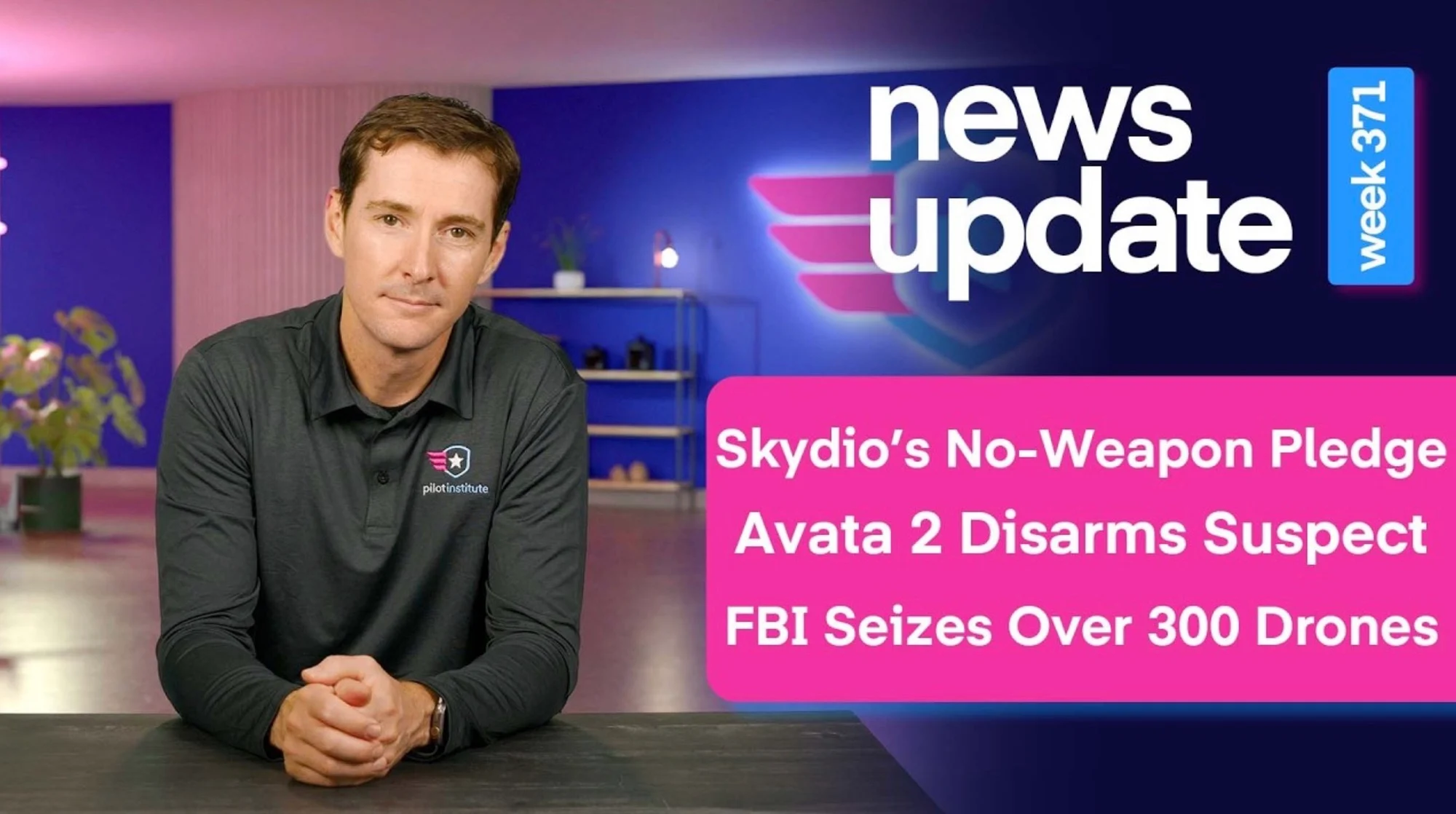
Three major U.S. drone stories this week: Skydio CEO Adam Bry publicly broke from the company's 2020 no-weapons principle and confirmed the U.S. Army has tested grenade launchers mounted on Skydio drones; Sacramento County Sheriff's Office used a DJI Avata 2 fitted with a powerful magnet to safely disarm a knife-wielding suspect in a garage standoff; and the FBI has seized more than 300 unauthorized drones at FIFA World Cup venues in just the first 10 days of the tournament.
Highlights
- Skydio CEO Adam Bry publicly distanced himself from the company's 2020 no-weapons pledge during an interview with The Verge's Decoder Podcast.
- The U.S. Army has conducted tests mounting grenade launchers on Skydio drones, according to Bry's own confirmation.
- Sacramento County Sheriff's Office used a magnet-equipped DJI Avata 2 to pull a knife from a suspect's hand during a garage standoff, safely resolving the situation without officer entry.
- The FBI seized over 300 unauthorized drones at FIFA World Cup venues across the U.S. in the first 10 days of the tournament, including 42 in Philadelphia and 39 in Dallas.
- Drone operators flying near World Cup venues face criminal fines of up to $100,000; FAA Part 107 certification and LAANC authorization do not exempt pilots from active TFR restrictions.
Skydio CEO Breaks from 2020 No-Weapons Principle
Skydio CEO Adam Bry recently appeared on The Verge's Decoder Podcast, publicly distancing himself from a principles statement the company published in 2020. That document had explicitly stated that Skydio would not weaponize its drones and opposed fully autonomous lethal weapon systems.
In the interview, Bry confirmed that the U.S. Army has conducted experiments mounting grenade launchers on Skydio drones, and argued that drawing ethical red lines is a "dangerous misdirection." He maintained that decisions about which systems can be used for which purposes should be made by elected officials, not by companies acting on their own.
Notably, as of the time of publication, the 2020 statement — titled Skydio Engagement and Responsible Use Principles — remained live on the company's website, retaining language explicitly opposing weaponization and fully autonomous lethal systems. The apparent reversal has sparked widespread debate across the industry.
Sacramento County Sheriff's Office Disarms Suspect Using DJI Avata 2 and Magnet
A striking drone enforcement case recently unfolded at the Sacramento County Sheriff's Office in California, where deputies used a DJI Avata 2 to execute a high-difficulty disarmament operation inside a garage.
A suspect armed with a knife had barricaded himself in a garage, creating a standoff. To avoid sending officers into a dangerous environment, the drone operator improvised by attaching a powerful magnet to the Avata 2, flew the drone into the garage, and successfully pulled the knife out of the suspect's hand. Reports indicate the suspect may have already lost consciousness at the time, but the maneuver nonetheless secured the safety of both officers and the subject.
The incident raises an intriguing question: was the magnet a pre-prepared piece of standard equipment, or a on-the-spot improvisation? Either way, the operation highlights the innovative potential of consumer-grade drones in law enforcement scenarios.
FBI Seizes Over 300 Unauthorized Drones in First 10 Days of FIFA World Cup
The 2026 FIFA World Cup is being held across multiple U.S. cities, but in just the first ten days of competition, the FBI has already seized more than 300 unauthorized drones at tournament venues. Breaking down the numbers: 34 drones were confiscated at SoFi Stadium in Los Angeles, 39 in Dallas, and 42 in Philadelphia.
Under applicable regulations, a Temporary Flight Restriction (TFR) is in effect on World Cup match days within a 3-nautical-mile radius and below 3,000 feet around each venue. Violators face criminal fines of up to $100,000, potential imprisonment, and drone confiscation.
A critical reminder: an FAA Part 107 Remote Pilot Certificate or authorization obtained through the LAANC system does not apply within an active TFR and cannot be used as the basis for legal flight. Operators with legitimate commercial operational needs must apply through a separate authorization process administered via the Department of Homeland Security (DHS), and applications must be submitted well in advance. Before any flight, always check tfr.faa.gov for the latest TFR information.
Law enforcement is fully mobilized — the FBI is not bluffing. If you are operating near World Cup venues in the coming weeks, ground your drone and do not become the next enforcement statistic.
原文來源: 查看原文
FAQ
Reviewed and published by the LAETimes editorial desk ·