How Sony AI's Table Tennis Robot Is Advancing Physical AI Technology
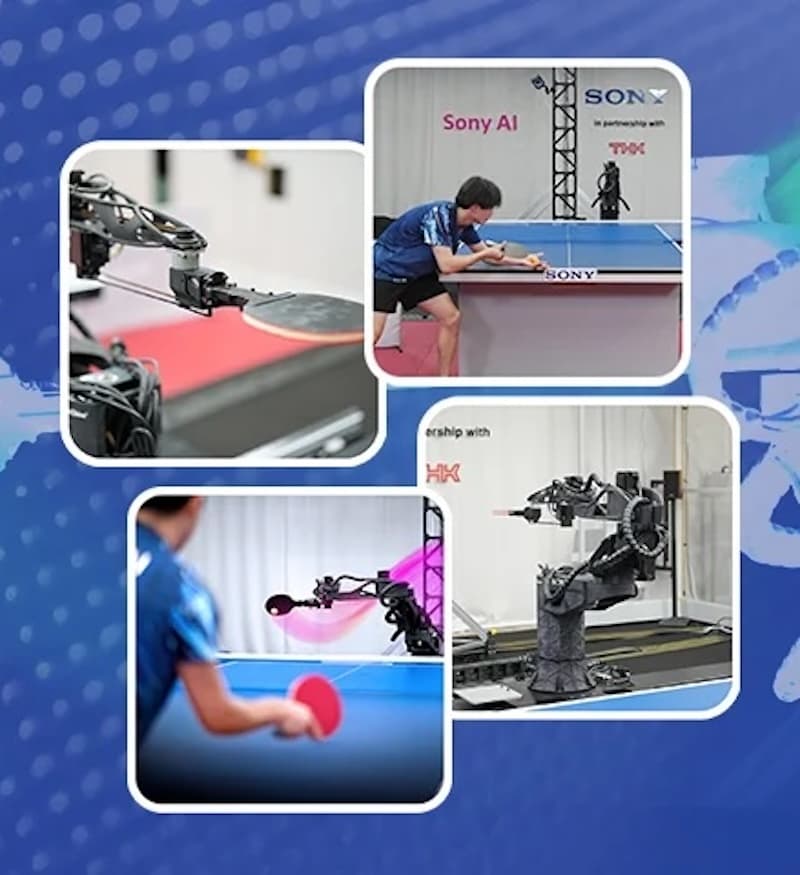
Sony AI's table tennis robot is more than a novelty — it represents a meaningful leap in physical AI research. By tackling the high-speed, dynamic challenges of table tennis, researchers are pushing the boundaries of robotic sensing, prediction, and real-time response, laying the groundwork for broader applications in logistics, healthcare, home service robots, and autonomous drones.
Highlights
- Sony AI's table tennis robot research targets core physical AI challenges including millisecond ball tracking, real-time motion planning, and opponent intent prediction.
- The system employs continuous learning, accumulating experience from every rally to iteratively improve its performance.
- Table tennis provides a high-frequency, quantifiable environment that rapidly generates large-scale perception–action paired data for AI training.
- Sony AI's approach differs from Omron's FORPHEUS and Kuka's exhibition robots by prioritizing generalizable, academically rigorous AI breakthroughs over demonstration performances.
- Technologies developed through this research have direct transfer value for logistics automation, medical robotics, home service robots, and autonomous drone obstacle avoidance.
To some observers, a robot that can play table tennis might still seem like a flashy tech gimmick — particularly given that companies such as Omron and Kuka have demonstrated similar systems before. After all, industrial robots have long been capable of assembling cars, sorting packages, and welding metal with remarkable precision.
Yet for researchers working at the intersection of robotics and artificial intelligence, table tennis represents one of the most demanding test environments available today.
Why Table Tennis Matters for AI
Table tennis is defined by extreme dynamic complexity: balls travel at high speed, spin varies widely, landing positions are difficult to predict, and no two rallies are exactly alike. These characteristics make the sport an ideal proving ground for Physical AI — the capability for AI systems to not only compute in the digital realm, but to perceive, interpret, and respond in real time to the physical world.
This is precisely the critical bottleneck preventing robots from moving out of factories and into everyday life.
Sony AI's Technical Breakthroughs
Sony AI's table tennis robot research focuses on several core technical challenges:
- High-speed visual sensing: The system must track a fast-moving ball within milliseconds, accurately calculating its trajectory and spin state.
- Real-time decision-making and motion planning: The AI must determine the optimal return angle, force, and timing within an extremely short window, then transmit commands to the robotic arm for execution.
- Opponent behavior prediction: More advanced iterations of the system go beyond passive reaction, anticipating the opponent's intended shot before it is made.
- Continuous learning: The robot accumulates experience from every rally, iteratively refining and improving its own performance.
From the Table to Broader Applications
These capabilities extend well beyond competitive sport. Mastering the tracking of high-speed dynamic objects and enabling real-time response has direct technology transfer value for future logistics automation, medical assistance robots, home service robots, and autonomous drone obstacle avoidance.
Researchers argue that table tennis offers a high-frequency, quantifiable training and testing environment that rapidly generates large volumes of perception–action paired data — data that is critical for training more generalizable AI models for the physical world.
Comparison with Earlier Work
Omron's FORPHEUS table tennis robot has appeared at exhibitions multiple times since 2013, and Kuka previously demonstrated a robotic arm competing against a table tennis world champion. Sony AI's research, however, places greater emphasis on academic-level technical breakthroughs and generalizable AI capabilities, rather than purely demonstrative performances.
As physical AI emerges as the next major battleground for the global robotics industry, Sony AI's sustained investment in table tennis research may yet prove to be a source of distinctive competitive advantage in the race ahead.
原文來源: 查看原文
FAQ
Reviewed and published by the LAETimes editorial desk ·