Russia's Su-57 Felon Spotted with Unusual Weapons Load, Possibly Configured for Anti-Drone and Cruise Missile Defense
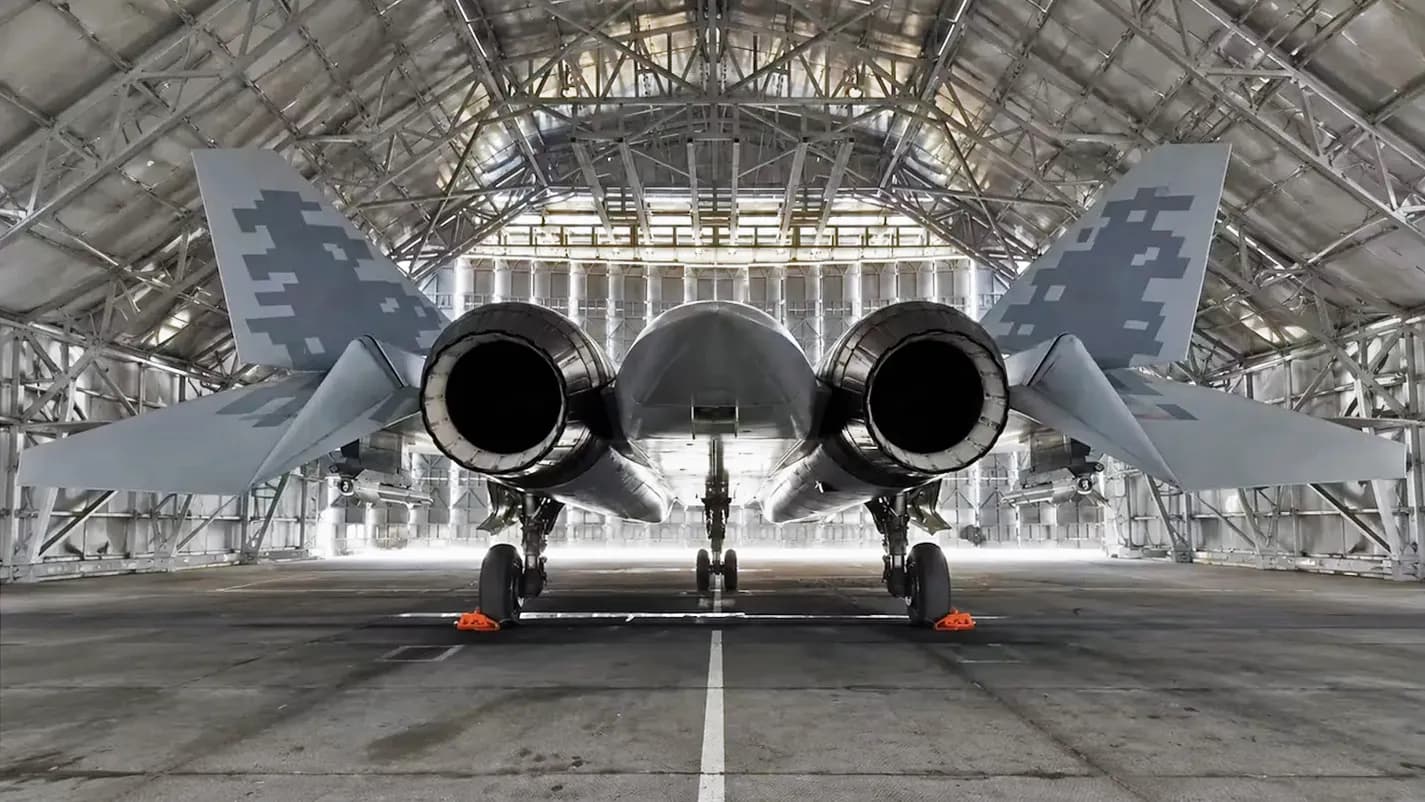
Newly leaked photographs show a Russian Su-57 Felon fighter jet carrying R-73/R-74 short-range air-to-air missiles on external pylons — an unusual configuration for a stealth aircraft with internal weapons bays — along with an unidentified targeting pod. Military analysts suggest the loadout points to an anti-drone and cruise missile interception role, as Ukraine continues its intensifying long-range drone and missile strikes deep into Russian territory.
Highlights
- Leaked photos show a Russian Su-57 Felon carrying R-73/R-74 short-range air-to-air missiles on external pylons — an unusual configuration for a stealth aircraft with internal weapons bays.
- An unidentified targeting pod was also visible beneath the aircraft's left engine nacelle, differing in profile from the known 101KS-N targeting pod.
- Military analysts interpret the loadout as indicating an anti-drone and cruise missile interception role, responding to Ukraine's intensifying long-range strikes deep into Russian territory.
- The photos are believed to have been taken at Akhtubinsk airfield in Astrakhan Oblast, over 350 miles from the front lines — a base that was itself struck by a Ukrainian drone in June 2024.
- Russia had only approximately nine production Su-57s in service as of early 2023, making the Felon a scarce high-value asset rarely risked in direct combat roles.
Russia's Su-57 Felon Spotted with Unusual Weapons Load, Possibly Configured for Anti-Drone and Cruise Missile Defense
Recently leaked photographs show a Russian Sukhoi Su-57 Felon carrying short-range air-to-air missiles on external pylons alongside what appears to be a previously unseen targeting pod — a configuration that may offer the first close-up look at an Su-57 equipped for anti-drone and cruise missile defense operations.
What the Photos Show
Two photographs of unknown origin show the Su-57 carrying a pair of R-73/R-74 (NATO designation: AA-11 Archer) short-range air-to-air missiles on underwing pylons. One of the images also reveals a mysterious targeting pod mounted beneath the left engine nacelle.
Both photos were taken from the rear of the aircraft inside a large aircraft shelter. One image reportedly first surfaced on TikTok and appeared to show teenagers posing with the jet — one of them seated in the cockpit — suggesting some form of unofficial access to the aircraft.
The images subsequently circulated widely on Russian social media, with Russian military bloggers interpreting the configuration as evidence that the Su-57 has been assigned to hunt and intercept Ukrainian drones.
Weapons Configuration Analysis
While the anti-drone interpretation is plausible, other explanations — such as a weapons test — cannot be ruled out. Notably, it is unusual for the Su-57 to carry short-range air-to-air missiles on external pylons in either operational or other contexts, given that the aircraft has dedicated internal weapons bays for this purpose.
Regardless of intent, the configuration is optimized for short-range engagements — precisely the kind needed to track and intercept Ukrainian long-range one-way attack drones and the growing threat of cruise missiles.
The large hangar structure visible in the photos is consistent with shelters built at Akhtubinsk airfield in Russia's Astrakhan Oblast, located more than 350 miles (approximately 560 km) from the front lines. In June 2024, Akhtubinsk was struck by a Ukrainian drone attack that is believed to have heavily damaged or destroyed an Su-57 parked in the open. Russia subsequently undertook a significant shelter-construction program to protect assets at the base, including long-range bomber units.
The Su-57's Strategic Role
The Su-57 is a highly valuable but scarce asset in the Russian Aerospace Forces (VKS). As of early 2023, Russia had only approximately nine production-standard Su-57s in service, along with fewer than twelve pre-production and prototype airframes with limited operational capability. While the fleet has since grown, Russia continues to prioritize the less costly and less complex Su-35S Flanker.
The UK Ministry of Defence has stated that the Su-57 has been deployed in the Ukraine conflict "at least since June 2022," primarily in a standoff strike role that keeps the aircraft out of Ukrainian airspace. The Su-57 also has formidable air-to-air capabilities, including the R-37M (AA-13 Axehead) with a range of up to 124 miles (approximately 200 km), and the R-77-1 (AA-12 Adder) with a range of approximately 68 miles (approximately 110 km).
Advanced Sensor Suite
The Su-57 is the only aircraft in active Russian service equipped with an Active Electronically Scanned Array (AESA) radar. Its N036 radar integrates five independent AESA arrays and is paired with the 101KS electro-optical suite, the N036Sh IFF (Identification Friend or Foe) system, and the L402 electronic countermeasures suite.
AESA radar offers significant advantages against drones and cruise missiles, enabling target tracking at greater ranges and with higher accuracy against low-radar-cross-section and very low-altitude targets.
The passive 101KS electro-optical suite includes an Infrared Search and Track (IRST) sensor, four ultraviolet missile approach warning sensors, and a directional infrared countermeasures turret — capabilities well-suited to anti-drone and cruise missile interception, analogous to the pod-mounted infrared sensors used by U.S. fighter aircraft for similar missions.
The Mystery Pod
The pod visible in the photographs differs in its rear profile from the standard 101KS-N targeting pod. It remains unclear whether this is a new variant or a version optimized for air-to-air operations. Russia has been reported to be developing laser-guided rockets for air-to-air engagements — a low-cost counter-drone solution similar to the U.S. 70mm APKWS II — but no evidence of operational deployment has emerged, making the R-73/R-74 the most cost-effective intercept option currently available.
The Su-57 is also equipped with a 30mm single-barrel cannon at the right wing root, with 150 rounds of ammunition. While theoretically usable against drones, intercepting slow, low-flying unmanned aircraft with a fighter's gun is extremely difficult in practice, and the limited ammunition supply further reduces its practicality.
Russia's Mounting Air Defense Challenges
Ukraine has sustained an intensifying campaign of deep strikes against targets inside Russia, including oil refineries, weapons manufacturing facilities, and key military installations. Last month's large-scale daytime drone and cruise missile attack on Moscow — in which multiple aircraft struck targets across the capital — was assessed as one of the most significant such attacks of the conflict to date.
Russia's existing air defense architecture, ranging from S-400 long-range surface-to-air missile systems to Pantsir short-range air defense units deployed on rooftops, has struggled to keep pace with Ukraine's expanding long-range strike capabilities. The increasing use of cruise missiles capable of carrying heavy warheads has further strained Russian ground-based air defenses.
Russian fighter aircraft are already known to play a role in the broader defensive effort — combat air patrols have been maintained at Engels bomber base, for example. The prospect of the sensor-rich Su-57 being integrated into these lower-intensity defensive missions is now drawing growing attention from analysts.
Source: The War Zone (TWZ) Contact: thomas@thewarzone.com
原文來源: 查看原文
FAQ
Reviewed and published by the LAETimes editorial desk ·