Russia's T-72B3A Tank Has One Job: Survive Ukraine's Drone War
Russia has reportedly fielded the T-72B3A tank equipped with the Arena-M Active Protection System (APS), designed to intercept anti-tank missiles and FPV drones. However, experts question whether its 12-round interceptor magazine can handle mass drone attacks, suggesting the move may be more about public relations than battlefield effectiveness.
Highlights
- Russia has officially fielded the T-72B3A tank, which is nearly identical to its predecessor but adds the Arena-M Active Protection System for 360-degree defense against FPV drones and anti-tank missiles.
- Arena-M carries only 12 interceptor rounds total — two per 90-degree sector — raising serious doubts about its ability to withstand coordinated mass drone attacks.
- Units equipped with T-72B3A tanks have been deployed to a training ground in Russian-occupied Dnepropetrovsk Oblast, though the total number of vehicles fielded remains undisclosed.
- Russian military analyst Dimitry Kornev called Arena-M a potential first APS with full counter-drone capability, while Ukrainian armor experts dismissed the announcement as primarily a public relations exercise.
- Arena-M has been in development for decades but has not yet been tested under real combat conditions; its battlefield effectiveness against Ukraine's drone tactics remains unproven.
Russia's Tanks Receive a Major Upgrade
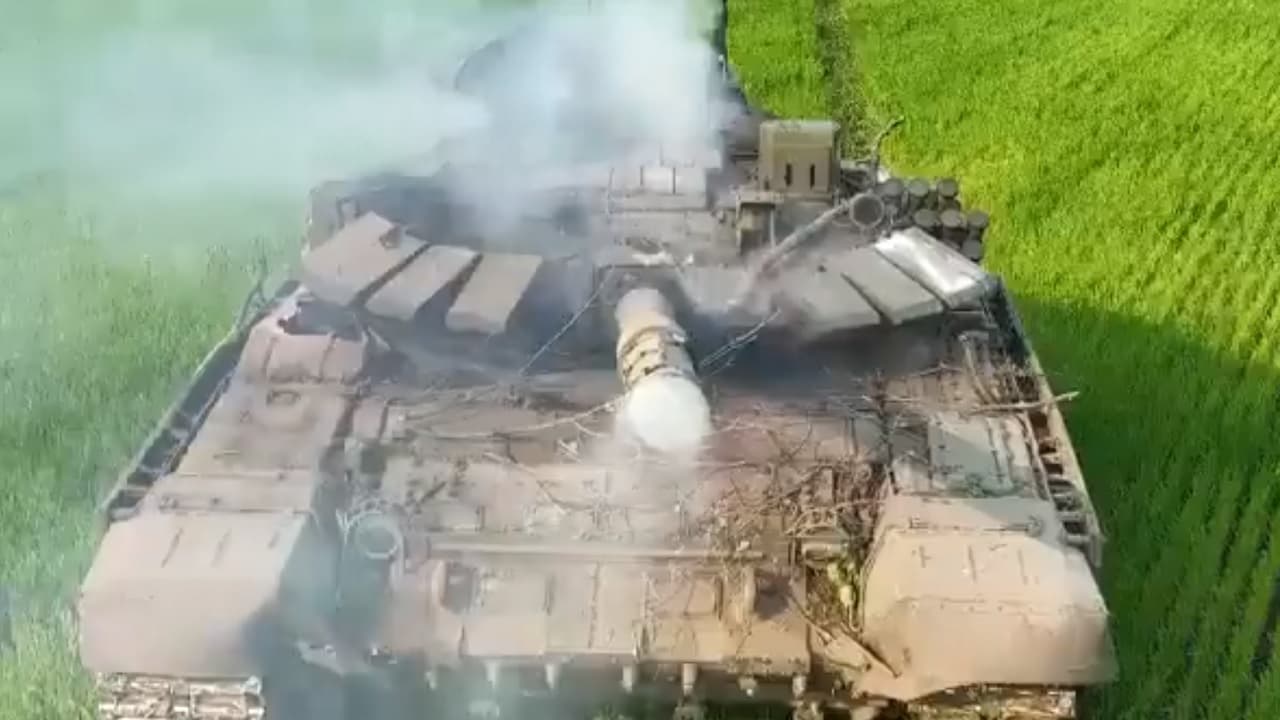
Russia's armed forces have officially fielded a new variant of the T-72 tank — the T-72B3A — according to Russian state news outlet Izvestia. The new tank is nearly identical to its predecessor, with one critical difference: it is fitted with the Arena-M Active Protection System (APS). Arena-M has been in development for decades, with only a handful of tanks previously receiving the system for trials. According to recent reports, the variant has now entered active service, and several units have been deployed to the Ukrainian theater. The news has drawn mixed reactions from armor experts, many of whom question whether the new APS will make a meaningful difference on the battlefield.
Some sources indicate the tanks have arrived at a training ground in Russian-occupied Dnepropetrovsk Oblast, where crews are familiarizing themselves with the APS-equipped vehicles. The exact number of T-72B3As currently in service remains unclear. Recent footage has also emerged showing more T-90M tanks undergoing trials with the Arena-M system fitted.
Russian military analyst Dimitry Kornev commented: "Arena-M has the potential to become the first APS with full counter-drone capability. Combat experience is allowing us to continuously improve it, and that work will continue." It is worth noting that Israel's Elbit Systems already demonstrated drone interception with its Iron Fist system some time ago, but the addition of Arena-M nonetheless represents a significant step forward for Russian armor — which has suffered heavily under Ukraine's drone offensive.
A Long-Delayed, Long-Awaited Active Protection System
The Arena-M APS features multiple launch units carrying a total of 12 interceptor rounds and provides 360-degree coverage. According to Russian specifications, the system is equipped with a multi-function Doppler radar capable of simultaneously tracking high-speed threats and low-flying, low-signature drones. Once the radar detects an incoming threat, the onboard computer calculates the projectile's speed and trajectory and fires a precision interceptor with a fragmentation warhead, destroying the threat before it reaches the tank. The system is theoretically capable of defeating top-attack threats such as the Javelin anti-tank missile and FPV drones.
Russia's development of the Arena system spans several decades. Active protection technology was first pursued by the Soviet Union, which produced both hard-kill and soft-kill APS variants — including the Drozd and Shtora-1 systems. Development stalled after the Cold War due to funding shortfalls. The Chechen Wars, during which Chechen fighters inflicted heavy losses on Russian armored vehicles with RPGs, reignited interest in protective systems. The first Arena variant, the Arena-E, was unveiled in the mid-1990s for the export market but was shelved after attracting little international interest.
In the 2000s, Russia pushed for an upgraded version capable of countering modern anti-tank missiles, including top-attack weapons like the Javelin and NLAW. The exact development timeline for Arena-M remains murky, but in 2023 — following the outbreak of the war in Ukraine — the Russian military announced it would begin fitting T-72 and T-90 series tanks with the upgraded APS. By that point, the threat from small drones had grown considerably, and Arena-M's schedule may have been delayed further as engineers worked to tune the system against the latest threats emerging on the Ukrainian battlefield.
Too Little, Too Late?
Skepticism about the Arena-M's prospects remains widespread. Ukrainian armor analyst and X (Twitter) user "AndreiBtvt" noted: "This increasingly looks like a PR exercise to cover up the fact that Russian tanks are completely failing to perform their battlefield role." His core criticism centers on the system's limited interceptor magazine, which he argues is insufficient for sustained combat. With only 12 rounds total — just two per 90-degree coverage sector — Arena-M would be rapidly overwhelmed by a coordinated multi-drone attack from a single direction. The system has also yet to be tested under real combat conditions, making it premature to judge whether it will live up to its advertised performance.
To be fair, limited interceptor capacity is not a problem unique to Arena-M — virtually every active protection system in service faces the same constraint. The Iron Fist system planned for integration on the M1E3 Abrams carries just four interceptors before requiring a reload. APS technology is not intended to make tanks invulnerable; rather, it is designed to improve overall survivability — a benefit that still justifies the investment.
The real test for Arena-M will come when these tanks reach the front line and face their first FPV drone. Only then will it become clear whether the system delivers genuine battlefield value — or whether it represents yet another expensive, time-consuming experiment that fell short of expectations.
原文來源: 查看原文
FAQ
Newsletter
Subscribe to our Low-Altitude Industry Newsletter
Daily curated news on low-altitude economy and drone industry, delivered to your inbox.
Reviewed and published by the LAETimes editorial desk ·