Teledyne FLIR Unveils Black Recon: A Vehicle-Mounted Autonomous Micro-Drone System Requiring No Dismount
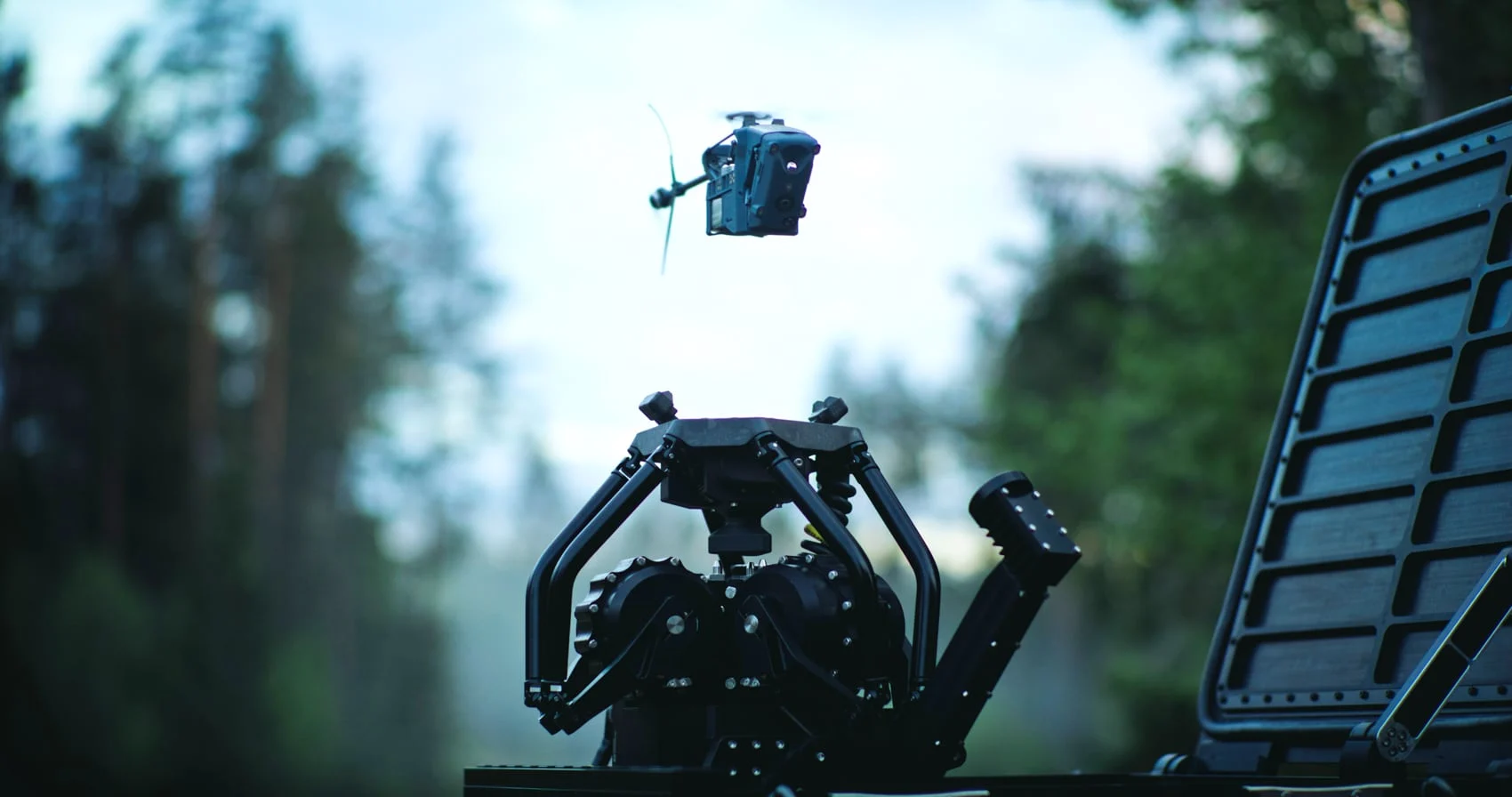
Teledyne FLIR Defense officially revealed the Black Recon at Eurosatory on June 15 — billed as the first vehicle-mounted micro-UAS capable of fully autonomous launch, recovery, and recharging without crew dismount. Three drones rotate through a shared docking station for continuous surveillance. Each drone weighs under 450 g, flies 50–60 minutes per charge, and operates in GNSS-denied environments. Deliveries are expected from 2027, with orders now open.
Highlights
- Teledyne FLIR Defense unveiled the Black Recon at Eurosatory on June 15, 2025, billing it as the first vehicle-mounted micro-UAS with fully autonomous launch, recovery, and recharging requiring no crew dismount.
- The system uses three drones under 450 g each, rotating through a shared docking station to deliver continuous aerial surveillance with 50–60 minutes of endurance per aircraft.
- Black Recon operates in GNSS-denied environments via Visual Inertial Navigation (VIN) and supports RF-silent missions, addressing electronic warfare threats seen in the Ukraine conflict.
- A 100 g optional payload slot supports CBRN sensors, extended ISR payloads, and a disclosed lethal module option, positioning the platform beyond pure reconnaissance.
- Deliveries are scheduled from 2027 with orders now open; pricing has not been publicly disclosed and will be discussed directly with customers.
Teledyne FLIR Defense officially unveiled the Black Recon at the Eurosatory defense exhibition on June 15, positioning it as the industry's first vehicle-mounted micro-UAS capable of fully autonomous launch, recovery, and recharging — with no requirement for crew to exit the vehicle. Three drones share a single docking station and rotate through continuous duty cycles, delivering persistent aerial surveillance. Each aircraft weighs under 450 g (15.9 oz) and achieves 50–60 minutes of flight time per charge. Deliveries are scheduled to begin in 2027, and the system is now open for orders.
Three Drones, One Vehicle, Persistent Coverage
The central selling point of Black Recon is that operators can conduct aerial reconnaissance without ever exposing themselves outside the vehicle. The docking station manages the entire flight cycle: one drone launches and assumes a surveillance position; when its battery is depleted, it returns and begins charging automatically while the next drone takes over. With three aircraft rotating in sequence, the system provides uninterrupted aerial coverage of convoys or fixed positions.
This rotation model fundamentally changes the operational logic for small reconnaissance teams. Traditionally, a two-person crew would have one soldier driving while the other dismounted to set up and manually operate a drone. Black Recon reduces that entire process to pressing a single button from inside the cab.
The ability to launch without dismounting adds a layer of concealment and provides meaningful force protection for crew members. A robotic arm handles repositioning of the drones automatically — operators do not need to physically handle any aircraft.
Breaking Down the Sub-450 g Specification
Each drone in the Black Recon system weighs under 450 g (15.9 oz). The published cruise endurance is 50–60 minutes per battery, with a top speed of 25 m/s (56 mph / 90 km/h). The aircraft ships with both a thermal imager and a visible-light camera as standard, and includes an onboard relay capability that can extend communications range beyond the line of sight of a single aircraft.
Teledyne FLIR has also reserved a 100 g (3.5 oz) payload slot for optional mission modules. Publicly disclosed candidates include a CBRN (chemical, biological, radiological, and nuclear) sensor, an extended-range ISR payload, and a lethal module. That final entry warrants attention. Read that combination — vehicle-mounted, autonomous, 25 m/s, sub-450 g, lethal module — and what emerges is a product that closely mirrors the tactical playbook for small loitering munitions written on the battlefields of Ukraine over the past three years.
Range, precise thermal sensor specifications, and unit pricing were not disclosed at launch; Teledyne FLIR has reserved those details for direct customer discussions.
GNSS-Denied and RF-Silent Operations
The specification most likely to capture procurement officers' attention is the drone's ability to operate in GNSS-denied environments. Black Recon uses Visual Inertial Navigation (VIN), combining onboard cameras and an inertial measurement unit (IMU) to maintain position tracking without any satellite signal input. The same architecture supports RF-silent missions, allowing the drone to execute surveillance loops without continuously broadcasting to the operator — transmitting only when there is something actionable to report.
That specification reads like a product brief written after observing three years of Russian and Ukrainian electronic warfare units jamming each other. Any micro-drone entering the market in 2027 without GNSS-denied capability would be shipping into a market that has already moved past it.
Teledyne is not repeating Nikon's mistake — Nikon entered the mirrorless camera market years after Sony had already established dominance, ultimately having to acquire RED to secure a foothold. Teledyne clearly understands what competitive landscape it is operating in. This is also not a first-generation product; early iterations from five years ago were far behind current technical standards, making this iteration a genuinely notable step forward.
Differentiation from the Black Hornet 4
As reported by Reflector, Black Recon is not intended to replace the Black Hornet 4 — it sits one tier above it. The Black Hornet 4 is a 70 g nano-drone designed for infantry to pull from a vest pocket and use to peek around the next corner.
The Black Hornet 4 is hand-launched, short-range, and individual-soldier equipment. The Black Recon occupies the vehicle tier of the same operational ecosystem: larger, longer-endurance, autonomous, and designed to give mounted crews persistent aerial surveillance support from inside their vehicle.
Teledyne FLIR is marketing the two as complementary solutions. A patrol can mount a Black Recon docking station on a vehicle while distributing Black Hornets among dismounted infantry. When the convoy halts, Black Recon handles perimeter surveillance; when a squad enters a building, Black Hornet executes room-by-room clearing support. The vendor is betting on a market logic in which militaries prefer a single supplier to cover both tiers.
Editorial Perspective
Black Recon is the first product unveiled this year that, in this editor's view, seriously incorporates lessons from the Ukrainian battlefield and repackages them for conventional military procurement processes.
GNSS-denied flight, autonomous recovery, vehicle-mounted docking, three-drone rotation, and a reserved lethal payload slot — this is not simply a reconnaissance drone. It is a small loitering munition platform that ships in reconnaissance configuration first, a sequencing that likely simplifies export documentation and regulatory clearance.
Eurosatory was the right stage for this announcement. European defense budgets have unlocked more significantly than at any point since the Cold War, and buyers in attendance have spent the past year actively pursuing exactly this kind of capability package. A 2027 delivery timeline signals that the production line is already in motion, not aspirational.
Military technology has historically filtered down into civilian applications — this is not a prediction but a pattern traceable across every decade of the past century. Announcements like this one will reshape what civilian drones look like in terms of size and capability over the next ten years.
Ultimate pricing will reveal the true target customer. If Black Recon's per-unit cost lands in the same range as the Black Hornet 4, it is a tool for small teams and patrols. If pricing aligns more closely with tactical munitions such as the Switchblade family, then the lethal module is not an accessory — it is the point.
Teledyne FLIR has not indicated which way it will go. The contracts signed in the next six months will speak for them.
Image credit: Teledyne FLIR
原文來源: 查看原文
FAQ
Reviewed and published by the LAETimes editorial desk ·