Control a DJI Tello With Your Mind: Open-Source Brain-Computer Interface Lets Drones Respond to Thought
Open-source biosensing company Upside Down Labs has built a real-time brain-computer interface (BCI) that flies a Ryze Tello drone using EEG brainwave, EMG muscle, and EOG eye-movement signals. Powered by the Neuro PlayGround Lite board and fully open-source hardware and software, the entire system costs less than a mid-range DJI battery and is aimed primarily at neuroscience education.
Highlights
- Upside Down Labs built an open-source BCI using EEG, EMG, and EOG signals to fly a Ryze Tello drone over Wi-Fi, with total hardware costs below the price of a mid-range DJI battery.
- The system's core sensor, the BioAmp EXG Pill, measures just 25.4 × 10.0 mm and reads biopotential signals cleanly even in AC power-line noise environments.
- The Neuro PlayGround Lite board processes all three biosignal channels, filters noise, detects command thresholds, and issues flight commands using the standard Tello SDK protocol.
- The Ryze Tello — weighing approximately 80 g and co-developed by Ryze, DJI, and Intel — was chosen for its open Wi-Fi command set and safe, lightweight indoor form factor.
- The project is positioned as a neuroscience education platform; the open-source biosignal pipeline has direct applications in assistive technology such as hands-free wheelchair and cursor control.
Open-source biosensing company Upside Down Labs has built a real-time brain-computer interface (BCI) capable of piloting a Ryze Tello drone through direct human biosignal input.
Image credit: Aman Maheshwari
The system uses the company's Neuro PlayGround Lite board to capture EEG brain activity, EMG muscle activity, and EOG eye-movement signals, translating them into flight commands transmitted to the drone over Wi-Fi. The entire project — hardware and software alike — is fully open-source, with complete documentation enabling anyone to replicate the build.
No traditional controller is required at any point. The pilot wears electrode patches and the Tello responds to arm movements or eye shifts. This is a research demonstration project, not a commercial product, and the total component cost comes in at less than the price of a mid-range DJI battery.
The System Is Built on Low-Cost, Open-Source Biosensors
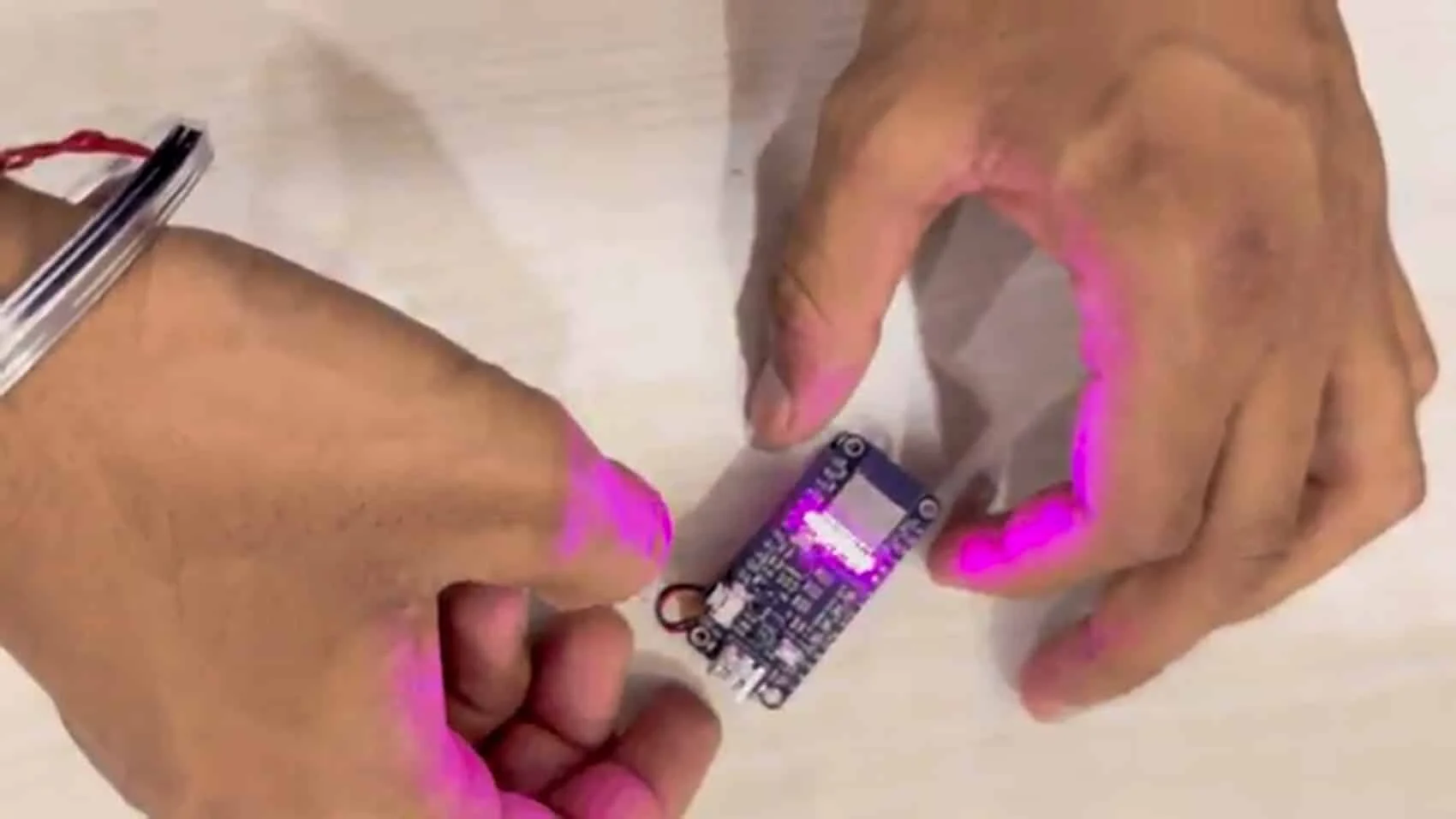
As reported by Hackster.io, the core of the system is the BioAmp EXG Pill — a biopotential signal board measuring just 25.4 × 10.0 mm (1.0 × 0.4 in). Despite its small footprint, it reads the body's electrical activity cleanly even in the presence of AC power-line noise, which is the Achilles' heel of most budget sensors.
Image credit: Aman Maheshwari
The EXG Pill ships pre-configured for EEG and EOG modes. Capturing clean EMG or ECG signals requires one manual step: soldering a specific node on the board to reconfigure the front-end circuit. That detail marks it as a maker tool rather than a sealed consumer device. It is compatible with virtually any microcontroller that has an analog input, including the Arduino Nano and Raspberry Pi Pico.
Image credit: Aman Maheshwari
In this project, the EXG Pill feeds into the Neuro PlayGround Lite — Upside Down Labs' microcontroller board designed specifically for biosignal experimentation. The NPG Lite handles signal acquisition and processing, then pushes commands to the Tello over Wi-Fi. Electrodes on the scalp capture EEG, electrodes on the forearm capture EMG, and a reference electrode maintains a stable baseline to keep the noise floor readable.
Image credit: Aman Maheshwari
The entire stack is vendor-lock-free. Schematics and firmware are publicly available, meaning any hobbyist with a soldering iron and a Tello can recreate the system at home.
How Brainwaves and Muscle Signals Become Flight Commands
The interface reads three distinct biosignals, treating each as a separate input channel. EEG tracks electrical activity patterns in the brain; EMG tracks voltage spikes produced by muscle contractions; and EOG tracks eye movement by measuring the small charge differential across either side of the eyeball.
The NPG Lite filters noise from each signal and monitors for thresholds that correspond to specific commands. A deliberate muscle contraction triggers one action; an eye movement triggers another. The board then issues the corresponding command to the Tello over Wi-Fi — using the same communication channel as the official Tello app.
Latency and reliability are the hard parts of any BCI demonstration. Biosignals are inherently messy, and converting noisy analog spikes into a clean takeoff command is the real engineering challenge — not the flight control itself. Upside Down Labs positions this as an educational platform for learning that signal-processing pipeline, rather than a mature flight system trustworthy enough for use over crowds.
Why the Ryze Tello Is the Right Drone for This Application
The Tello is a budget drone co-developed by Ryze, DJI, and Intel, and it has become a popular choice for this type of experiment for several reasons. It weighs approximately 80 g (2.8 oz), is affordably priced, and ships with a well-documented SDK that accepts simple text commands over Wi-Fi.
Image credit: Aman Maheshwari
That open command set is the key. Developers can send takeoff or directional commands to the Tello from any device on the network — which is exactly what the BCI receiver side needs. The drone itself does not care whether the command originated from a smartphone or a microcontroller reading forearm signals.
A heavier camera drone would raise the risk profile considerably. The Tello's lightweight design and indoor-friendly size make it a safe sandbox for an input method that still produces occasional false triggers.
The Real Value Is Accessibility and Education
Strip away the novelty factor and the project's genuine value is educational. Upside Down Labs designs these boards for neuroscience education and sells DIY kits that guide students through recording their own biosignals. The drone is simply a compelling entry point.
The project gives students a complete, documented path — from raw biosignal to physical action — that mirrors the same technology chain underlying prosthetics and clinical BCI research. Making a drone take off is just the flashy demo that keeps younger learners engaged.
An accessibility thread runs through the entire project. An input system that can command a drone using EMG and EOG signals is, in a different form, a system that could command a wheelchair or move a cursor for someone without the use of their hands. Open-sourcing the full technology stack means labs worldwide can build on it without licensing fees.
DroneXL Perspective
Controlling a drone with brainwaves sounds like clickbait, and as a flying machine it largely is. The Tello here is the hook that gets people through the door; the real substance is the underlying open-source biosignal processing pipeline, which is worth paying attention to even if you never intend to put on electrode patches yourself.
This educational project is off to a strong start. It is not the first mind-controlled drone ever built, and there is plenty of room for refinement. What is genuinely appealing is the on-ramp it provides for students: a low-cost, well-documented entry point into both the drone world and hands-on engineering.
The question worth watching is whether open-source biosignal boards can continue getting cheaper and faster. Today it is a demonstration; the same pipeline, once refined, may well continue appearing in assistive technology and hands-free control long after the hype has faded.
Image credit: Upside Down Labs
原文來源: 查看原文
FAQ
Reviewed and published by the LAETimes editorial desk ·


