Thales Acquires Exail Technologies to Dominate Autonomous Underwater Warfare
French defense giant Thales has signed a binding agreement to acquire the Gorgé family's stake in Exail Technologies and launch a full tender offer. The merger integrates complementary capabilities in unmanned mine countermeasures, autonomous anti-submarine warfare, and inertial navigation. The initial phase is expected to close in Q3 2027, with full integration targeted for early 2028.
Highlights
- Thales has signed a binding agreement to acquire the Gorgé family's stake in Exail Technologies, with the initial transaction phase expected to close in Q3 2027 and full integration in early 2028.
- The merger combines Thales' sonar suites and C2 systems with Exail's UMIS unmanned mine countermeasures platform and DriX USV, enabling a fully vertically integrated, turn-key unmanned MCM offering.
- Thales and Exail hold complementary optical gyroscope technologies — RLG and FOG respectively — giving the merged company a dual-technology inertial navigation portfolio spanning submarines, surface ships, guided munitions, and aerospace platforms.
- Exail's entire product line is ITAR-free, giving the combined Thales entity a competitive advantage in export markets and ensuring full operational sovereignty for European defense customers.
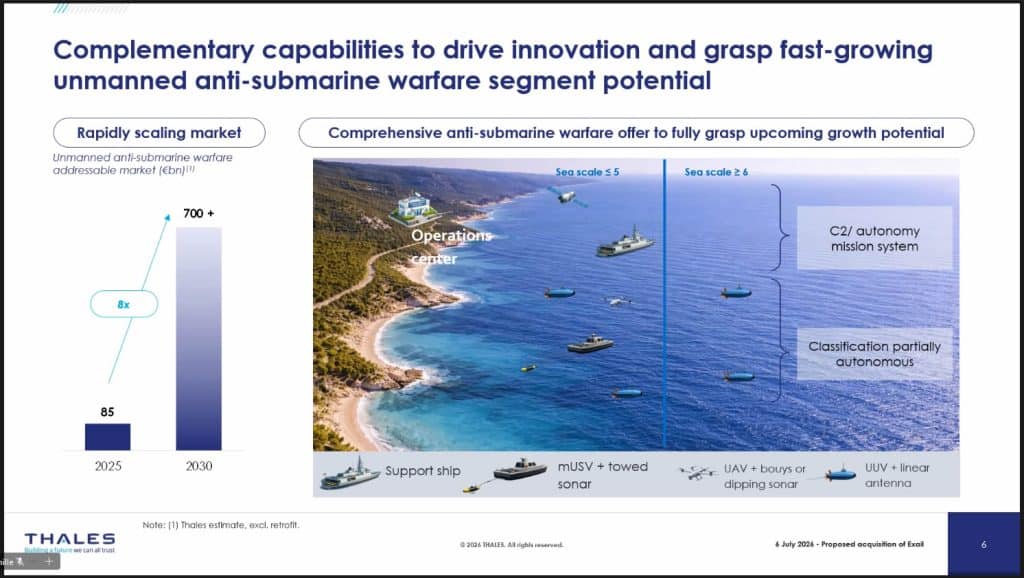
- Thales projects the unmanned ASW market will grow exponentially before 2030, and the acquisition positions the group to lead this segment by pairing world-class acoustic sensors with Exail's high-endurance autonomous surface and underwater vehicles.
French defense technology group Thales has announced it has signed a binding agreement to acquire the Gorgé family's stake in Exail Technologies, using that position as the basis for a full public tender offer. Beyond its considerable financial scale as a major defense industry transaction, the deal's deeper significance lies in the two companies' highly complementary operational capabilities and technologies — combining forces to lead in the fast-growing fields of autonomous mine countermeasures (MCM), unmanned anti-submarine warfare (ASW), and high-resilience inertial navigation.
Consolidating the Mine Countermeasures Market
The product portfolios of Thales and Exail demonstrate powerful synergies in unmanned surface systems. Exail has established itself as Europe's premier naval robotics vendor, particularly through its flagship UMIS (Unmanned Mine Countermeasures Integrated System). This complete ecosystem operates through a chain of autonomous assets — including the DriX unmanned surface vessel (USV), autonomous underwater vehicles (AUVs), and remotely operated vehicles (ROVs) — capable of detecting, classifying, and neutralizing seabed mines from a safe standoff distance.
Thales itself is already a prime systems integrator on major MCM programs, including the joint Franco-British MMCM (Maritime Mine Countermeasures) initiative. Integrating Exail's native robotic platforms with Thales' high-end sonar suites and command-and-control (C2) systems eliminates the architectural friction of cross-vendor interfaces, enabling Thales to offer fully autonomous, vertically integrated, turn-key unmanned MCM solutions to navies worldwide.
Complementary Navigation Technologies
Beyond robotics, the acquisition will also reshape the global high-precision naval navigation market. Modern naval defense relies heavily on resilient positioning, navigation, and timing (PNT) capabilities that function in GPS-denied or GPS-contested environments.
The two companies possess entirely complementary expertise in optical gyroscope technology:
- Thales: Long established around Ring Laser Gyroscope (RLG) technology.
- Exail: A global leader in Fiber Optic Gyroscope (FOG) systems, whose solid-state reliability and extreme precision are particularly suited to extended underwater operations.
By bringing RLG and FOG technologies under one roof, Thales effectively commands a dual-technology product portfolio spanning surface combatants, strategic submarines, guided munitions, and aerospace platforms.
Beyond mine warfare, the acquisition positions Thales to capitalize fully on the major market inflection point of unmanned ASW. According to Thales' estimates, the addressable market for unmanned ASW is projected to grow exponentially before 2030.
Focus on Autonomous Anti-Submarine Warfare
While mine warfare provides immediate industrial integration benefits, the long-term operational strategic implication of the deal centers on anti-submarine warfare. The rapid proliferation of quiet conventional submarines is forcing navies to turn to high-endurance unmanned vehicles to maintain maritime domain awareness.
Combining Thales' world-class underwater acoustic sensors, towed array sonars, and signal-processing algorithms with Exail's high-performance autonomous surface vehicles — such as the DriX — creates an ideal development environment for unmanned ASW. Through joint research in artificial intelligence and machine-to-machine autonomy, the merged entity will be capable of deploying persistent unmanned sensor networks across wide ocean areas to conduct submarine-hunting missions.
Both companies are also deeply invested in quantum sensor research. Incorporating Exail's advanced photonics and quantum technology capabilities into Thales' multi-billion-euro annual R&D ecosystem is expected to accelerate the development timeline for next-generation, jamming-resistant quantum navigation systems.
Strengthening European Technological Sovereignty
A notable aspect of this transaction is that Exail's entire product line is free from ITAR (International Traffic in Arms Regulations) restrictions. For Thales, maintaining a fully European-manufactured, ITAR-free supply chain in critical technology areas such as inertial navigation and marine robotics represents a significant competitive advantage. This not only ensures complete operational autonomy for European defense forces, but also streamlines export processes for customers worldwide seeking sovereign defense alternatives.
The transaction is expected to complete its initial phase in Q3 2027, with full integration targeted for early 2028. For the global naval defense market, this move sends a clear signal: Thales is doubling down on undersea warfare, integrating the sensors, autonomy, and navigation technologies required for the unmanned naval era — with ambitions to lead the emerging undersea revolution.
原文來源: 查看原文
FAQ
Newsletter
Subscribe to our Low-Altitude Industry Newsletter
Daily curated news on low-altitude economy and drone industry, delivered to your inbox.
Reviewed and published by the LAETimes editorial desk ·