Tytan Technologies Targets 3,000 Interceptor Drones Per Month as German Factory Set for August Launch
Munich-based counter-drone startup Tytan Technologies is preparing to open a new German manufacturing facility targeting 3,000 autonomous interceptor drones per month, with production set to begin in August. CEO Balázs Nagy confirmed the expansion to Defense News, citing sustained demand driven by the war in Ukraine, where the company's interceptors are already deployed by Ukrainian armed forces. Tytan claims its systems cost 200 times less than conventional air defense platforms, and plans to replicate the factory model in Poland and Hungary.
Highlights
- Tytan Technologies is opening a German factory in August 2025 with a target monthly output of 3,000 autonomous interceptor drones.
- CEO Balázs Nagy claims Tytan's systems protect the same airspace at 200 times lower cost than conventional air defense platforms.
- Tytan's EOS (multirotor, NATO Class I) and METIS (fixed-wing, NATO Class II) interceptors are already deployed by Ukrainian armed forces.
- Germany and the Baltic states are confirmed customers; Poland and Hungary are named as future factory replication sites.
- The German facility is designed as a replicable manufacturing blueprint, not merely a capacity expansion, to meet NATO eastern flank supply demands.
Munich-based counter-drone startup Tytan Technologies is actively preparing to open a new German manufacturing facility with a target monthly output of 3,000 autonomous interceptor drones, with production operations scheduled to begin in August.
![Photo credit: Tytan Technologies]
CEO and co-founder Balázs Nagy confirmed the expansion plan to Defense News, citing sustained market demand driven by the war in Ukraine. Tytan's interceptors are already deployed in active combat by Ukrainian armed forces as a low-cost solution against small aerial threats. Germany and the Baltic states have also been confirmed as customers.
Nagy was direct about the cost advantage: "What Tytan does is make the protection of the same airspace 200 times cheaper than traditional systems." He framed the company's direction as a shift away from expensive, difficult-to-scale hardware toward simplified hardware paired with sophisticated software that can be mass-produced — describing it as "a major paradigm shift."
Tytan's Dual-Platform Lineup Covers Two NATO Threat Categories
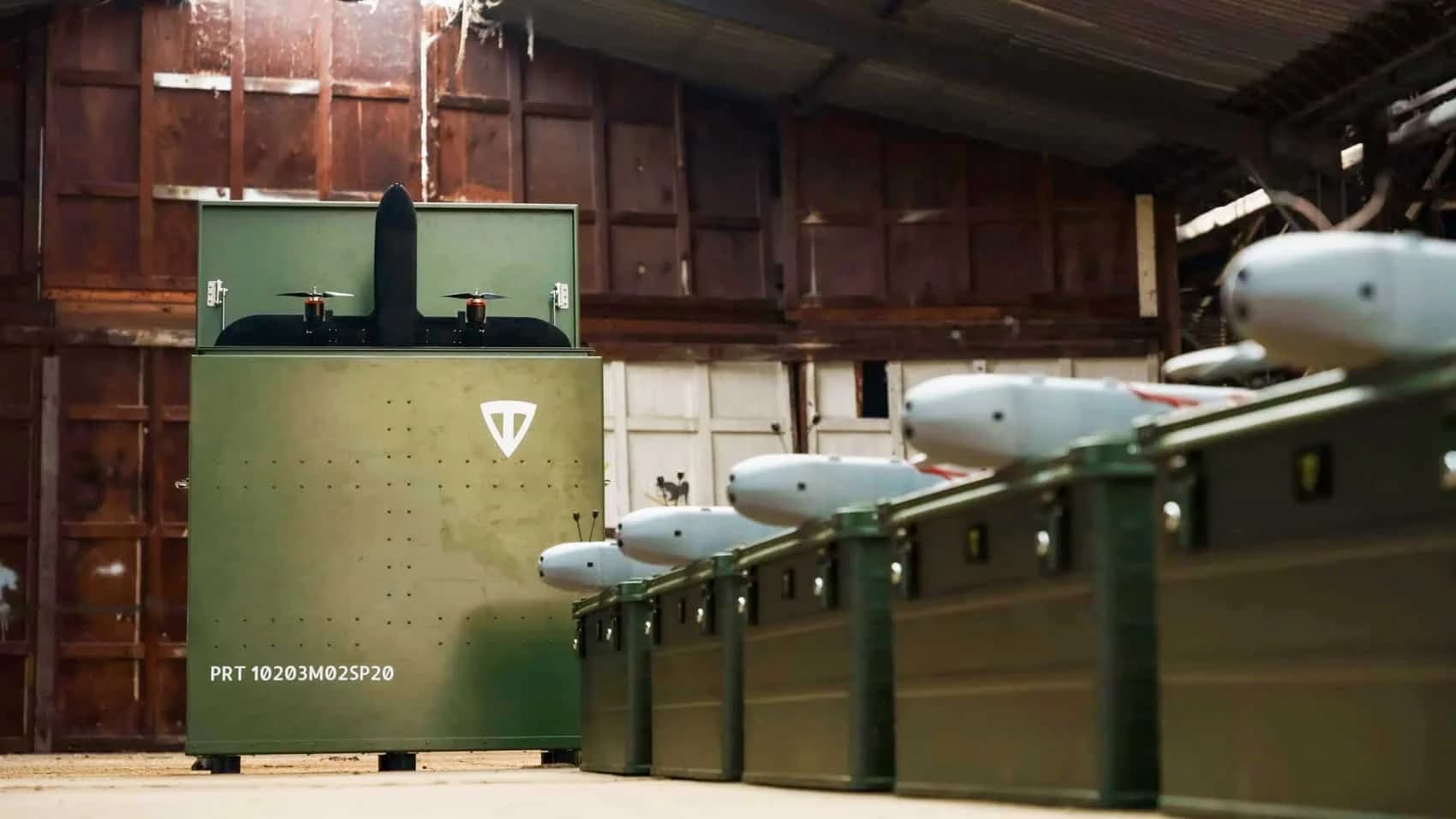
Tytan's current product line addresses two distinct threat categories as defined by NATO. EOS is a short-range multirotor interceptor designed to neutralize NATO Class I small drones — unmanned systems weighing under 150 kg (330 lbs).
METIS is a long-range fixed-wing interceptor built to engage NATO Class II drones — medium-range unmanned systems weighing between 150 and 600 kg (330 to 1,320 lbs).
![Photo credit: Tytan Technologies]
Both systems are autonomous and AI-enabled. Tytan did not disclose specific operational range, endurance, payload specifications, or unit pricing in its Defense News interview.
The dual-platform architecture reflects a deliberate engineering decision. A drone cruising at 4 km (13,000 ft) altitude presents an entirely different intercept problem from a target flying at 300 m (1,000 ft) — requiring different engagement geometry, intercept speeds, and kinetic energy profiles. A fixed-wing platform optimized for long-range missions is not the ideal tool for engaging fast, low-flying multirotor targets. Rather than attempting to cover all scenarios with a single platform, Tytan has developed dedicated systems for each threat class.
New Factory Is a Replicable Blueprint, Not Just a Capacity Expansion
As reported by Defense News, the upcoming German facility is positioned as more than a production scale-up. Nagy explicitly framed it as a replicable manufacturing model: "As we launch our larger new German factory, we have developed a blueprint that can be used to scale production in different regions," he told Defense News. Poland and Hungary have been named as potential future sites.
This is a deliberate manufacturing strategy: validate the factory model domestically, then replicate it within allied nations. The approach distributes supply chain risk, reduces logistical exposure, and positions Tytan to meet the localized production requirements increasingly demanded by European defense procurement.
If the 3,000-unit monthly target is met, it would represent a meaningful industrial scale for the counter-drone sector. Throughout the conflict, Ukrainian forces have consumed interceptors and counter-drone systems faster than most manufacturers have been able to supply.
Achieving that output from a single facility is not merely a commercial milestone — it is a core question for NATO's eastern flank strategic supply capacity.
Ukraine: The Battlefield Validation Conventional Systems Couldn't Deliver
Nagy addressed the lessons Ukraine has exposed in existing air defense architectures directly: "Conventional systems couldn't prove themselves in Ukraine. Larger platforms were destroyed by extremely cheap drones." The implication is that Tytan's own interceptors have passed tests that expensive legacy systems have not.
![Tytan Technologies CEO and co-founder Balázs Nagy / Photo credit: Tytan Technologies]
It is worth noting that this claim requires scrutiny. Tytan's Ukraine deployment has been confirmed by the company and Defense News, but no independent third-party assessment of its operational effectiveness — beyond original reporting — is currently available.
The "200 times cheaper" figure comes from Nagy himself, not from third-party analysis or government procurement documents. It is an executive's promotional claim, not a certified performance result.
That said, the broader trend underlying these claims is real. Just two days prior, Stark Defence closed a $570 million funding round led by Peter Thiel's Founders Fund and Sequoia, also citing Ukraine battlefield deployment as its primary credibility marker. Both companies are Munich-based, both point to the same conflict as their technology proving ground, and both identify scaling manufacturing as the next critical strategic bottleneck.
This is not a coincidence — it is the shared playbook among Europe's emerging defense tech players.
DroneXL Analysis
To be direct: 3,000 units per month is a target, not a fait accompli. The factory doesn't open until August, and until the production line is running and output is confirmed, this remains a planning figure from a company with every incentive to project ambition.
There are no independently verified performance numbers on the table. But the "200x cost differential" claim is worth watching. Field operating costs are high, and if a new entrant can genuinely undercut incumbents on cost structure — assuming that advantage holds at production scale — there is a real competitive angle against established players.
What is more credible is the manufacturing logic. Tytan is not just building a bigger factory; it is building a factory that can be copied. Poland and Hungary being named as follow-on sites is not arbitrary: both are NATO members, positioned on or near the eastern flank, with active defense procurement budgets and strong political incentives to host weapons production facilities. If Tytan delivers on the German factory on schedule, the "replicable blueprint" question could become reality as early as early 2027.
The August factory launch is the next observable milestone in this story. Watch for whether production actually begins on schedule, and whether the 3,000-unit monthly target is publicly confirmed after full production ramp-up. That will determine whether this corporate briefing becomes a meaningful data point — or stays on the slide deck indefinitely.
Photo credit: Tytan Technologies
原文來源: 查看原文
FAQ
Reviewed and published by the LAETimes editorial desk ·