Valour Consultancy Report: Over 6,500 Electric Air Taxis to Be in Operation Globally by 2050
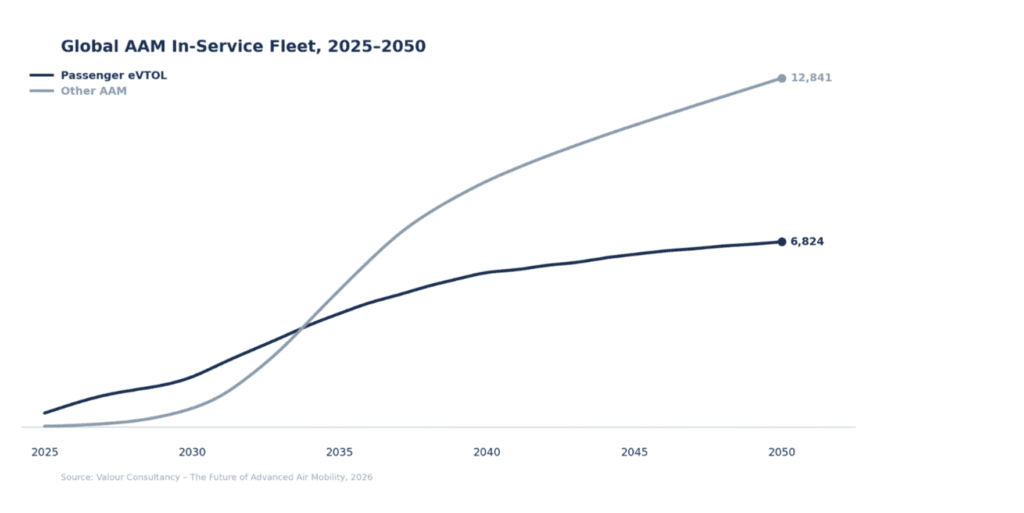
Market research firm Valour Consultancy forecasts that nearly 7,000 eVTOL air taxis will be in service globally by 2050, with China continuing to dominate the market. The report also predicts that the total global Advanced Air Mobility (AAM) fleet—including regional aviation, cargo drones, and specialized mission aircraft—will exceed 19,500 units.
Highlights
- Valour Consultancy forecasts nearly 7,000 eVTOL air taxis in global operation by 2050, with China accounting for the majority of deployments.
- The total global AAM fleet—including regional aviation, cargo drones, and specialized mission aircraft—is projected to exceed 19,500 units by 2050.
- China leads the passenger eVTOL market due to large-scale vertiport construction, government subsidies, and EHang's EH216-S receiving certification ahead of all overseas rivals.
- AutoFlight's CarryAll cargo drone has completed its first deliveries to customers for offshore cargo missions, signaling near-term commercial traction.
- Over half of the approximately 4,000 sub-50-seat aircraft globally are expected to retire before 2040, creating a natural replacement window for eCTOL aircraft.
Nearly 7,000 Electric Air Taxis to Fly by 2050, With China Maintaining a Clear Lead
Market research firm Valour Consultancy has published a new report forecasting that nearly 7,000 electric air taxis will be in operation worldwide by 2050—though the overall market scale is considerably more conservative than the optimistic projections of earlier years.
China Far Ahead; Western Deployments Concentrated in Megacities
Report author Craig Foster notes that outside of China, vertiport infrastructure is expected to remain heavily concentrated in Western megacities, where sufficiently high disposable incomes can sustain demand for such services. Valour's forecast holds that over the next 25 years, the global eVTOL fleet will be predominantly based in China.
"Landing fees are a significant component of cost per available seat mile (CASM), and combined with extremely expensive and frequently replaced batteries, potentially high insurance premiums, and pilot salaries, the long-touted 'Uber Black pricing model' still looks a long way off," Foster said.
He elaborated: "China is already building vertiports at scale—something that has not happened elsewhere. Add to that China's unique top-down, centrally directed approach, generous subsidies supporting the low-altitude economy, and the fact that EHang's autonomous EH216-S received certification far ahead of overseas rivals, and China leads every other nation in passenger eVTOL by a wide margin."
Regional Aviation and Cargo Drones Offer Greater Growth Potential
The report highlights that other segments of the Advanced Air Mobility (AAM) market may offer stronger growth prospects. Foster singles out Regional Air Mobility (RAM) as a particularly attractive commercial opportunity.
Cargo drones also present considerable near-term market potential, especially in industrial resupply operations—a segment currently served by crewed helicopters that are both costly and risky to operate at low altitudes. AutoFlight's CarryAll cargo drone has already completed its first deliveries, with initial customers ordering units for offshore cargo missions. Additional growth drivers include deliveries to remote and underserved communities, growing mid-range logistics demand, and the deployment of electric and hybrid-electric aircraft in specialized roles such as emergency medical services.
Natural Replacement Windows and Repurposing of Existing Airports
"Of the approximately 4,000 small aircraft globally with fewer than 50 seats, more than half are expected to retire before 2040, creating a natural replacement window that aligns well with the entry-into-service timelines of leading electric conventional take-off and landing (eCTOL) aircraft," Foster noted.
"Because many of these aircraft use hybrid-electric designs and can operate from tens of thousands of existing underutilized airports, the investment required in new ground infrastructure is significantly reduced."
Total Market: Over 19,500 Aircraft—But Far Below Early Hype
Taken together, the report paints a picture that goes well beyond the air taxi narrative alone—the story that attracted unprecedented investment over the past several years.
Valour's forecast projects that when regional aviation, cargo, and specialized mission aircraft are included, the global AAM fleet in service by 2050 will exceed 19,500 units.
The report's central conclusion is that these aircraft will largely complement—rather than replace—existing modes of transport such as helicopters and light jets. While a genuine market exists, its scale is far more measured than the wildly optimistic projections that characterized the SPAC boom of the early 2020s.
原文來源: 查看原文
FAQ
Newsletter
Subscribe to our Low-Altitude Industry Newsletter
Daily curated news on low-altitude economy and drone industry, delivered to your inbox.
Reviewed and published by the LAETimes editorial desk ·