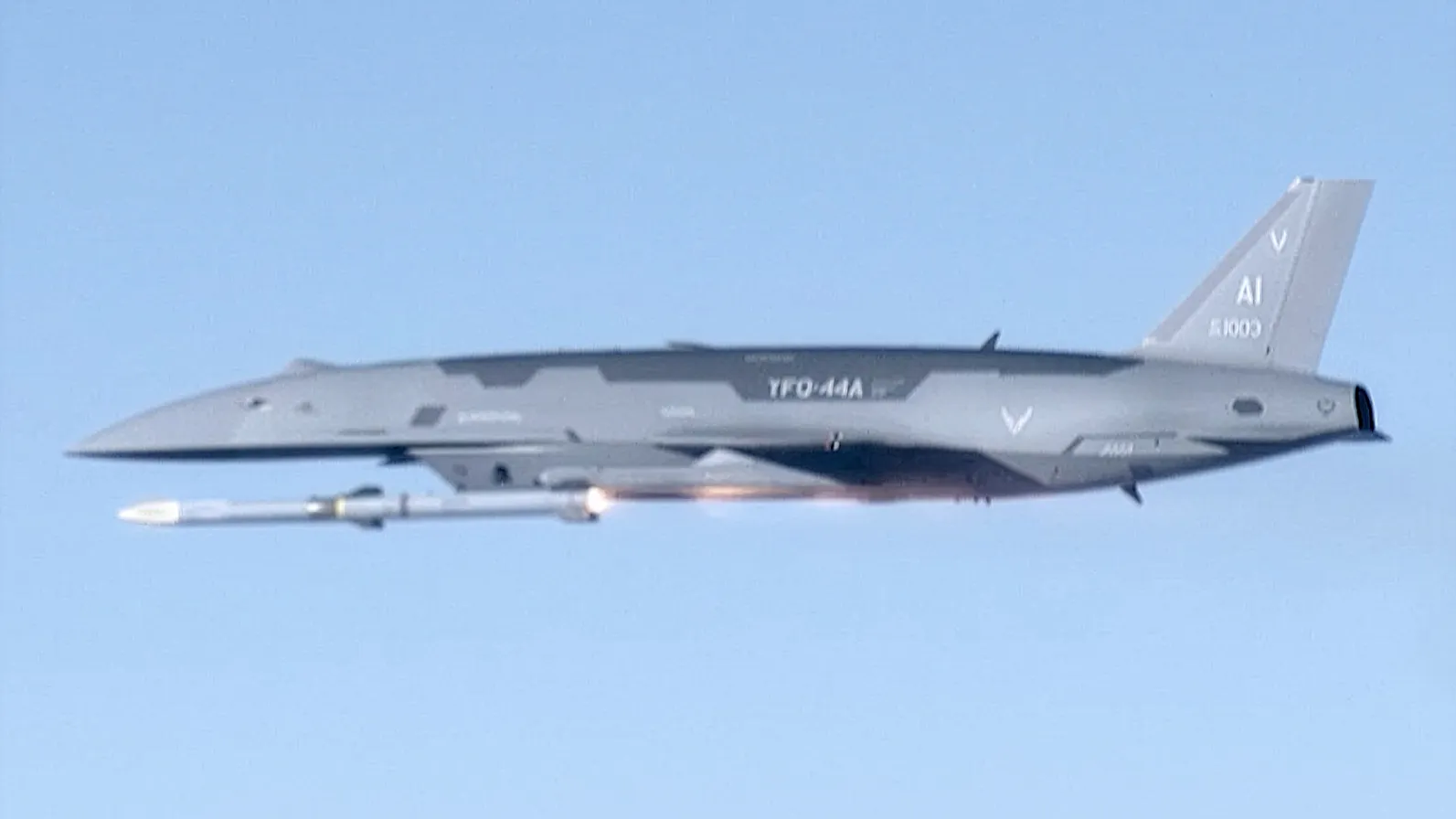
YFQ-44A Fury Completes First Live AIM-120 AMRAAM Missile Firing
Anduril's YFQ-44A Fury Collaborative Combat Aircraft (CCA) successfully fired a live AIM-120 Advanced Medium-Range Air-to-Air Missile (AMRAAM) at Edwards Air Force Base, California — marking the first live air-to-air missile launch by any U.S. CCA-type unmanned aircraft. The test represents a major milestone for the U.S. Air Force's CCA program, which has also placed production orders for both the YFQ-44A and General Atomics' YFQ-42A Dark Merlin.
Highlights
- Anduril's YFQ-44A Fury fired a live AIM-120 AMRAAM at Edwards Air Force Base, marking the first live air-to-air missile launch from any U.S. Collaborative Combat Aircraft (CCA).
- The test was conducted in restricted airspace over the Mojave Desert; Anduril's Lattice software received target track data and the aircraft fired on operator command.
- The U.S. Air Force has issued Increment 1 production orders for both the YFQ-44A Fury and General Atomics' YFQ-42A Dark Merlin, which will together form an initial mixed CCA fleet.
- General Atomics' YFQ-42A Dark Merlin has not yet conducted a live-fire test and is expected to do so later in 2025.
- Turkey's Kizilelma and Australia's MQ-28 Ghost Bat both completed live air-to-air missile firings in December 2025, predating the U.S. CCA live-fire milestone.
YFQ-44A Fury Completes First Live AIM-120 AMRAAM Missile Firing
Anduril's YFQ-44A Fury Collaborative Combat Aircraft (CCA) has conducted its first live-fire weapons test at Edwards Air Force Base in California, successfully launching a live AIM-120 Advanced Medium-Range Air-to-Air Missile (AMRAAM) against a simulated target. The test marks the first live air-to-air missile firing by any U.S. CCA-type unmanned aircraft, representing a significant milestone for both the Fury program and the broader U.S. Air Force CCA initiative.
The Two Contenders of the CCA Program
The YFQ-44A is one of two aircraft being developed under Increment 1 of the U.S. Air Force's CCA program, alongside General Atomics' YFQ-42A Dark Merlin. Last month, the Air Force announced production orders for both designs, which will together form an initial mixed CCA operational fleet.
Test Details
In a press release issued today, the U.S. Air Force stated: "The live-fire test was coordinated by the 412th Test Wing's Air Superiority Combined Test Force, whose team of active-duty military members, government civilians, and government contractors worked together to refine and validate the models required for safe live-fire operations. This latest milestone continues to advance the rapid developmental test process for safe and effective CCA operations."
The Air Force said the AIM-120 was fired at a "digital target" within restricted airspace over the Mojave Desert. In its current configuration, the YFQ-44A carries one weapon on each of two underwing hardpoints.
"We completed the first weapons shot from the YFQ-44A, a significant milestone in transitioning CCAs into a lethal capability," said Mark Shushnar, Anduril's Vice President of Autonomous Air Dominance, in a statement. "This wasn't just a simple weapon release test — it demonstrated end-to-end, beyond-visual-range engagement capability against a simulated target. The YFQ-44A took off from Edwards Air Force Base, our Lattice software received track data on the target, the operator directed the aircraft to engage, and the YFQ-44A fired an AIM-120 on command."
A Methodical Test Progression
In February, the U.S. Air Force announced that the CCA program had entered the weapons integration and captive-carry flight test phase, releasing a photograph of the YFQ-44A carrying an inert (non-explosive) AIM-120. By contrast, General Atomics' YFQ-42A has not yet been photographed carrying any weapon — inert or live. According to Breaking Defense, the Air Force and General Atomics have indicated that the YFQ-42A is expected to conduct its own live-fire test later this year.
The Air Force explained in today's statement: "The live fire was part of a deliberate, phased test progression that began earlier this year with an inert captive-carry evaluation. The initial inert captive-carry flights focused on gathering flight data to validate aircraft handling characteristics. Subsequent evaluations verified data link integration between the aircraft and the weapon system, ensuring that operator commands were precisely executed by the flight platform in a simulated environment."
Lt. Gen. Dale White, Program Executive Officer for Fighters and Advanced Aircraft, added: "From the inert captive carry earlier this year to today's weapon release, we've demonstrated program maturity by validating our digital integration models with real-world data. These tests provide operationally relevant validation that the CCA can autonomously execute weapon employment procedures within pilot-defined parameters, accelerating delivery of capability to the warfighter."
International Context: Not a Global First
The U.S. Air Force is not the first in the world to conduct a live-fire test from a CCA-type unmanned aircraft. In December 2025, Turkey's Kizilelma drone fired two domestically developed Gökdoğan air-to-air missiles, with one successfully hitting a live target drone. In the same month, the Royal Australian Air Force (RAAF) and Boeing successfully launched an AMRAAM from the MQ-28 Ghost Bat, striking an Australian-made Phoenix jet-powered target drone.
Strategic Significance
The U.S. Air Force has long emphasized that air-to-air combat will be the primary mission for its initial CCA fleet. These aircraft will also help extend the sensor reach of manned fighters. As additional designs enter service through iterative development cycles, CCAs may take on a broader range of mission types. Overall, the Air Force views CCAs as providing critical additional combat mass in future operations — particularly in high-end conflict scenarios against adversaries such as China — while reducing risk to manned platforms and opening up new tactical possibilities.
"This live-fire test is an important next step in the development of Collaborative Combat Aircraft," said Gen. Ken Wilsbach, Air Force Chief of Staff, in today's statement. "We are one step closer to delivering capability to the warfighter."
With the U.S. Air Force targeting initial CCA deployment before the end of this decade, weapons integration and other test activities are expected to accelerate in the months ahead.
原文來源: 查看原文
FAQ
Newsletter
Subscribe to our Low-Altitude Industry Newsletter
Daily curated news on low-altitude economy and drone industry, delivered to your inbox.
Reviewed and published by the LAETimes editorial desk ·