Ukraine Lands Armed Ground Robot on Russian-Occupied Territory via Drone Boat, Marking a New Era in Amphibious Unmanned Warfare
Ukraine's 123rd Independent Territorial Defense Brigade has conducted what it describes as the world's first unmanned amphibious landing operation. An unmanned surface vessel (USV) delivered a Rys-series unmanned ground vehicle (UGV) armed with a 7.62mm machine gun onto the Russian-occupied Kinburn Spit in southern Ukraine, where it engaged targets — all without a single soldier setting foot on the beach.
Highlights
- Ukraine's 123rd Independent Territorial Defense Brigade executed what it claims is the world's first unmanned amphibious landing, deploying a UGV from a USV onto the Russian-occupied Kinburn Spit without any soldiers on the ground.
- A Rys-series UGV manufactured by Roboneers, equipped with a 7.62mm machine gun and AI-assisted targeting, drove ashore via a bow ramp and engaged targets on the beachhead.
- The operation was led by brigade commander Col. Oleg Makukha and carried out by the 1st Unmanned Systems Battalion under Maj. Denys Gipik.
- Kinburn Spit is a 9.6-kilometer Russian-occupied sandbar in Mykolaiv Oblast used for electronic warfare and artillery; the ISW reported Russian withdrawal from it in June 2025.
- The mission signals Ukraine's expanding use of integrated USV-UGV systems for high-risk coastal combat, positioning it as a global leader in unmanned surface vessel and ground robot innovation.
An unmanned robotic boat slips silently through the night, reaches an enemy-held shore, lowers a ramp, and an armed ground robot rolls onto the beach to engage targets — all without a single soldier setting foot on the shoreline. What sounds like a scene from a future war has already played out in southern Ukraine, offering a vivid demonstration of Kyiv's rapid integration and innovative use of unmanned systems in its defense against the Russian invasion.
World's First Unmanned Amphibious Landing Operation
According to a statement from Ukraine's 123rd Independent Territorial Defense Brigade, which carried out the mission, the operation — described as a global first — took place on the Kinburn Spit in Mykolaiv Oblast, currently under Russian occupation in southern Ukraine. The exact date was not disclosed.
"A new era of warfare begins with the decisions of brave commanders," the brigade wrote on its Telegram page, noting that the operation was led by brigade commander Col. Oleg Makukha and executed by the brigade's 1st Unmanned Systems Battalion, commanded by Maj. Denys Gipik.
Mission Details: USV Delivers UGV Ashore
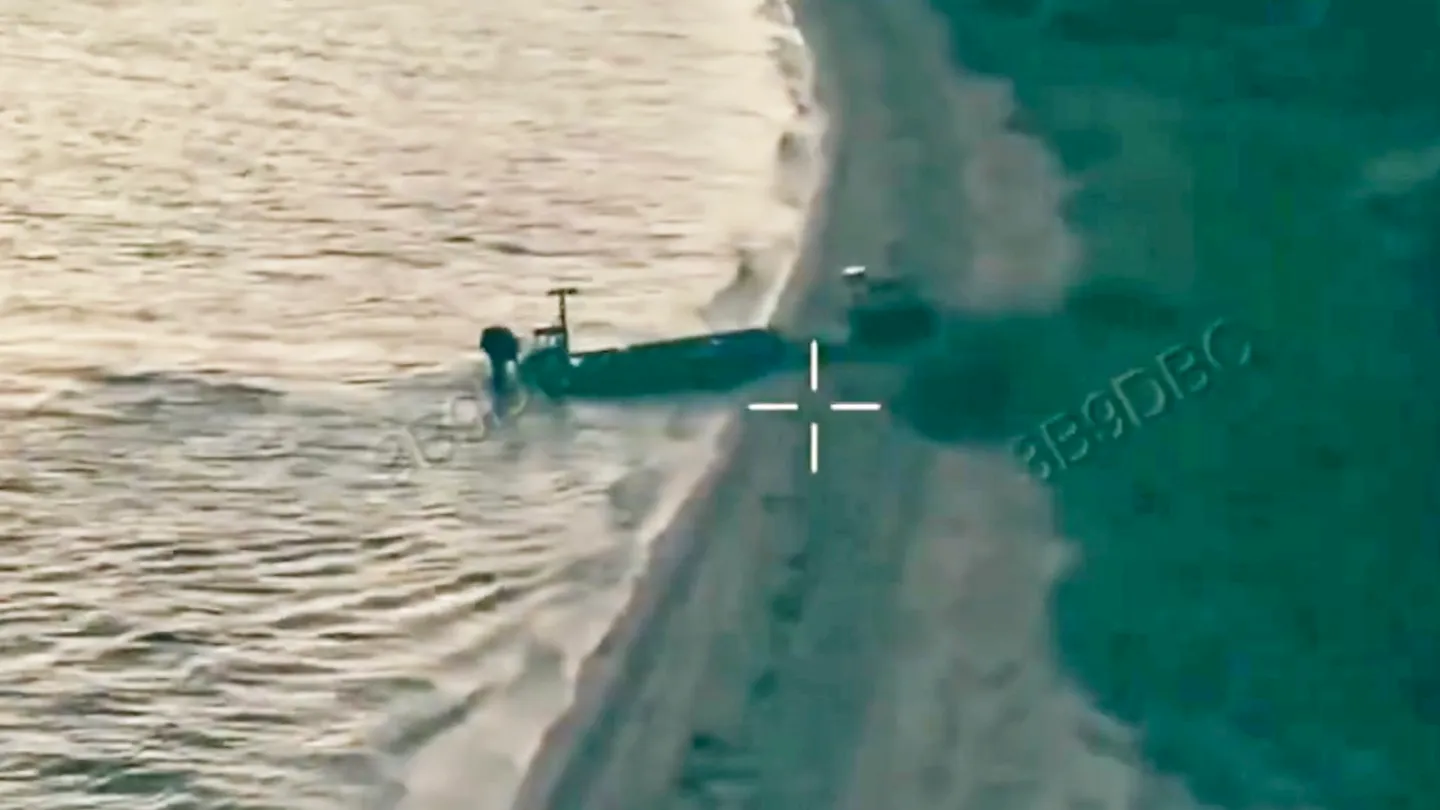
Footage released by the brigade documents the mission from multiple angles — an overhead aerial drone, the UGV itself, and the transport vessel.
An outboard-motor-powered unmanned surface vessel (USV) beached itself on the shoreline, lowered a bow ramp, and allowed a wheeled UGV fitted with a 7.62mm machine gun to drive ashore under its own power. The UGV then opened fire on targets beyond the beachhead. The USV subsequently departed; it remains unclear whether any attempt was made to recover the UGV.
The Rys-Series UGV
The UGV involved in the landing is believed to belong to the Rys series, manufactured by Roboneers, and is equipped with a 7.62mm machine gun. Platforms of this type typically integrate ballistic computers to enhance firing accuracy, along with AI-assisted autonomous target detection, tracking, and engagement capabilities.
Rys-series vehicles have been widely deployed for logistics resupply, casualty evacuation, engineering tasks, and combat support missions. Some variants have also been adapted for mine-laying and mine-clearing operations.
Ukraine has been rapidly scaling up its use of comparable UGVs. Earlier this year, a Droid TW-7.62 — also armed with a 7.62mm machine gun — reportedly shot down two Russian drones in succession, engaged Russian infantry (killing one and wounding another), continued fighting under artillery fire, and successfully repelled a subsequent Russian infantry assault.
Kinburn Spit: One of Southern Ukraine's Most Contested Zones
Kinburn Spit is among the most fiercely contested coastal areas in southern Ukraine. Russian forces occupied the approximately 9.6-kilometer-long narrow sandbar in the summer of 2022, using it as a base for electronic warfare systems and launching missile and artillery strikes against southern Ukraine. Russian forces also constructed concrete fortifications there and reportedly established drone control stations on the spit.
From late 2022 onward, Ukraine conducted multiple reconnaissance missions, raids, and precision strikes against Kinburn Spit, steadily degrading Russian defensive capacity. The Institute for the Study of War (ISW) reported in June of this year that Russian forces had withdrawn from the spit under sustained Ukrainian pressure; Ukrainian marines subsequently flew the national flag there via drone. Ukraine's Southern Defense Forces announced on June 25 that Russian troops had retreated under heavy fighting, with survivors continuing to evacuate.
Whether Russian forces have since returned to the spit remains unclear, suggesting this latest operation may have served a dual purpose — both reconnaissance and concept validation.
A Glimpse at the Future of Unmanned Amphibious Warfare
Regardless of the current Russian disposition on the ground, Kinburn Spit represents an ideal proving ground for unmanned combat systems. The dense concentration of surveillance assets, artillery, and drones makes conventional amphibious landings extremely hazardous, while robotic systems can conduct reconnaissance and combat operations without exposing soldiers to direct fire.
This operation reflects Ukraine's deepening reliance on unmanned systems: ground robots are increasingly taking on high-risk roles in logistics, engineering, fire support, and battlefield reconnaissance to reduce frontline casualties. At the same time, Ukraine has emerged as a global leader in unmanned surface vessel innovation, fielding platforms capable of strike, intelligence gathering, logistics, and even the deployment of other robotic systems.
While this mission was most likely a battlefield proof-of-concept, it adds to a growing body of evidence of Ukraine's rapid innovation in unmanned systems — and offers a glimpse of a future in which amphibious landings are led not by soldiers, but by robots.
The 123rd Brigade closed its account of the Kinburn Spit operation with a brief but telling prediction: "It's going to get more interesting."
原文來源: 查看原文
FAQ
Reviewed and published by the LAETimes editorial desk ·