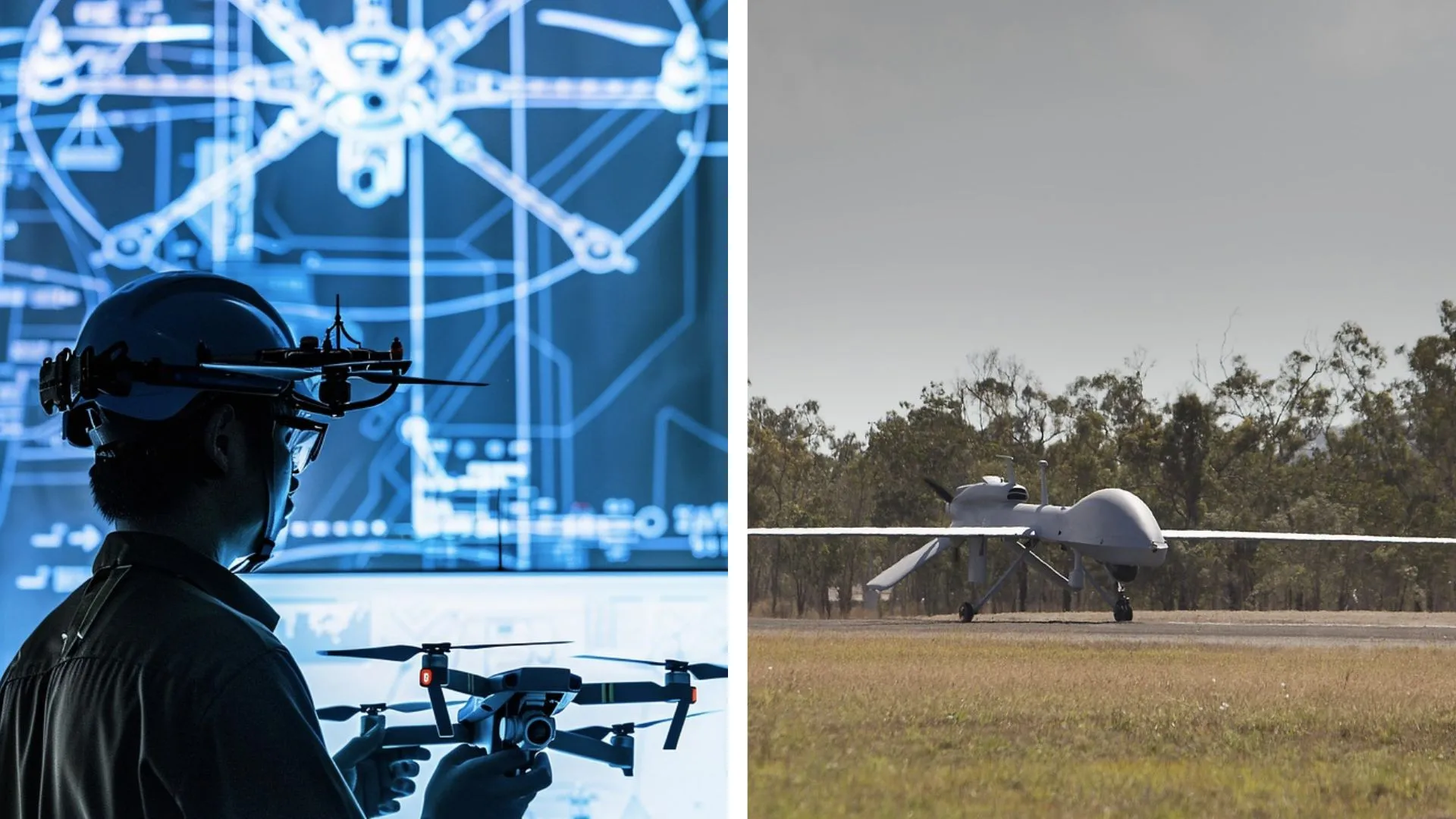
China Unveils Truck-Mounted Electromagnetic Catapult System Capable of Launching Attack Drones from Any Location
Beijing Institute of Technology's School of Mechanical Engineering has released footage of a modular, containerized Electromagnetic Aircraft Launch System (EMALS) mounted on standard eight-wheeled trucks. Three vehicles can rapidly link together to form a continuous launch platform, accelerating fixed-wing propeller drones to takeoff speed without requiring a conventional runway. The highly mobile system can be transported by road, rail, or sea, significantly enhancing the PLA's distributed drone-strike capabilities.

Highlights
- Beijing Institute of Technology revealed a modular containerized EMALS in which three standard eight-wheeled trucks link together to form a mobile drone catapult requiring no runway.
- The system can transport individual launch segments by road, rail, or ship and assemble them rapidly at any chosen location, significantly complicating enemy targeting.
- Chinese military analyst Fu Qianshao stated the system allows launch capability 'almost anywhere—you don't even need a regular road,' highlighting its extreme mobility.
- China already deploys EMALS on the Type 076 amphibious assault ship Sichuan; this land-based variant extends the technology from naval to ground-force applications.
- The containerized modules are part of a broader family that can also house missile launchers, radar units, electronic-warfare equipment, and command-and-control centers.
China Unveils Truck-Mounted Electromagnetic Catapult System Capable of Launching Attack Drones from Any Location
China has publicly demonstrated an innovative drone-warfare concept: a modular, containerized Electromagnetic Aircraft Launch System (EMALS) that can be deployed and used to launch drones from virtually any suitable location, according to media reports.
The system was revealed by the School of Mechanical Engineering at the Beijing Institute of Technology (BIT) in a demonstration video, underscoring Beijing's emphasis on mobility, dispersed deployment, and rapid power projection as part of its ongoing People's Liberation Army (PLA) modernization drive.
Mounted on Standard Eight-Wheeled Trucks
Unlike conventional drone launch infrastructure that relies on fixed runways or dedicated airfields, this new system is carried aboard standard eight-wheeled trucks fitted with container-sized modules. In the demonstration, three trucks are aligned side by side and mechanically joined to form a continuous launch rail. The electromagnetic catapult then accelerates a fixed-wing propeller-driven drone to takeoff speed and launches it successfully.
The core concept is modularity: each launch segment can be transported independently by road, rail, or ship, then rapidly assembled wherever needed. This affords far greater operational flexibility than permanent fixed installations and allows the PLA to disperse drone-launch capabilities across multiple sites, making it significantly harder for adversaries to detect and target them.
According to the developers, the aircraft catapult unit is just one member of a larger family of containerized military systems. Similar modules are reported to be capable of housing missile launchers, radar units, electronic-warfare equipment, command-and-control centers, or logistics support packages. The standard container form factor also facilitates movement of military assets through civilian transport infrastructure, further enhancing operational agility. As the South China Morning Post (SCMP) noted, this approach aligns with a broader trend in modern warfare in which mobility and concealment have become as important as firepower, and containerized systems can blend into commercial logistics networks to complicate enemy intelligence-gathering and targeting.
Electromagnetic Aircraft Launch System (EMALS) Technology
The launcher employs EMALS technology to accelerate aircraft to takeoff speed without the need for rocket boosters or steam-driven catapults. Compared with conventional launch methods, electromagnetic systems deliver a smoother acceleration profile, reducing mechanical stress on airframes and offering greater flexibility when handling drones of varying sizes and weights.
Chinese military analyst Fu Qianshao commented: "With just a few trucks you can assemble a mobile electromagnetic catapult and gain launch capability almost anywhere—you don't even need a regular road."
China has already adopted EMALS technology on its newest naval platforms, including the Type 076 amphibious assault ship Sichuan—widely described as a future drone carrier. The emergence of a land-based mobile variant signals that the technology is expanding beyond its naval origins.
The growing emphasis on mobile drone-launch systems reflects operational lessons drawn from the conflicts in Ukraine and the Middle East, where drones have become central to intelligence gathering, long-range strikes, and battlefield reconnaissance. Fixed airfields are increasingly vulnerable to precision missile attack, compelling militaries to seek more dispersed alternatives.
Vehicle-mounted launch systems can be rapidly deployed from highways, improvised aprons, or remote locations, sustaining operational tempo without dependence on permanent infrastructure. Analysts argue that this flexibility will carry significant strategic value in high-intensity future conflicts where conventional airfields remain under persistent threat.
If deployed in large numbers, containerized launch systems would dramatically complicate an adversary's planning. Rather than targeting a handful of known airfields, an enemy would be forced to search for a potentially vast and ever-shifting network of mobile launch sites.
The modular design also aligns with China's broader military strategy of distributed operations, dispersing combat assets across multiple locations to improve survivability. Combined with long-range drones, electronic-warfare systems, and missile launchers housed in similar containers, the concept could give rise to a highly adaptable battlefield network.
Nonetheless, key questions remain unanswered, including deployment speed, logistical requirements, the power supply needed for electromagnetic launch, and vulnerability to electronic warfare or precision strikes. Ultimately, the system's real-world combat effectiveness will depend on how successfully it can be integrated into the PLA's broader command-and-control architecture.
原文來源: 查看原文
FAQ
Newsletter
Subscribe to our Low-Altitude Industry Newsletter
Daily curated news on low-altitude economy and drone industry, delivered to your inbox.