Blue Helmets on a New Battlefield: Drones, Proxy Forces, and Intelligence Failures
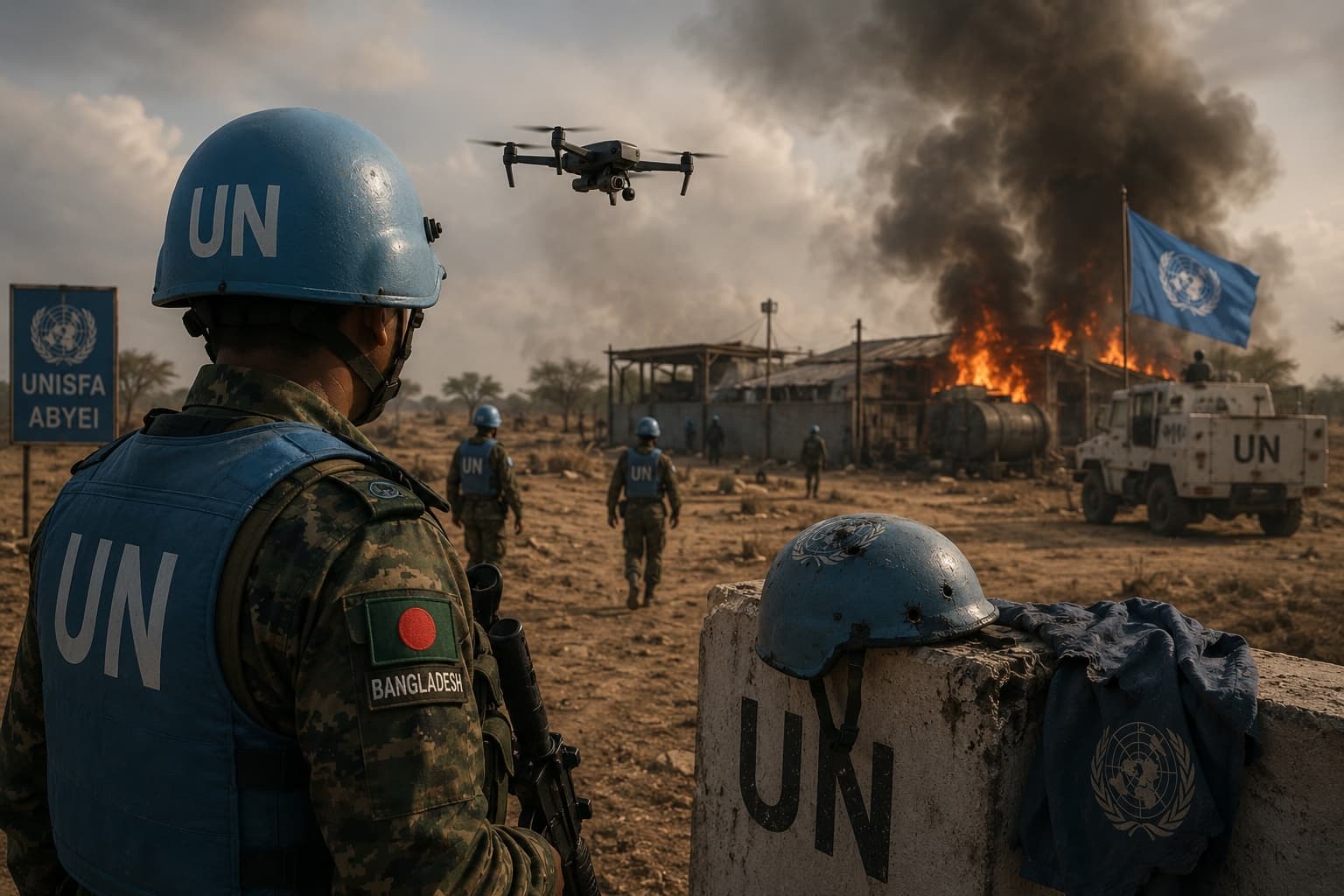
In December 2025, a drone strike on a UN facility in Kadugli, Sudan, killed six Bangladeshi peacekeepers. The attack exposed systemic vulnerabilities — cheap attack drones, proxy armed groups, inadequate intelligence sharing, and shrinking mission resources — that have rendered traditional assumptions about UN peacekeeping force protection dangerously obsolete, demanding urgent institutional reform.

Highlights
- A December 2025 one-way attack drone strike on the UNISFA logistics base in Kadugli, Sudan, killed six Bangladeshi peacekeepers and wounded eight, bringing Bangladesh's total UN peacekeeping fatalities since 1989 to 174.
- The RSF, which has known ties to the UAE and operates as a proxy force, used cheap attack UAVs — a tactic that UN peacekeepers are neither equipped nor authorised to defend against with counter-drone systems.
- Trump administration cuts to UN peacekeeping funding are expected to force approximately 1,400 Bangladeshi peacekeepers to return home ahead of schedule by mid-2026, degrading mission capacity across Africa and the Middle East.
- UNISFA's Joint Mission Analysis Centre (JMAC) failed to issue timely warnings partly because contingent commanders were prohibited from collecting HUMINT and were financially incentivised to remain deployed despite documented RSF escalation signals dating back to October 2024.
- Peacekeeping experts and TCC advocates are calling for institutional reforms including counter-UAV procurement, ISR drone integration into peacekeeping intelligence, and revised training curricula to address loitering munitions and high-technology conflict environments.
Overview
In December 2025, a drone strike on a United Nations facility in Kadugli, Sudan, killed six Bangladeshi UN peacekeepers amid the country's ongoing civil war. The attack was not an isolated battlefield tragedy. It revealed a deeper systemic crisis: the proliferation of cheap attack drones, the rise of proxy armed groups, critically inadequate intelligence sharing, and the steady erosion of mission resources have rendered the traditional assumptions underlying UN peacekeeping force protection dangerously outdated. Drawing on interviews with peacekeeping intelligence officials, this article argues that Bangladesh and other major troop-contributing countries (TCCs) must actively push for better early warning systems, counter-UAV capabilities, revised training curricula and rules of engagement, and greater agency over threat assessment and response in peacekeeping missions.
What Happened
On 15 December 2025, funerals were held at the headquarters of the United Nations Interim Security Force for Abyei (UNISFA) for six Bangladeshi peacekeepers killed two days earlier in a drone strike on a mission logistics base. The midday attack, which lasted approximately ten minutes, struck a fuel depot inside the camp, killing six and wounding eight. All of the victims were assigned to UNISFA, which monitors the volatile border zone between Sudan and South Sudan. The Sudanese Armed Forces (SAF) attributed the strike to the Rapid Support Forces (RSF) — the principal rebel faction in Sudan's civil war — which had previously employed relatively rudimentary one-way attack UAVs in earlier engagements. Both parties to the conflict have continued to acquire more sophisticated equipment; the RSF in particular has introduced the Chinese-made FK-2000 air defence system.
The incident served as a stark warning: the conventional assumptions governing peacekeeper protection are dangerously out of date. Personnel originally deployed to supervise ceasefires and separate warring parties now operate in conflict environments shaped by cheap attack drones, proxy militias, long-range precision strikes, and rapidly shifting front lines — often without the intelligence, equipment, or authorisation needed to defend themselves. For Bangladesh — one of the world's leading TCCs — and for other contributing nations, adapting to this environment requires more than additional training or one-off equipment purchases. It demands institutional reform across peacekeeping intelligence, counter-drone defence, mission doctrine, and rules of engagement, as well as collective advocacy by TCCs for adequate surveillance, logistics, and force-protection resources in future deployments.
Bangladesh has long been among the UN's largest troop contributors. For Dhaka and other high-volume contributing nations, peacekeeping has traditionally offered benefits that outweigh the risks: financial compensation, equipment reimbursement, international prestige, and military training and operational experience that would otherwise require significant national defence expenditure.
Yet the risks facing peacekeepers are rising. The most recent illustration came on 4 June 2026, when a peacekeeper was killed in Lebanon. The Trump administration's deep cuts to UN peacekeeping funding have directly reduced the scale and resources of multiple missions in the Middle East and Africa. By mid-2026, approximately 1,400 Bangladeshi peacekeepers are expected to return home ahead of schedule as a result of these reductions. Resource constraints undermine not only Blue Helmet numbers but also support capacity, logistical efficiency, and morale. Meanwhile, demand for peacekeeping has not diminished — territorial conflicts from Thailand to eastern Democratic Republic of Congo (DRC) continue to proliferate, pointing to greater, not lesser, need for peacekeeping and ceasefire monitoring in the years ahead.
Bangladesh's Foreign Minister and newly elected President of the UN General Assembly reportedly expressed interest — during his tenure as National Security Adviser — in contributing to a future Gaza stabilisation force, a decision likely motivated by both the practical economics of soldier pay and the diplomatic leverage such a commitment could generate in Washington. In the near term, this signals an increasingly transactional approach to peacekeeping. However, in the wake of the December 2025 attack in Sudan, any commitment to new stabilisation missions warrants careful scrutiny.
Although Bangladesh suffered painful early experiences in difficult missions such as Rwanda, it has built a reputation over subsequent decades as a disciplined and reliable TCC. Dhaka may now need to hold itself to a higher standard of accountability for personnel safety. With no single country or institution willing to fill the vacuum left by the United States' retrenchment, TCCs may need to use available tools collectively to advocate for greater peacekeeping resources both within and outside the UN system.
A More Dangerous Era
The bombing of Bangladeshi peacekeepers in Sudan was shocking but not without precedent. Since 1989, the incident brought Bangladesh's total UN peacekeeping fatalities to 174. It was the second-deadliest battlefield loss in Bangladesh's peacekeeping history; the single deadliest incident occurred on 25 February 2005, when nine soldiers were killed in an ambush by armed groups in the Ituri region of the DRC during the MONUC stabilisation mission.
As one of the world's largest TCCs, Bangladeshi peacekeepers are the proverbial canary in an increasingly dangerous mine. From attacks on ASEAN observer missions in Myanmar in 2023 to the recent strike on UNISFA, the past two years have witnessed the continued normalisation of violence against peacekeeping, ceasefire monitoring, and peacebuilding organisations.
This situation is largely the product of global forces beyond the control of any individual mission. Cheap and continuously innovating military technology — such as the drone attack in this case — continues to proliferate to a wider range of actors, making localised wars increasingly lethal. Opportunistic states, operating without robust international pressure, are seeking to change facts on the ground as rapidly as possible, particularly as the scope of territorial conflicts expands. In many cases, the use of deniable non-state actors or militia groups has become a common pattern — the M23 armed group's seizure of Goma in the DRC, which directly resulted in 17 UN peacekeeping fatalities, being a prime example.
This proxy-force model creates a more permissive environment for attacking peacekeepers: states can claim these armed groups fall outside their military command and control while covertly funding and arming them. The RSF's known connections to the United Arab Emirates have afforded it a degree of diplomatic protection.
The proliferation of armed drones allows any armed force to strike from well beyond the intelligence-gathering range of its targets, while peacekeepers broadly neither possess nor should possess counter-drone defences. Training curricula at peacekeeping centres — including Bangladesh's own Peace Support Operations Training Institute — should be revised to incorporate instruction on operating in high-technology conflict environments. Bangladeshi instructors could use the Sudan attack as a case study to train future peacekeepers in battlefield situational awareness and shelter-in-place procedures against both advanced attack drones and loitering munitions.
Just as peacekeeping underwent profound growth and challenge during a particular period of the 1990s, early 2025 may need to be recognised as the historical inflection point at which the mission type began to face sustained and distinctive pressure.
The Path Forward
Regarding this specific incident, it is worth noting that the UNISFA logistics base that was struck is not located within the Abyei area itself but in South Kordofan State, Sudan. The peacekeepers killed appear to have been caught up in a broader RSF offensive across South Kordofan following the RSF's seizure of El-Fasher — the key city in Darfur — and the mass atrocities carried out there. One-way drone attacks had been reported in locations including Kalogi and Dilling.
The UN Security Council had been aware since October of the previous year of the escalating RSF attacks and force build-up in the northern sectors of the Abyei mission area. More alarmingly, UNISFA had been involved in numerous confrontations with the RSF over the latter's establishment of illegal checkpoints along critical logistics routes through Abyei into South Kordofan, repeatedly negotiating for their removal. In early 2025, the RSF confiscated UNISFA contractor fuel trucks and began harassing ground convoys moving between the Kadugli logistics base and UNISFA headquarters. In hindsight, this may have been a precursor to the December attack — the RSF apparently viewed UNISFA as an obstacle to its forthcoming offensive.
The RSF may also have perceived UNISFA as aligned with the opposing SAF. In May, the RSF demanded that Sudanese monitors withdraw from the UNISFA authorised area, and in the same month abducted local government members appointed by the SAF.
A key unresolved question is whether any of these events were adequately interpreted as crisis warning signals. The Security Council briefly discussed RSF provocations in Abyei at its November meeting, but this was not the primary focus. Even after the RSF's seizure of El-Fasher and its advance into South Kordofan, UNISFA continued attempting to maintain the logistics supply line from Kadugli to Abyei by air.
How might the December attack have been prevented? One dimension worth examining is peacekeeping intelligence (PKI). Intelligence is an acutely sensitive subject for the United Nations, but the Kadugli incident illustrates clearly that successful strategic-level analysis of Sudan's civil war trajectory could have yielded warning signals that the RSF was preparing indiscriminate attacks on peacekeepers in the area.
Every UN peacekeeping mission — including UNISFA — has a Joint Mission Analysis Centre (JMAC), the all-source analytical unit that integrates law enforcement, military, and civilian personnel to produce tactical, operational, and strategic intelligence assessments. However, these centres are not always granted sufficient authority or resources to effectively assess the security environment in which they operate; UNISFA's JMAC was still seeking to fill critical analytical vacancies this year. More fundamentally, JMACs face inherent limitations on the operational side of mission-oriented intelligence.
Interviews with peacekeeping intelligence officials identified three problems that undermined UNISFA's ability to warn its peacekeepers of the escalating crisis in a timely manner.
First, peacekeeper contingents can only receive formal intelligence briefings from the JMAC — assessments that are frequently delayed or simply absent. Open-source intelligence (OSINT) or first-hand observations by peacekeepers themselves are rarely used as a basis for judging the threat environment facing a contingent. Typically, contingent commanders and their deputies must await a formal JMAC intelligence briefing before considering withdrawal or redeployment.
Second, OSINT is sometimes used to delay deployment adjustments, a problem officials linked to a separate but related issue: contingent commanders are often extremely reluctant, for political reasons, to withdraw forces when the threat level rises significantly. The financial incentives that peacekeeping provides to contributing militaries and governments create a powerful motivation to discount a deteriorating threat environment, particularly since personnel withdrawn from a contingent are typically not replaced at the time of mission renewal. In the Abyei attack, contingent leadership was aware of multiple alarming indicators of RSF activity — information that subsequently appeared in UN Security Council reports — yet refused to consider withdrawing from Kadugli.
The third problem concerns the inherent limitations of peacekeepers engaged in intelligence work. Contingents are prohibited from conducting any human intelligence (HUMINT) collection — a restriction that extends even to volunteers who wish to provide information. Even when local community members actively seek to share information with a contingent, it is neither accepted nor incorporated into JMAC assessments. Beyond HUMINT, the most critical intelligence tool available in the Central African context, according to interviewees, is intelligence, surveillance, and reconnaissance (ISR) missions. This is the primary information source intelligence officers can draw on without generating controversy, and there is a strong preference across the board for unmanned drone sorties, given their superior ability to survey the surrounding environment.
Note: The original article was truncated due to length. This translation is based on the full text available.
原文來源: 查看原文
FAQ
Newsletter
Subscribe to our Low-Altitude Industry Newsletter
Daily curated news on low-altitude economy and drone industry, delivered to your inbox.