The Ultimate Guide to Multirotor Drones: Types, Specs, Applications, and Pricing
This comprehensive guide breaks down multirotor drone configurations—from tricopters to octocopters—covering flight mechanics, key advantages, real-world applications, and pricing. It also compares multirotors against fixed-wing drones to help consumers and professionals make informed purchasing decisions.

Highlights
- Quadcopters (4 rotors) are the industry standard for commercial drones, typically priced between $2,000 and $20,000, offering ~30-minute flight times but zero motor redundancy.
- Hexacopters (6 rotors) provide motor redundancy—able to fly on five of six motors—and carry heavier payloads such as LiDAR and thermal cameras, at roughly 40–60% higher cost than equivalent quadcopters.
- Octocopters (8 rotors) offer the highest payload capacity in the multirotor category, with some platforms like the ATLAS 8 carrying 50–60 kg, and provide dual motor redundancy for critical missions.
- The X8 coaxial configuration delivers octocopter-class lift and redundancy in a quadcopter-sized frame, but suffers a 15–30% efficiency loss due to prop wash interference between stacked rotors.
- Multirotors use fixed-pitch propellers and variable motor speed—rather than variable-pitch blades—making them mechanically simpler than helicopters and capable of hovering indefinitely until battery depletion.
The Ultimate Guide to Multirotor Drones: Types, Specs, Applications, and Pricing
Have you ever watched a drone hover effortlessly over a construction site, inspect wind turbine blades, or deliver medical supplies to a remote village?
That drone was almost certainly a multirotor.
From the DJI Phantom—a staple at weddings and real estate shoots—to the JOUAV PH-20 handling demanding industrial missions, multirotor drones have become the most widely recognized drone type in the world.
But here's the problem: most people use "quadcopter," "drone," and "multirotor" interchangeably—and they're not the same thing.
Some assume all drones can hover—fixed-wing aircraft cannot. Others believe six rotors must be better than four—that isn't always true.
When faced with real operational requirements and the need to choose between a multirotor and a fixed-wing platform, most buyers find themselves lost.
This guide cuts through the confusion, covering types, flight time, real-world applications, pricing, market outlook, and the classic fixed-wing vs. multirotor comparison.
What Is a Multirotor Drone?
Before diving into comparisons and buying advice, let's establish the basics: what exactly is a multirotor drone?
A multirotor—also called a multicopter—is a rotorcraft with two or more lift-generating rotors. In plain terms, it's a drone kept airborne by three or more spinning propellers mounted on extended arms.
The most common configurations include the quadcopter (4 rotors), hexacopter (6 rotors), and octocopter (8 rotors).
There's also the less common tricopter, as well as specialized designs like the X8 coaxial configuration—which looks like a quadcopter but actually carries eight rotors, with two counter-rotating props stacked on each arm. More on that later.
Unlike the complex swashplate systems and variable-pitch rotors found in traditional helicopters, multirotors use fixed-pitch propellers and control flight by varying motor speed. This makes them simpler to manufacture, easier to operate, and far more accessible to new pilots.
How Do Multirotor Drones Fly?
Multirotors appear to do something simple—hover, fly forward, turn—but that simplicity conceals a carefully orchestrated mechanical balance.
Unlike the complex systems in traditional helicopters, multirotors take a more elegant approach: fixed-pitch blades combined with variable motor speed. Rather than adjusting blade angle, they simply spin propellers faster or slower.
The Core Challenge: Torque
Every spinning propeller generates two forces: lift (upward force) and torque (a rotational force that tries to spin the airframe in the opposite direction).
If all rotors spun in the same direction, the drone would enter an uncontrolled spin. Multirotors solve this with counter-rotating propellers—half spinning clockwise, half counter-clockwise—so the torques cancel each other out and the airframe stays stable.
Four Basic Movements
Multirotors control flight by varying the speed of individual rotors:
- Hovering: All rotors spin at equal speed; lift exactly equals the drone's weight, and the aircraft holds position.
- Pitch (forward/backward tilt): Rotors on one side speed up while those on the opposite side slow down, tilting the airframe and redirecting the thrust vector to produce horizontal movement.
- Roll (left/right tilt): The same principle applied along the lateral axis.
- Yaw (rotation): The clever part—by exploiting torque, speeding up clockwise rotors while slowing counter-clockwise ones (or vice versa), the net torque is no longer zero and the airframe rotates.
The Brain: The Flight Controller
All of the above—continuous fine-tuning, torque balancing, real-time response to wind and pilot input—happens automatically. That's the job of the flight controller.
Hundreds of times per second, the flight controller reads data from onboard gyroscopes and accelerometers, compares the drone's actual state against the pilot's commanded inputs, calculates precise adjustments for each motor, and sends those commands to the Electronic Speed Controllers (ESCs), which regulate motor speed accordingly.
The entire process happens faster than any human perception—you simply see a drone that remains stable and responsive in any condition.
Types of Multirotor Drones
Multirotors come in many configurations. Rotor count is more than an aesthetic choice—each configuration represents a different trade-off between cost, payload capacity, flight time, and redundancy.
Here's a breakdown from simplest to most capable.
Tricopter (3 Rotors) — The Rare Oddity
The tricopter is the odd one out of the multirotor family. Three rotors make for the simplest multirotor design—and the rarest.
How it works: Where quadcopters use counter-rotating pairs to cancel torque, tricopters use a servo motor to tilt one of the rear rotors, enabling yaw control.
Advantages:
- Simple construction and low cost
- Lower aerodynamic drag from the airframe
- More agile than other multirotor configurations
Disadvantages:
- Less stable than quadcopters or hexacopters
- No motor redundancy—a single motor failure means a crash
- More difficult center-of-gravity management
Best use case: Tricopters were popular in the early days of DIY drones when brushless motors were scarce and expensive. Today they're a niche curiosity—interesting from an engineering standpoint, but rarely used in commercial or industrial applications.
Quadcopter (4 Rotors) — The Industry Standard
The quadcopter is the configuration you've seen most often. Four rotors arranged in a square or X pattern—two spinning clockwise, two counter-clockwise—it's the default platform for everything from a $50 toy to a $20,000 enterprise-grade system.
Why it dominates: The quadcopter hits a sweet spot—mechanically simple, relatively inexpensive to produce, and capable enough for a wide range of tasks.
Advantages:
- Simple design, easy to manufacture and maintain
- Lightweight and portable
- Affordable—commercial quadcopters typically range from $2,000 to $20,000
- Good wind resistance (capable of handling Force 5–7 winds)
- Flight times of approximately 30 minutes under standard payload
Disadvantages:
- No redundancy—a single motor or ESC failure will bring a quadcopter down, without exception and without recovery
- Lower payload capacity compared to hexacopters or octocopters
Best for: Aerial photography, lightweight inspection, rapid deployment, and any mission where portability and cost outweigh payload capacity or redundancy requirements.
Configurations: Quadcopters come primarily in two layouts—the X configuration (nose positioned between two arms; most common, as seen on the DJI Phantom) and the plus/cross configuration (nose aligned with an arm; preferred by some freestyle pilots).
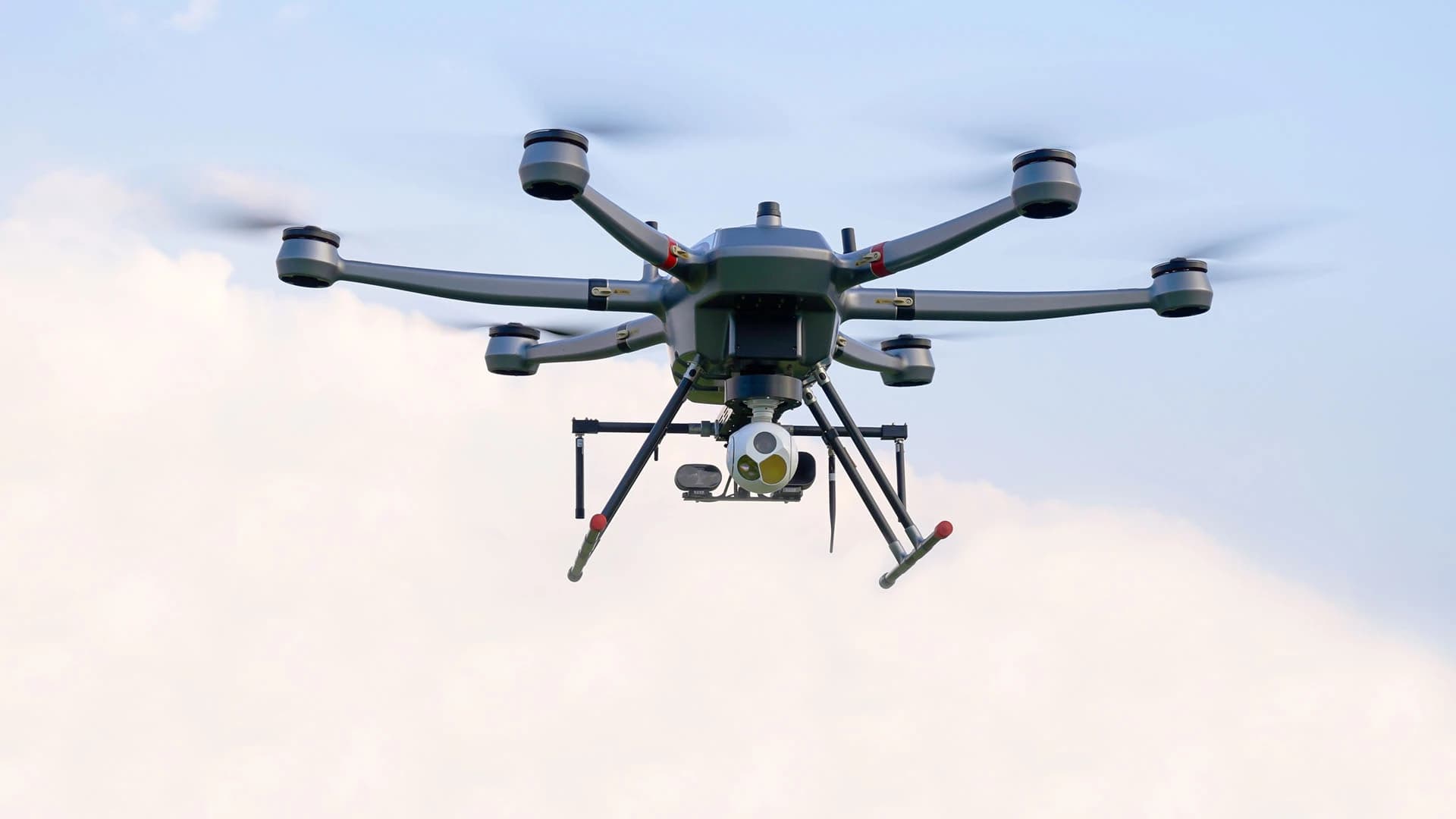
Hexacopter (6 Rotors) — The Professional's Choice
Add two more rotors and you have a hexacopter. Six motors arranged in a hexagonal pattern—three clockwise, three counter-clockwise.
What sets it apart: The hexacopter is the first configuration in this guide to offer motor redundancy. Should one motor fail, the flight controller can compensate, and the aircraft can continue flying—or at minimum execute a controlled landing.
Advantages:
- Motor redundancy—five of six motors can keep it airborne
- Greater payload capacity than a quadcopter
- Smoother, more stable flight
- Better suited to heavy mission payloads such as LiDAR, thermal cameras, and multispectral sensors
Disadvantages:
- More expensive—typically 40–60% more than an equivalent quadcopter
- Heavier airframe (approximately 20–30% more weight)
- More complex to build and maintain
- Slightly lower efficiency due to the additional motor and ESC weight
Payload math: If each motor on a hexacopter produces 1.2 kg of thrust, six motors yield 7.2 kg total. An equivalent quadcopter delivers only 4.8 kg. For payloads exceeding 500 g, a hexacopter is actually more efficient—the additional motors more than offset their own weight.
Best for: Professional cinematography, LiDAR mapping, public safety, agriculture, and any mission carrying expensive equipment where a crash is not an option. The JOUAV PH-20 is a compelling example—a heavy-lift hexacopter with a 10 kg payload capacity, 55-minute endurance under full load, and IP45 weather resistance for industrial operations.
Octocopter (8 Rotors) — Maximum Redundancy, Maximum Payload
Eight rotors. Eight motors. Eight ESCs. The octocopter is the heavy-lift crane of the multirotor world.
Advantages:
- Dual motor redundancy—can continue flying even with two motor failures
- Highest payload capacity—some models can carry 50–70 kg
- Exceptional flight stability
- Superior handling in high winds
Disadvantages:
- High cost
- Heavy airframe with lower efficiency
- Complex maintenance
- High power and battery demands
Real-world examples: The ATLAS 8 octocopter can carry 50–60 kg for cargo delivery; the Malloy T-150 is used by multiple national militaries to transport ammunition and medical supplies to front-line positions; ASW's Heavy Lift Multirotor (HLM) octocopter carries 66 lb (approximately 30 kg) and is constructed from aerospace-grade carbon fiber.
Best for: Heavy cargo delivery, military logistics, firefighting, and any mission with maximum demands on payload capacity and redundancy.
X8 Coaxial Configuration — The Compact Heavy Lifter
The X8 looks like a quadcopter—four arms—but each arm carries two motors stacked vertically, with counter-rotating props. Eight motors total, packed into a quadcopter-sized frame.
Why choose X8 over a flat octocopter? The X8 delivers octocopter-class lift and redundancy in a far more compact footprint, ideal for missions requiring heavy-lift capability without the physical footprint of eight separate arms.
Advantages:
- Greater lift from a compact frame
- Motor redundancy
- Superior handling in strong winds
Disadvantages:
- Efficiency loss of approximately 15–30%—the lower propeller operates in the wake of the upper propeller, reducing its effectiveness
- More complex to build and tune
- Double the failure points—more motors means more potential failures
Applications: Almost exclusively used in professional heavy-lift applications such as aerial cinematography and industrial cargo transport.
Key Advantages of Multirotor Drones
Vertical Takeoff and Landing (VTOL) — No Runway Required
This is the multirotor's greatest operational advantage. A multirotor can take off and land vertically from almost anywhere—a ship's deck, a truck bed, a balcony, a forest clearing—with no need for a runway, catapult launcher, or recovery net.
Practical impact: A bridge inspection team can launch directly from the bridge deck; a search-and-rescue crew can take off from beside a vehicle parked on a dirt road; a farmer can launch from the corner of a field. This operational flexibility is difficult to overstate.
Hover Capability — A Game-Changer for Precision Operations
This is where fixed-wing aircraft simply cannot compete. A multirotor can hover indefinitely—at least until the battery runs out—maintaining a stable position in three-dimensional space while you inspect, photograph, or monitor.
Why it matters:
- Inspection: A multirotor can hold position 2 meters from a wind turbine blade, allowing an inspector to examine every centimeter of the surface. A fixed-wing can only orbit the structure—precision close inspection is impossible.
- Photography: That perfect real estate aerial shot? The drone holds its exact position. That cinematic tracking shot following a moving vehicle? The multirotor matches speed while remaining stable.
- Surveillance: A multirotor can monitor a specific area for extended periods without moving; a fixed-wing must keep flying, continuously entering and exiting the target zone.
- Precision delivery: Medical supply drops often require hovering while a package is lowered by winch—something a fixed-wing cannot do.
Superior Maneuverability in Confined Spaces
Multirotors can fly sideways, fly in reverse, rotate in place, and navigate through spaces that fixed-wing aircraft cannot enter.
Fixed-wing aircraft require banked turns and need substantial airspace to maneuver; multirotors can weave between buildings, fly down warehouse aisles, and pass beneath bridges. This makes them highly effective for indoor inspection, urban search-and-rescue, and any mission in constrained environments.
An Important Note on Efficiency
Here's a counterintuitive truth: more rotors does not mean better.
Each additional motor adds weight—the motor itself, the ESC, and the wiring. That extra weight must be lifted, consuming more power. As a result, hexacopters and octocopters are less efficient than quadcopters—they burn through more battery capacity just to carry their own additional hardware.
So why choose a hexacopter or octocopter? The answer is redundancy and payload capacity. If you're carrying a $30,000 camera, or flying over a densely populated area, the ability to survive a motor failure is worth the efficiency trade-off. If you're flying recreationally or shooting real estate photography, a quadcopter is almost always the smarter choice.
原文來源: 查看原文
FAQ
Newsletter
Subscribe to our Low-Altitude Industry Newsletter
Daily curated news on low-altitude economy and drone industry, delivered to your inbox.
Reviewed and published by the LAETimes editorial desk ·