The Operational Window: How Environmental Context Determines Military Feasibility
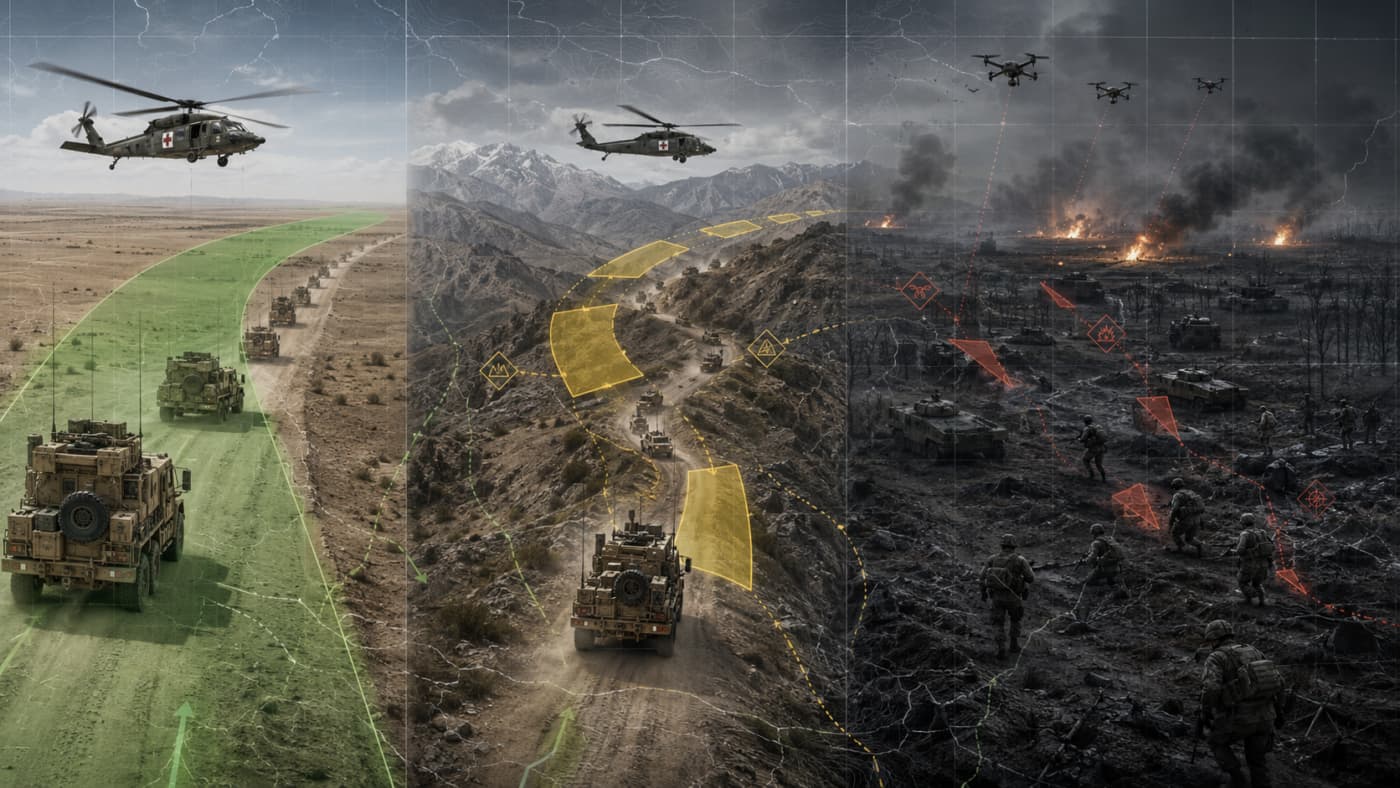
This article examines the concept of the 'operational window'—the brief interval during which forces can maneuver, move supplies, or evacuate casualties while enemy observation and fires are suppressed. Drawing on case studies from Iraq, Afghanistan, and Ukraine, it analyzes how drone reconnaissance and distributed fires compress these windows, and argues that commanders must assess window availability before designing any campaign.

Highlights
- Operational windows—intervals when enemy observation or fires are suppressed—are the primary determinant of military operational feasibility, varying fundamentally across Iraq, Afghanistan, and Ukraine.
- In Iraq (2003–2008), the absence of air-to-air threats kept logistics and medical evacuation windows continuously open, enabling centralized forward operating bases and predictable resupply cycles.
- In Afghanistan's Kunar Province (2009–2013), route-clearance patrols created intermittent suppression windows of approximately thirty minutes, after which windows closed for up to twelve hours, making centralized logistics unsustainable.
- In Ukraine (2023–2025), persistent drone reconnaissance and distributed fires compressed logistics movement windows to thirty to ninety minutes and rendered large-scale breakthrough operations—such as the 2023 Zaporizhzhia counteroffensive—infeasible.
- Commanders must assess available windows against per-function requirements before campaign design begins; planning without this assessment risks operations built on foundational assumptions that no longer hold.
Abstract
Operational windows—the brief intervals during which forces can move, maneuver, or evacuate casualties while enemy observation and fires are suppressed—determine which military operations remain feasible in practice. Windows are created by the dynamic interplay between friendly suppression capability and enemy capacity to observe and engage. The number and duration of available windows is determined by operational context.
In Iraq, the absence of air-to-air threats allowed logistics and casualty evacuation to proceed without interruption. In Afghanistan, while the near-absence of air threats kept medical evacuation windows open, ground logistics required a hybrid approach: route-clearance patrols created brief suppression windows, while commanders had to identify safe movement intervals between threat indicators and reposition forces accordingly. In Ukraine, persistent drone reconnaissance and distributed fires simultaneously compressed available windows across all operational functions, leaving commanders neither able to establish sustained suppression nor reliably predict the emergence of natural gaps.
Commanders must assess the gap between available windows and the windows required for each operation, and design multi-layered protection to create and sustain them. Campaign endurance depends on accurately answering the question of window availability before operations are planned.
Introduction
In February 2023, Russian forces advanced to positions surrounding Bakhmut, gaining artillery control over the primary ground supply routes into the city. Ukrainian defenders faced increasingly narrow operational windows: Russian fires threatened the main supply lines running from Chasiv Yar and the western approaches, while the cost of abandoning the city was unacceptable both militarily and politically.
Force movement depended on concealment, route discipline, engineer support, dispersion, and the ability to exploit moments when Russian observation was interrupted or fire coordination broke down. Ukrainian commanders identified brief gaps when Russian reconnaissance was redirected or fire coordination faltered, and exploited them before Russian forces could re-engage. These windows were not created through active suppression—they were discovered and seized. As Russian artillery control tightened, windows continued to narrow, further constraining Ukrainian freedom of maneuver.
Nonetheless, Ukrainian forces continued to move personnel, evacuate casualties, and resupply by identifying gaps in Russian reconnaissance or fire coordination, and acting before those windows closed. This reveals a fundamental principle: operational feasibility depends on window management—the gaps in enemy observation, surveillance, or fire coordination that allow forces to move, consolidate, or be resupplied before being re-engaged. The operational environment determines what windows exist and whether they can be created or discovered.
Bakhmut illustrates a core insight: operational windows are determined by context, not by static doctrine or organizational structure. What windows exist? Which can be created through suppression? Which gaps can be identified and exploited? The answers to these questions determine which operations remain feasible. This article uses three operational contexts—Iraq, Afghanistan, and Ukraine—to show how available windows shape campaign design, and why commanders must answer the question of window availability before planning operations.
Understanding the Operational Window
Different operational tasks impose fundamentally different window requirements. Logistics resupply requires enemy observation along supply routes to be suppressed long enough for vehicles to pass; casualty evacuation requires route protection and observation suppression to move wounded from collection points to aid stations; maneuver operations require concealment of force assembly areas and masking of movement signatures during the assault phase. Window requirements derive from the task itself, not from doctrinal norms.
Whether windows exist depends on what can be suppressed and what gaps exist—or can be created—in enemy observation and fires. Enemy ISR capabilities define what can be observed; enemy fires (artillery, air attack, and precision strike) define what can be destroyed. Available windows represent the duration during which enemy observation or fires are suppressed, bypassed, or fail. The more effective the suppression, the wider the window. Context determines this balance: the absence of enemy air capability eliminates the air observation and strike threat; persistently contested roads overwhelm limited suppression assets; distributed reconnaissance simultaneously compresses windows across all operational domains.
Case Study 1: Iraq (2003–2008)
In Iraq, the absence of air-to-air threats and Iraq's limited surface-to-air capability created a fundamentally different set of operational conditions. This allowed rotary-wing medical evacuation to function continuously: casualties could be moved from point of wounding to a Level III surgical facility within hours, significantly improving soldier survivability. Medical evacuation became a permanent operational function rather than a capability constrained by intermittent windows.
Logistics operations benefited equally from the absence of an air threat: supply convoys ran on predictable schedules along established routes, forward operating bases were centralized, and resupply followed routine cycles. Because enemy air threats were absent, the windows required for medical evacuation and logistics remained permanently open. Commanders could plan accordingly, establishing stable supply lines, centralized maintenance facilities, and predictable casualty management procedures. Continuously available windows fundamentally shaped campaign design—all operations assumed uninterrupted logistics flow and reliable casualty evacuation.
Case Study 2: Afghanistan (2009–2013)
In Kunar Province, Afghanistan, contested roads produced uneven window compression. Medical evacuation windows remained open—the absence of air-to-air threats kept rotary-wing operations viable. Logistics faced different constraints: route-clearance patrols periodically suppressed ground threats on mountain roads, creating brief suppression windows; between clearance operations, brief safe movement intervals appeared when threat indicators dropped.
Unlike Iraq's continuous logistics flow, Afghan windows opened intermittently: a patrol might have a thirty-minute movement window before threat indicators rose and the window closed for up to twelve hours, until the next clearance operation. This compressed and intermittent availability made centralized resupply models unsustainable.
Case Study 3: Ukraine (2023–2025)
In Ukraine, persistent drone reconnaissance and distributed fires compressed available windows across all operational functions far more severely than in Iraq or Afghanistan. Unlike Iraq's continuously open windows or Afghanistan's intermittent gaps, Ukraine faced compressed windows that could neither be reliably suppressed nor predictably discovered.
Operational windows did exist, but they were brief and unpredictable, and exploiting them required accepting higher operational costs (casualties, extended timelines, dispersed operations). Logistics suppression had to cover dispersed route segments, but enemy reconnaissance was itself dispersed; maneuver concealment was theoretically feasible, but enemy drone coverage was persistent; casualty evacuation, with no reliable windows to anticipate, required the development of forward medical capability.
Multi-Layered Protection and Window Constraints
Achieving windows requires multi-layered protection combining suppression of enemy observation and fires with exploitation of existing gaps. This balance varies by context: in Iraq, near-absent air threats made suppression largely unnecessary; in Afghanistan, suppression of ground threats created windows that commanders then exploited tactically; in Ukraine, distributed threats made reliable suppression across all operational domains impossible, leaving only the option of identifying brief windows and accepting higher operational costs to exploit them.
Establishing a logistics window requires multiple protection layers working in combination: air defense systems suppress drones and reconnaissance assets; electronic warfare masks vehicle signatures; fires suppress observation posts capable of directing strikes; night or low-visibility movement uses timing as concealment. Each layer addresses a different threat element; when one layer fails, the others can sustain the window.
Establishing a maneuver window carries different priorities: concealing force assembly areas takes precedence over suppressing routes; electronic warfare masking of movement signatures takes precedence over air defense suppression of static positions; deceptive positioning forces enemy reconnaissance to redirect to decoys; the timing of maneuver phases must account for enemy reconnaissance cycles to determine when assembly is feasible.
In late 2025 near Pokrovsk, Ukrainian forces demonstrated how compressed windows could be exploited under persistent surveillance: forward casualty collection points were established at temporarily occupied sites, protected by concealment and frequent relocation rather than suppression; evacuation routes were continuously changed to avoid predictable strike patterns; evacuation timing was synchronized with gaps in reconnaissance cycles—when drone coverage briefly shifted or reconnaissance was being redirected—to create brief windows. These operations continued under compressed window conditions by accepting extended casualty evacuation timelines and continuous movement rather than relying on fixed, defensible collection points.
Windows and Operational Feasibility
Different operational contexts produce different window availability. In Iraq, where no air-to-air threat existed, windows for movement, logistics, and medical evacuation remained continuously open; commanders built large forward operating bases, implemented centralized maintenance, fixed supply routes, and predictable casualty evacuation procedures.
Some contexts compress windows without eliminating them, forcing operational redesign. In Afghanistan, logistics windows became too brief and unpredictable to sustain an Iraq-style centralized resupply model. Windows did not disappear, but the cost of relying on them was accepting higher operational costs. Commanders dispersed supply caches and accepted slower, intermittent resupply cycles; medical evacuation windows remained adequate for most casualties, but commanders deployed forward medical capability to handle cases where window timing failed. Operations adapted rather than stopped.
Some contexts compress windows to the point where only mission-critical brief intervals remain. In Ukraine, logistics movement windows—subject to suppression effectiveness and route selection—might exist for only thirty to ninety minutes; maneuver assembly windows existed only when reconnaissance cycles were synchronized with deception and electronic warfare masking; casualty evacuation windows depended on forward medical capability and required acceptance of extended evacuation timelines. This was not because windows had disappeared, but because reliable windows had become rare enough that medical responses had to be dispersed rather than centralized.
The 2023 Ukrainian Counteroffensive: The Limits of Window Management
Ukraine's 2023 counteroffensive near Zaporizhzhia demonstrated the limits of window management rather than tactical failure. A breakthrough operation requires a large, sustained window: assault force assembly, bridging equipment, supporting fires, command and control, and logistics support must be synchronized within a concentrated area.
Ukraine's multi-layered protection might have created windows for individual components—individual bridging columns, assault force movement, exploitation operations after a breach—but a breakthrough requires all components to be integrated within a single large window. The required force density generates observable signatures; Russian persistent reconnaissance would detect the assembly. The level of dispersion needed to avoid detection undermines the force concentration required for a breakthrough.
Unlike operations at Bakhmut or Pokrovsk—which could continue by accepting casualties, extended timelines, and dispersed actions—a breakthrough cannot be achieved through dispersion. The requirement for a large, integrated, sustained window exceeded what suppression and concealment could provide. Accepting the near-certain destruction of a concentrated force exceeded acceptable parameters, and commanders elected not to proceed.
A Window Management Framework for Campaign Planning
Campaign operations require multiple functions to have their own simultaneous windows: a maneuver window for main force movement, a logistics window for supply convoys, and a medical evacuation window for casualty movement. These functions operate on different timelines, each requiring its own multi-layered protection to create and sustain its specific window. Campaign action succeeds when all windows are synchronized and each function receives its required protection layers. Failure of any single window triggers cascading effects: if the main force advances and becomes disconnected from supply, and the logistics window cannot reopen in time, and the commander cannot establish forward supply caches or accept extended resupply cycles, campaign endurance collapses.
Commanders must accurately assess available windows before planning operations. This means evaluating enemy observation and fires capability, analyzing suppression requirements for window creation, determining which gaps can be reliably identified, and defining which windows are genuinely essential for campaign functions—all before campaign design begins.
Answering this question requires assessing the distribution of enemy ISR capability across all relevant operational domains, evaluating the comparative advantage of available suppression assets (air defense systems, electronic warfare, artillery) against enemy capabilities, determining which gaps can be reliably identified, and identifying the windows required for each campaign function.
The answer determines which operations are feasible—not theoretically feasible, but actually feasible within real environmental constraints. Getting it wrong can produce plans that assume continuous windows that do not exist, waste suppression assets through misassessed window-creation requirements, or risk breakthrough operations where no feasible window exists.
Conclusion
Operational windows are a function of the operational environment, not of doctrine or organizational structure. Iraq, Afghanistan, and Ukraine each reveal a distinct state of window availability, each requiring a different approach to campaign design.
In Iraq, continuous windows made centralized, predictable operations feasible. In Afghanistan, intermittent windows forced logistics design toward dispersed, constraint-accepting models. In Ukraine, compressed and unpredictable windows rendered breakthrough operations infeasible and forced fundamental redesign of all campaign functions.
Persistent drone reconnaissance represents a fundamental challenge to operational window management: it eliminates natural gaps, compresses windows that can be created, and forces acceptance of higher operational costs to exploit whatever gaps remain. Commanders must accurately assess available windows before planning operations—otherwise they are designing operations on the basis of foundational assumptions that have already failed.
The question of window availability is not merely one consideration within the planning process. It is the foundational question that determines which operations remain feasible in practice.
原文來源: 查看原文
FAQ
Newsletter
Subscribe to our Low-Altitude Industry Newsletter
Daily curated news on low-altitude economy and drone industry, delivered to your inbox.
Reviewed and published by the LAETimes editorial desk ·