Why Mesh Communications Are Critical for Public Safety Drone Programs
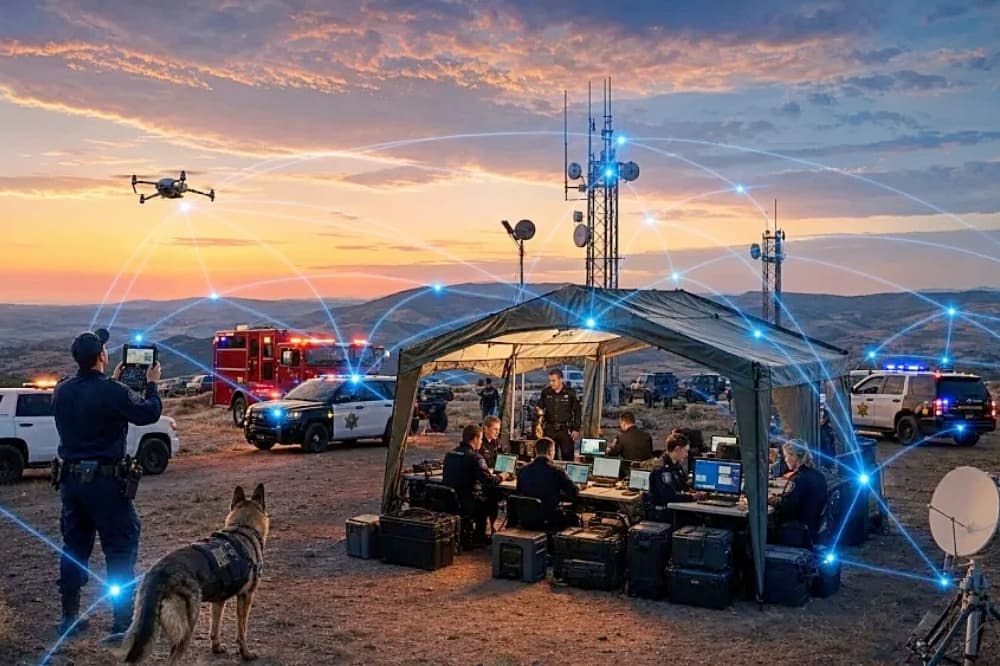
As public safety agencies expand drone programs, reliable data infrastructure has become as essential as traditional voice radio. Mesh communications — with their decentralized, self-healing network design — are emerging as the backbone technology for Drone as First Responder (DFR) operations, enabling BVLOS coverage, multi-drone coordination, and resilient connectivity across disaster scenes, complex terrain, and dynamic deployments.

Highlights
- Mesh communications use a decentralized, node-to-node architecture that automatically reroutes data when individual nodes fail, maintaining network connectivity without a single point of failure.
- Public safety drone programs (DFR) rely on stable, low-latency communications links to stream real-time HD video and receive command instructions — requirements that mesh networks are specifically designed to meet.
- Mesh networks extend BVLOS drone coverage by chaining relay nodes, enabling signal reach across mountain terrain, tunnels, dense urban areas, and disaster-damaged infrastructure.
- Multi-drone operations benefit from mesh networks' ability to dynamically allocate bandwidth across simultaneous airborne assets, ground command vehicles, and fixed camera systems.
- Public safety agencies are increasingly treating mesh communications not as an optional upgrade but as foundational infrastructure investment for modern emergency response operations.
Why Mesh Communications Are Critical for Public Safety Drone Programs
Every major incident reinforces the same operational truth: response effectiveness is inseparable from communications reliability. For public safety agencies, that reality now extends well beyond traditional voice radio.
The Communications Challenge in Modern Public Safety
Drone programs, fixed and mobile cameras, sensors, and frontline command applications all depend on a robust, fault-tolerant data backbone. When communications fail, live video feeds go dark, command decisions lose situational awareness, and both rescue and law enforcement operations are severely compromised.
Mesh Communications: A Flexible Deployment Solution
Unlike conventional star-topology networks that rely on a single base station, mesh communications use a decentralized, node-to-node architecture. Each node acts as both a receiver and a relay — so even if individual nodes fail, the network automatically reroutes traffic to maintain connectivity.
This makes mesh particularly well-suited to the following public safety scenarios:
- Large-scale disaster scenes: Earthquakes, wildfires, or floods can destroy fixed infrastructure, leaving traditional networks inoperable.
- Challenging terrain: Mountain ranges, tunnels, and dense urban environments where conventional signals struggle to penetrate.
- Dynamic deployment requirements: As incident perimeters expand or shift, the communications network must extend rapidly to keep pace.
The Core Infrastructure for Drone Programs
For Drone as First Responder (DFR) programs, reliable communications infrastructure is especially critical. Whether conducting search-and-rescue, aerial reconnaissance, or traffic monitoring, drones require stable, low-latency links to stream high-definition video in real time and receive mission commands from the operations center.
Mesh communications directly address key pain points in drone operations:
- BVLOS (beyond visual line of sight) missions requiring extended signal coverage
- Bandwidth allocation across simultaneous multi-drone operations
- Unified communications integration between ground command vehicles, fixed cameras, and airborne assets
A Growing Choice Among Agencies
Facing increasingly complex emergency response demands, public safety agencies are actively evaluating and deploying mesh communications solutions to ensure uninterrupted information flow between frontline personnel and command centers — under any environmental condition. This is not simply a technology upgrade; it is a foundational infrastructure investment for the modern public safety ecosystem.
As drone applications in public safety continue to deepen, the resilience of communications infrastructure will become a decisive factor in mission success or failure.
原文來源: 查看原文
FAQ
Newsletter
Subscribe to our Low-Altitude Industry Newsletter
Daily curated news on low-altitude economy and drone industry, delivered to your inbox.
Reviewed and published by the LAETimes editorial desk ·