DRAGON Drone's Mid-Air Shape-Shifting Targets Fukushima Decommissioning Missions
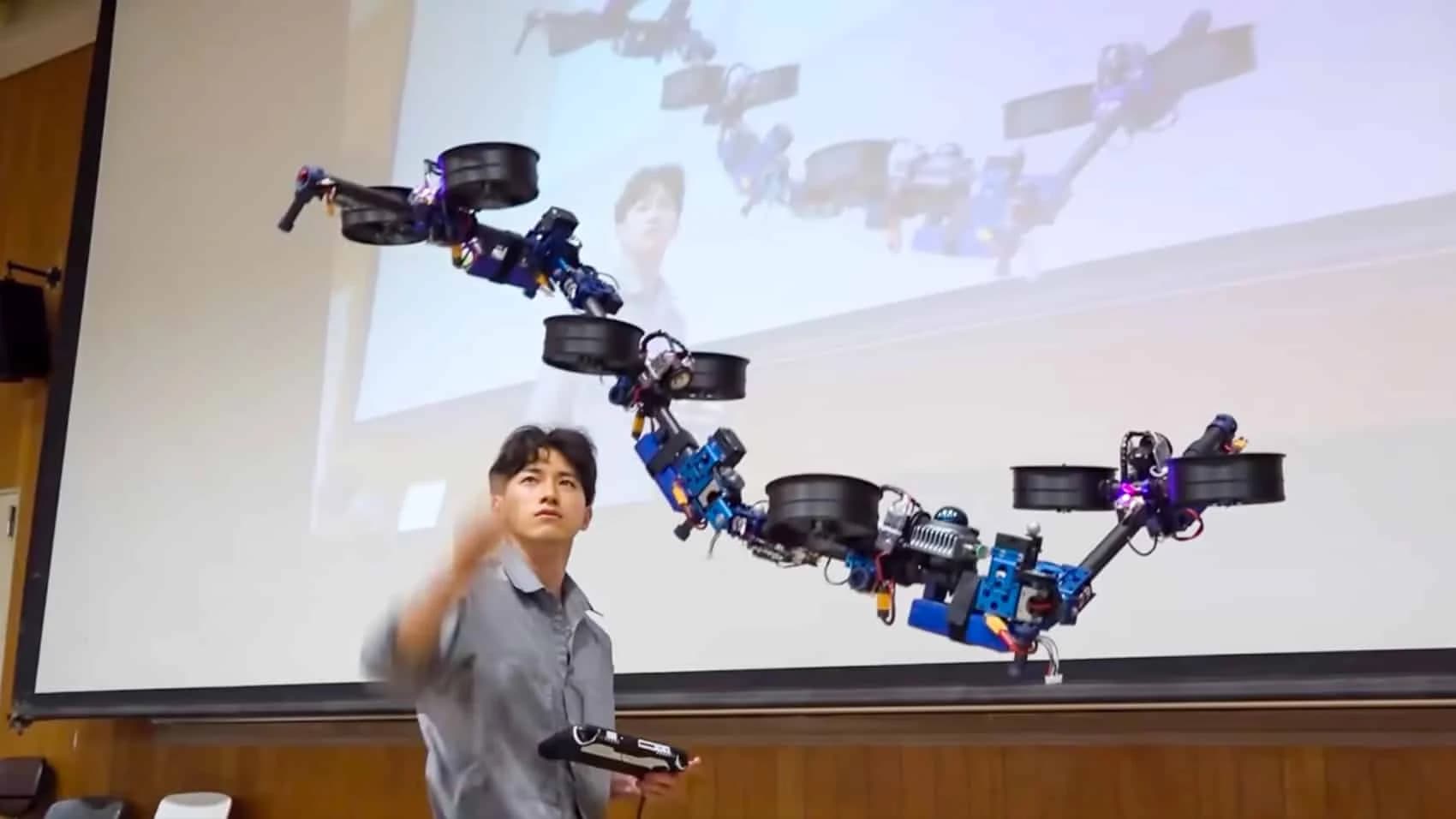
The University of Tokyo's JSK Lab has demonstrated DRAGON v1.5, a morphing aerial robot comprising four articulated links and eight gimbal-mounted ducted fans. The drone can autonomously reshape itself in flight to squeeze through narrow gaps unreachable by conventional fixed-frame UAVs. Principal investigator Dr. Moju Zhao confirmed the team is actively pursuing disaster-response applications and is participating in a national project tied to the decommissioning of the damaged Fukushima Daiichi nuclear plant.

Highlights
- DRAGON v1.5, developed by the University of Tokyo's JSK Lab, is described as the world's first morphing aerial robot capable of fully autonomous flight and reconfiguration using only onboard sensors including 3D LiDAR, IMU, and joint encoders.
- The drone's four articulated links and eight gimbal-mounted ducted fans allow it to reshape mid-flight and pass through gaps narrower than its fully extended body length—a capability impossible for conventional fixed-frame quadcopters.
- Principal investigator Dr. Moju Zhao confirmed DRAGON is part of a major Japanese national program targeting the decommissioning of the radiation-contaminated Fukushima Daiichi nuclear power plant, where robots are expected to replace human workers.
- Limited battery flight time and durability under harsh conditions—including dust and radiation—are identified by Dr. Zhao as the primary barriers to real-world deployment.
- The original DRAGON platform debuted in 2018; v1.5 demonstrated at Komaba Campus represents the first iteration to achieve complete onboard autonomy without relying on external tracking infrastructure.
DRAGON Drone's Mid-Air Shape-Shifting Targets Fukushima Decommissioning Missions
The University of Tokyo's JSK Laboratory recently held a live demonstration at the Komaba Campus in Tokyo, giving DRAGON v1.5 its public debut. The morphing aerial robot can bend and coil its body in flight to pass through narrow gaps that conventional fixed-frame drones cannot, relying entirely on onboard sensors without any external positioning assistance.
Principal investigator Dr. Moju Zhao told DroneXL that the team's next objective is disaster-response deployment—and, ultimately, contributing to the decommissioning of Japan's stricken Fukushima Daiichi nuclear power plant.
Eight Gimbal-Mounted Ducted Fans Power Morphing Flight
DRAGON is constructed from four articulated links connected end-to-end, resembling a snake in flight. Each link carries two ducted fans mounted on gimbals, giving the platform eight independently steerable thrust points—far more flexible than the four fixed rotors of a conventional quadcopter.
The original DRAGON was first unveiled in 2018, and its acronym captures the design philosophy: Dual-rotor embedded multilink Robot with the Ability of multi-deGree-of-freedom aerial transformatiON.
Because every fan can rotate independently, the drone maintains stable flight in almost any configuration. It can extend into a straight line or coil into a more compact shape, with the gimbaled fans continuously adjusting thrust vectors to prevent loss of control during reconfiguration.
Where a standard quadcopter has a single, fixed geometry, DRAGON treats its shape as a parameter that can be changed at any moment in flight—and that is precisely what allows it to pass through gaps narrower than its fully extended length.
Onboard Sensors Enable Fully Autonomous Morphing
The most significant achievement showcased at Komaba was complete autonomy. The JSK Lab describes DRAGON v1.5 as the world's first morphing aerial robot capable of fully autonomous flight and reconfiguration using only onboard sensors. An onboard 3D LiDAR scans the surrounding environment, an IMU tracks motion state, and joint encoders report the angle of each link in real time. An onboard computer fuses all this data without relying on any external tracking system for position information.
The challenge is more formidable than it sounds. Every time a joint bends, the robot's center of mass shifts and thrust vectors change. The control system must rebalance and reorient all eight fans at high speed to prevent the airframe from tumbling. Achieving this with onboard computation alone is the core technical problem the team spent years solving.
Dr. Zhao: The Goal Is Places Humans Cannot Reach
Dr. Zhao outlined DRAGON's intended applications to DroneXL: "Deploying such robots in disaster-response scenarios is one direction we are actively pursuing, especially given Japan's urgent need for this type of technology." He identified the central motivation behind the design: "Being able to reach locations that are inaccessible or too dangerous for humans is one of the most important driving forces behind DRAGON's development."
Japan has concrete reasons to need this technology urgently. Frequent earthquakes and aging infrastructure create an abundance of narrow, hazardous spaces where a morphing drone has a decisive advantage. A machine that can fold itself thin to pass through an obstruction and then unfold to continue flying is a fundamentally different tool from a rigid quadcopter that either fits or it does not.
Battery Life and Durability Remain the Real Bottlenecks
Dr. Zhao was candid about the gap between a demonstration prototype and real-world deployment: "The biggest challenges for real-world deployment are the limited flight time imposed by onboard batteries and durability in harsh environments."
Neither challenge is unique to DRAGON, but both are more acute for a robot of this complexity. Eight ducted fans plus an onboard computer draw considerable power, directly limiting how long the drone can remain inside a collapsed structure or reactor building. Dust and radiation in harsh environments also place severe demands on the precision mechanical joints that the system depends on.
Dr. Zhao remained optimistic nonetheless: "Both challenges are steadily improving with advances in hardware and software, and we believe they can ultimately be overcome."
Involvement in the Fukushima Decommissioning Program
The most specific target Dr. Zhao mentioned is also one of the most demanding tasks in the country. "We are also participating in a major national project related to the decommissioning of the damaged Fukushima nuclear power plant," he said. "DRAGON robots are expected to replace human workers in these kinds of hazardous scenarios."
That statement reframes the entire research program. The decommissioning of Fukushima Daiichi is a decades-long undertaking aimed at dismantling reactor facilities where radiation levels prevent personnel from working for extended periods. A drone that can change its shape and navigate through radiation-contaminated, confined interior spaces is not simply a novelty there—it is a means of keeping humans out of harm's way.
DroneXL's Take
For most drone users, this eight-ducted-fan snake robot will never replace the quadcopter sitting in the back of a vehicle, and it was never designed to. What matters most in this report is that the development team has told us explicitly where it is headed: disaster response and a nuclear reactor that has remained too dangerous for people to enter safely for more than a decade.
This research warrants greater investment. Parallel breakthroughs in structural strength and thrust efficiency could produce a machine genuinely capable of penetrating damaged buildings to search for survivors. The Fukushima program is the progress indicator worth watching, because it represents a real deadline backed by national resources. Once DRAGON receives an actual operational assignment in a decommissioning task, morphing drones will no longer be a laboratory exhibit—they will be a real tool doing dangerous work so humans do not have to.
Image credit: Moju Zhao
原文來源: 查看原文
FAQ
Newsletter
Subscribe to our Low-Altitude Industry Newsletter
Daily curated news on low-altitude economy and drone industry, delivered to your inbox.