Counter-Drone Market 'Red Hot' as Echodyne CEO Eyes 10x Radar Demand Growth by 2030
Echodyne CEO Eben Frankenberg says demand for the company's compact radars could grow tenfold by 2030, driven by surging counter-UAS requirements. The company is investing $40 million in a new facility to reach annual production capacity of 30,000 radar panels, and showcased integrations with at least 29 counter-drone exhibitors at Eurosatory 2026.

Highlights
- Echodyne CEO Eben Frankenberg預測,平價小型反無人機雷達的市場需求將在2030年前成長10倍,從目前的數萬片增至數十萬片。
- Echodyne正投資4,000萬美元興建新廠,年產能將提升至3萬片雷達面板,新廠已於2026年7月正式剪綵前提前投入運作。
- 在2026年歐洲薩托里防務展上,至少29個攤位展出整合Echodyne雷達的反無人機解決方案,顯示其在C-UAS市場的主導地位。
- Echodyne書本大小的EchoGuard雷達售價約4萬美元,登機箱尺寸的EchoShield約16萬美元,遠低於傳統國防雷達每片50萬至100萬美元的售價。
- Echodyne已於2025年實現獲利,目前對維持私有、IPO或被收購等各種長期選項保持開放態度,國防業務佔公司銷售額約65%。
Counter-Drone Market 'Red Hot' as Echodyne CEO Eyes 10x Radar Demand Growth by 2030
PARIS — Echodyne CEO Eben Frankenberg says militaries scrambling to counter the drone threats dominating modern battlefields have sent demand for the company's compact radars soaring. Those radars now underpin detection and fire-control capabilities for dozens of counter-UAS solutions worldwide.
Demand 'Red Hot,' Could Grow 10x Before 2030
Speaking to Defense News at the Eurosatory defense exhibition outside Paris last month, Frankenberg said the counter-drone market is currently "red hot" and that demand for affordable short-range radars could increase tenfold before 2030. The Seattle-area company is racing to fulfill orders and cut the ribbon this month on a new manufacturing facility that, at full capacity, will multiply its production output by a factor of ten.
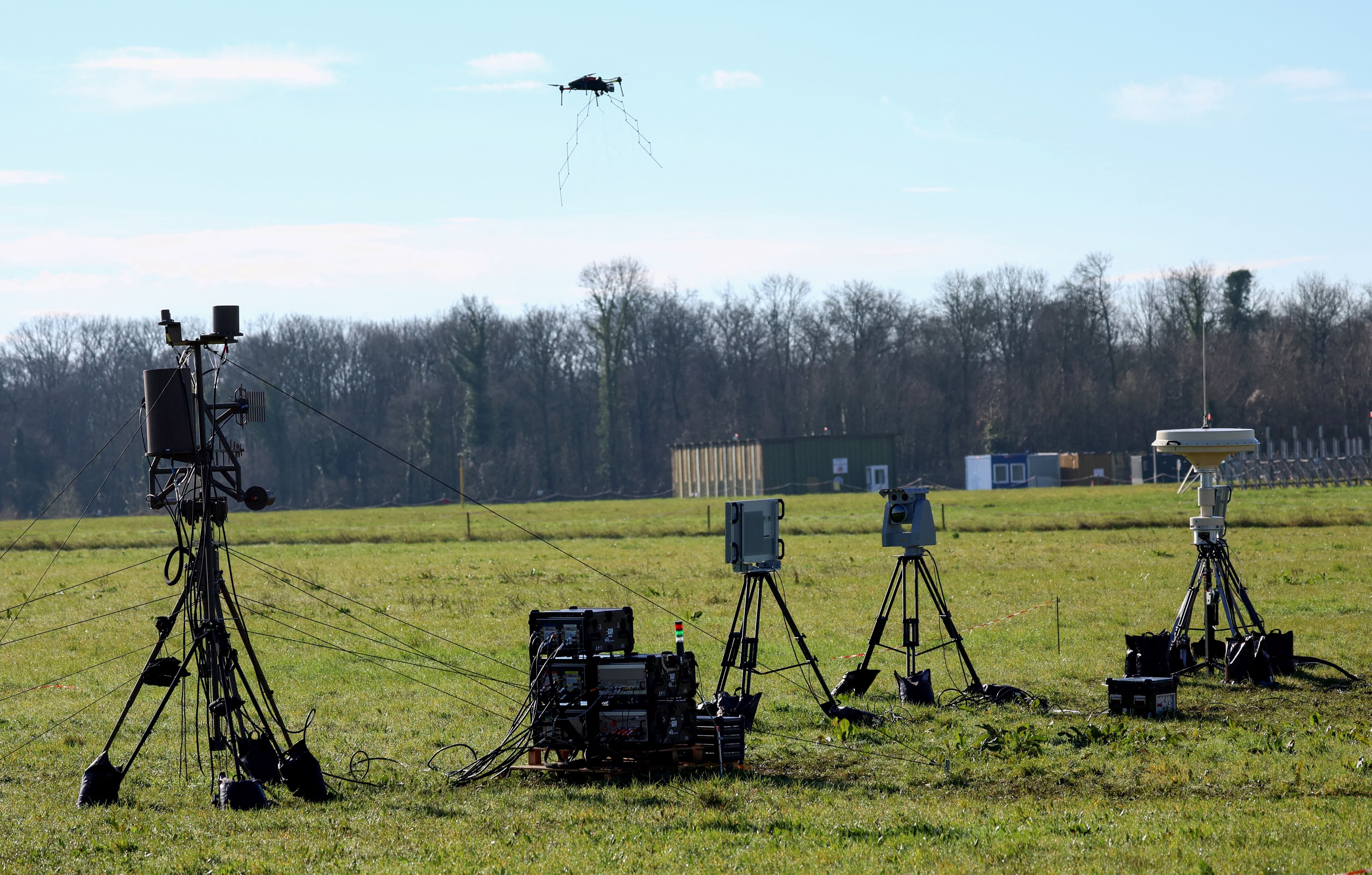
As drones have become the primary instrument of killing on the Ukrainian battlefield and have caused billions of dollars in damage across the Middle East, counter-UAS systems were omnipresent at Eurosatory 2026 — the world's largest defense exhibition. The Echodyne team counted at least 29 booths displaying counter-drone solutions integrated with the company's radar technology.
"Global interest in counter-drone is accelerating rapidly," Frankenberg said. "The war in Ukraine made everyone realize drones have changed the face of warfare, and the Iran conflict made it clear that everything is at risk."
Affordable Small Radars Fill a Critical Gap
Detecting a drone is the first step to defeating it, and vendors offering relatively compact, cost-effective radars — including Echodyne, Blighter, and Robin Radar — are benefiting from a surge in counter-UAS operational demand that does not require the large, expensive sensors used in missile and air-defense systems.
Frankenberg said he has great respect for traditional defense radar primes such as RTX, SRC, and Thales, "but those panels cost $500,000 to $1 million each. Against millions of cheap, lethal drones, you can't rely solely on a battlefield-integrated system priced at $5 million to $10 million. You need large numbers of affordable but capable systems."
Proprietary Metamaterial Technology Drives Down Cost
Echodyne's compact solid-state radars use the company's proprietary metamaterials technology, which achieves electronic beam steering through densely packed antenna arrays — dramatically reducing the complexity and cost associated with traditional phased-array systems.
Founded in 2014 as a spin-out from Intellectual Ventures, with early backing from Microsoft co-founder Bill Gates, Echodyne was built from the ground up to deliver active electronically scanned array (AESA)-class radar performance "at a fraction of the cost," Frankenberg said.
In terms of pricing, Echodyne's book-sized small radar is priced at approximately $40,000 per unit, while the larger carry-on-luggage-sized model runs around $160,000.
$40 Million Factory Investment to Push Annual Capacity to 30,000 Panels
The company is investing $40 million in a new facility designed to bring annual production capacity to 30,000 radar panels across both size variants. Frankenberg said Echodyne pulled forward its overall expansion plan — originally scheduled for 2027 — to this year, with the new plant already operational ahead of its formal ribbon-cutting in July.
"Demand is enormous right now, and it all comes back to the same logic — you fight mass with mass, so there will be large quantities of these systems in the field," Frankenberg said. "We have every reason to build this factory."
He estimates the small-radar market will grow from the tens of thousands of units today to hundreds of thousands by 2030, a segment in which Echodyne currently holds a leading position.
From Commercial Collision Avoidance to Military Counter-UAS
Echodyne's first radar, the EchoFlight — book-sized and originally designed for commercial drone collision avoidance — attracted significant media attention but achieved slow commercial traction. A major turning point came in 2017 when Anduril integrated the EchoGuard into its Sentry autonomous surveillance tower, sparking broader market interest in ground-to-air drone detection.
Around the time of Russia's full-scale invasion of Ukraine, Echodyne introduced the larger EchoShield radar to meet customer demand for greater detection range. Defense now accounts for approximately 65% of company revenue — a complete reversal of its pre-2022 revenue mix.
In terms of performance, the EchoGuard can typically track a small quadcopter at 1 kilometer (roughly 1,100 yards); the larger EchoShield can do the same at 3 kilometers while simultaneously tracking more than 1,000 targets. These radars are typically deployed as part of sensor packages alongside optical sensors and radio-frequency detection equipment.
Integration Across Major Weapon Platforms
Around 2020, Echodyne partnered with Northrop Grumman to integrate the EchoGuard into the Bushmaster chain gun for counter-drone fire control. Frankenberg said radar cueing effectively resolved the difficulty of maintaining continuous track on fast-moving targets using optical sensors alone. The approach has since been adopted by turret manufacturers including Kongsberg and Rheinmetall.
"Any platform carrying a gun needs the ability to protect itself," Frankenberg said. "Every maneuver unit should have a system like this. It may not be the most sophisticated counter-drone solution, but it lets you defend yourself and survive on the battlefield."
Echodyne radars are now integrated across a wide range of systems, including: high-power microwave counter-UAS platforms from Epirus and ThinKom; laser systems from AeroVironment and Electro Optic Systems; multiple European laser weapon programs; directed-energy weapons projects at several large defense primes; and pallet-based interceptor systems using Echodyne radar for guidance.
"In the counter-drone space, almost every system you can think of has our radar in it," Frankenberg said.
Profitable and Open to IPO or Acquisition
Frankenberg said no single system will win the counter-drone contest — "you will see large numbers of different systems coexisting." He noted that lasers and high-power microwave weapons are strong options where collateral damage tolerance is low, while rotary cannons are "extremely effective" where collateral effects are less of a concern.
Confronted with an overwhelming array of new counter-drone products on the market, "procurement officials must feel overwhelmed," Frankenberg acknowledged, "but many of these systems will prove their worth and rise to the top — it's just hard to predict which ones right now."
Echodyne turned a profit last year and is currently open to all long-term options, including remaining private, pursuing an initial public offering (IPO), or being acquired. Frankenberg said investors are "extremely pleased" with the company's trajectory.
"We are clearly at the center of this red-hot market, so it is natural that we would be attractive to potential buyers or partners," Frankenberg said. "We are profitable — quite profitable — so we can operate independently for the long term, but sound business management tells you to remain open to opportunities."
原文來源: 查看原文
FAQ
Newsletter
Subscribe to our Low-Altitude Industry Newsletter
Daily curated news on low-altitude economy and drone industry, delivered to your inbox.