Fire Point Screens Live Moscow Refinery Strike Footage at Eurosatory 2026 — Combat Video Becomes the Ultimate Sales Pitch
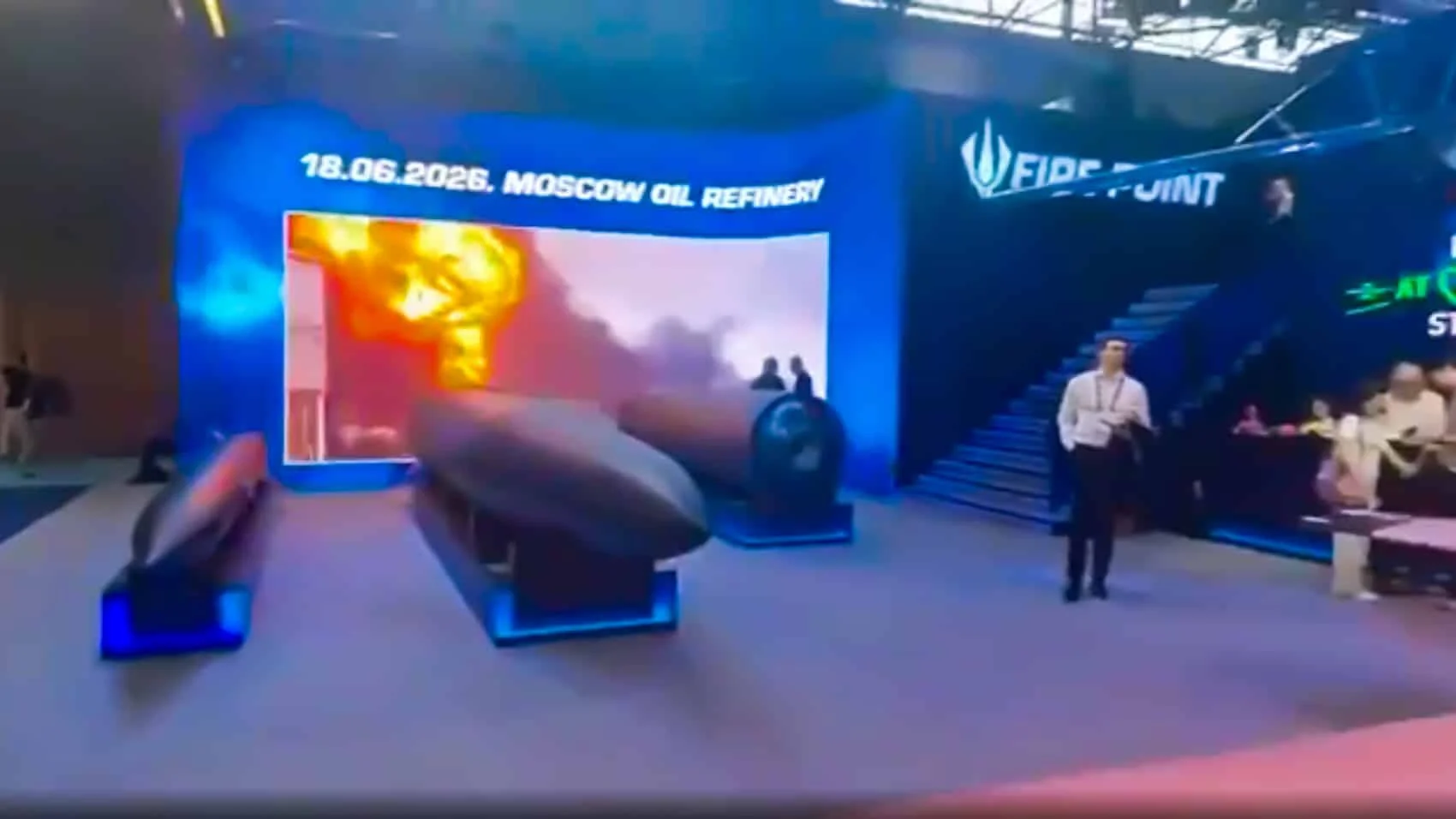
Ukrainian drone and missile maker Fire Point played real-time combat footage of its FP-1 and FP-2 drones striking Moscow's Kapotnya oil refinery at its Eurosatory 2026 booth in Paris — just hours after the attack occurred. Physical hardware sat meters away from the looping screens, giving procurement officials an unscripted, live-fire product demonstration that branding scholars are calling an 'improvisational stroke of genius.'

Highlights
- Fire Point screened unedited FP-1 and FP-2 strike footage at Eurosatory 2026 in Paris within hours of the drones hitting Moscow's Kapotnya oil refinery on the same day.
- The upgraded FP-1 on display has a maximum range of 1,678 miles (2,700 km), a 728 lb (330 kg) MTOW, and carries a 132 lb (60 kg) warhead over an 18-hour endurance.
- Fire Point CEO Iryna Terekh told Janes that the company's drones conduct 5–20 sorties per day against Russia, accounting for roughly 60% of Ukraine's deep-strike missions.
- The FP-5 Flamingo cruise missile — 6 tonnes, 3,000 km range, 1,150 kg payload — is in series production and struck a military factory in Cheboksary, Russia on 10 June 2025.
- NYU brand strategist Angeli Gianchandani called the live-footage exhibition moment 'real-time proof of concept,' noting defence buyers require demonstrated capability over spec-sheet promises.
Ukrainian drone and missile manufacturer Fire Point turned an active warzone operation into the most compelling product demonstration at this year's Eurosatory defence expo — screening unedited combat footage of its FP-1 and FP-2 drones striking the Kapotnya oil refinery in Moscow just hours after the strike took place.
No actors, no script, no rehearsal — only real footage on loop, black smoke billowing on-screen, with the hardware that carried out the mission displayed just metres away.
Fire Point Screens Live Combat Footage at Its Exhibition Booth
Eurosatory 2026 ran from 15–19 June at the Paris Nord Villepinte Exhibition Centre. On Thursday afternoon, Fire Point's booth screened footage of FP-1 and FP-2 drones striking Russia's Kapotnya refinery in Moscow — the footage appearing on the display within hours of the attack.
One clip showed a fuel-tank roof erupting in a pillar of black smoke, a shot that went viral on social media and spawned countless memes within hours. The screen was positioned just metres from a physical FP-1 on static display, allowing visitors to cross-reference the weapon's live combat performance with the actual hardware without moving a step.
Most defence exhibition booths run professionally edited promotional reels behind their hardware — videos that typically take weeks to produce. Fire Point skipped that process entirely. The footage on the booth screen was raw, unedited material from a strike that had taken place hours earlier that same day, not a highlight reel produced months in advance.
The Drones in the Footage Carry Real-World Strike Range
According to EDR Magazine, the FP-1 on display was an upgraded variant fitted with new wings and an integrated fuel tank that extends its range from 1,025 miles (1,650 km) to 1,678 miles (2,700 km) — enough to reach targets deep into Western Siberia. The FP-1 has a maximum take-off weight of 728 lb (330 kg), an 18-hour endurance, carries a 132 lb (60 kg) warhead, and cruises at 87–112 mph (140–180 km/h), with a top speed of 127 mph (205 km/h).
The smaller FP-2 trades range for greater strike power. With a full 441 lb (200 kg) warhead, its maximum range is 230 miles (370 km); using a lighter 231 lb (105 kg) warhead extends range to 435 miles (700 km), though endurance drops from 18 hours to roughly four.
Fire Point CEO Iryna Terekh told Janes that both types are conducting strikes against Russia daily, flying between 5 and 20 sorties per day combined and accounting for approximately 60% of Ukraine's deep-strike missions inside Russian territory.
Terekh also noted that the FP-1 achieved a combat success rate of around 70% when it first entered service in late 2024, which dipped as Russian air-defence systems adapted, and is now gradually recovering.
Branding Scholars Call the Moment an 'Improvisational Stroke of Genius'
Two professors researching brand strategy told Forbes that the Moscow strike footage worked precisely because none of it was pre-planned. They argued that the few metres between a video wall and a physical drone did more for Fire Point's credibility than any polished sales pitch could.
Jason Mollica, a communications lecturer at James Madison University, said the booth demonstration illustrated how Fire Point's drones are being "successfully used" by the Ukrainian military, framing the footage as evidence that the company's weapons are helping shorten a war now in its fifth year.
Angeli Gianchandani, a brand strategist at NYU, described the moment as "real-time proof of concept," noting that defence procurement officials have always required demonstrated capability rather than specification-sheet promises.
The venue context makes that assessment sharper. Eurosatory draws procurement officers from dozens of militaries — audiences professionally sceptical of vendor claims — and a screen showing a strike from earlier that morning is considerably harder to dismiss than a marketing slide deck.
Fire Point's Broader Weapons Portfolio Extends the Display
Beyond the FP-1 and FP-2 seen in the strike footage, Fire Point used Eurosatory to showcase a growing weapons catalogue. The centrepiece was the FP-5 Flamingo — a 6-tonne cruise missile already in series production and in combat use inside Russia.
The Flamingo is 43 ft (13 m) long with a 23 ft (7 m) wingspan, can deliver approximately 2,530 lb (1,150 kg) of warhead payload to targets 1,864 miles (3,000 km) away, and cruises at 404–435 mph (650–700 km/h), with a top speed approaching 590 mph (950 km/h). Fire Point said a Flamingo struck a military factory in Cheboksary, in Russia's Chuvash Republic — more than 600 miles (970 km) from Ukraine's border — on 10 June.
The company also displayed early-stage hardware for the FP-7 interceptor programme and the longer-range FP-9 ballistic missile programme, both still in development and positioned as future counter-air-defence solutions rather than mature products.
None of that, however, was what drew crowds to the booth — the viral footage did all the work, with the missile lineup giving procurement visitors something to explore once they arrived.
DroneXL Perspective
Marketing language aside, this is a case of a company realising its best advertisement had already written itself. Fire Point did not plan a single frame of the Moscow footage — it simply had the presence of mind to put up a screen before the smoke cleared, and let visitors standing metres from the mission hardware draw their own conclusions.
This is not entirely new territory for defence contractors; combat footage as product validation is nearly as old as arms exhibitions themselves. What is different is the degree of time compression — hours between attack and exhibition display rather than weeks — and that gap is narrowing, given that everyone on the show floor had already watched the footage on their phones before Fire Point played its first second of video.
Whether this becomes a template for other manufacturers or remains a one-company opportunistic moment is still an open question. Eurosatory returns in two years — it will be worth watching then to see whether this has become the new exhibition norm, or whether it remains a one-off story about a company's timing.
Image credits: EDR Magazine, YouTube
原文來源: 查看原文
FAQ
Newsletter
Subscribe to our Low-Altitude Industry Newsletter
Daily curated news on low-altitude economy and drone industry, delivered to your inbox.