Drone Academy Founder Launches National HBCU Aviation Initiative to Open Career Pathways for Black Students
Steffanie Rivers, founder of Dallas-based TCB Drones Academy, announced the National HBCU Aviation and Drone Leadership Initiative on July 4, aiming to connect students at Historically Black Colleges and Universities with careers in the drone and aviation industry through FAA Part 107 certification training, campus workshops, and mentorship programs.

Highlights
- Steffanie Rivers, founder of Dallas-based TCB Drones Academy, announced the National HBCU Aviation and Drone Leadership Initiative on July 4, targeting students at Historically Black Colleges and Universities.
- The initiative aims to deliver FAA Part 107 certification training, campus workshops, career events, and mentorship programs to HBCU campuses by the end of 2026.
- Two campuses have been confirmed so far — Alcorn State University in Mississippi and Arkansas Baptist College in Arkansas — making the current scale significantly smaller than the 'national' label suggests.
- HBCUs have a documented aviation history rooted in the Tuskegee Airmen program; Delaware State University currently holds the largest HBCU aviation program and has a pilot training agreement with United Airlines.
- The FAA Part 107 certificate, which costs a few hundred dollars and requires passing a single knowledge exam, is positioned as a low-barrier entry point compared to full manned-aviation degrees.
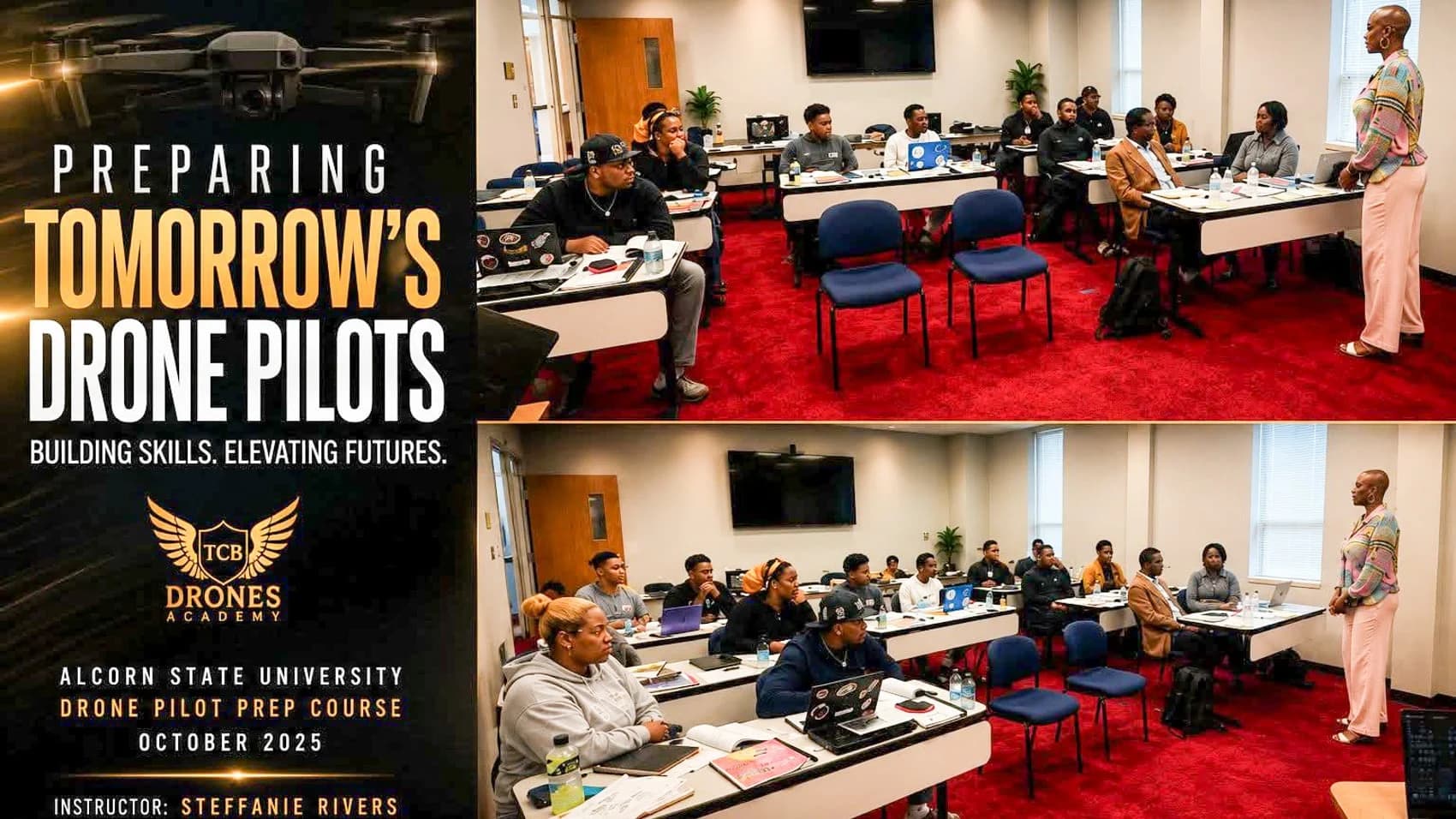
Steffanie Rivers, founder of TCB Drones Academy in Dallas, Texas, announced a nationwide initiative on July 4 aimed at guiding students at Historically Black Colleges and Universities (HBCUs) toward careers in the drone and aviation industry. The program has been formally named the National HBCU Aviation and Drone Leadership Initiative.
Image source: Ein Press Wire
Rivers, an alumna of Tennessee State University, describes herself as the first Black woman in Texas to found a drone academy. She says the initiative's core objective is to help HBCU students understand that earning a drone pilot certificate is not just a hobby pursuit — it is the entry point to a paying career. She plans to bring certification training, career events, and mentorship programs to campuses by the end of 2026.
Rivers: Drones Are a Career, Not a Toy
In announcing the initiative, Rivers repeatedly emphasized a single message: commercial drone piloting is a stable, compensated profession — not a weekend pastime — yet too many Black and minority students are simply unaware that the industry is hiring.
She noted that public safety, construction, agriculture, surveying, and infrastructure inspection are all fields where licensed drone operators are already finding work. The entry-level credential is the FAA Part 107 Remote Pilot Certificate — an aeronautical knowledge exam that, once passed, authorizes the holder to fly drones commercially. Certified pilots can take on work such as inspecting rooftops for insurance companies, mapping construction sites, capturing real estate imagery, and monitoring crop health for farmers.
Image source: Ein Press Wire
According to Ein News Desk, Rivers' TCB Drones Academy primarily helps students prepare for the Part 107 exam and then connects them to commercial work opportunities. The new initiative extends that training model to HBCU campuses, where Rivers believes awareness of drone career pathways has been especially slow to spread.
Since Part 107 regulations took effect in 2016, the commercial drone workforce has grown steadily, reaching into municipal governments, utility companies, farms, and film production. However, the FAA does not publish demographic breakdowns of licensed pilots, meaning the underrepresentation Rivers describes — while visible to anyone attending industry events — cannot be confirmed through official statistics. That is precisely why she has chosen her own visibility as her most powerful argument.
Initiative Is Still an Early-Stage Declaration, with Only Two Campus Partnerships Confirmed
At this stage, the initiative is more of a public commitment than a fully operational institution. Rivers says the program will advance through 2026 via workshops, keynote presentations, career events, and mentorship matching, and she has invited universities, workforce development organizations, and corporate partners to join.
Image source: Ein Press Wire
The confirmed on-the-ground activity is considerably more modest than the word "national" implies. Rivers has mentioned classroom instruction and curriculum planning discussions at Alcorn State University in Mississippi, as well as an ongoing working relationship with Arkansas Baptist College in Little Rock, Arkansas.
No specific funding figures, formal partner lists, or campus event schedules have been announced. The initiative was publicized through a commercial newswire service, and the "first in Texas" designation is Rivers' own characterization — not a third-party verified record. In its current form, this is a founder with a genuine track record in Part 107 training formally naming and setting goals for her next phase of growth.
Rivers established TCB Drones after earning her own Part 107 certificate, operating a small academy that offers both online and in-person exam preparation. The HBCU initiative is a scaling effort layered on top of that foundation, not a separate institution with its own faculty or budget. That distinction is worth stating clearly, because in the drone training market, the line between a nationally branded program and a solo-instructor operation can be easy to blur.
HBCUs Carry a Deep Aviation History of Their Own
The engagement of historically Black universities in aviation is not new, and that history gives this initiative a genuine foundation to build on. The legacy traces back to the Tuskegee Airmen — roughly 1,000 Black military pilots who flew during World War II through a civilian pilot training program.
Tuskegee University today offers an aerospace engineering degree, one of the few HBCUs to do so. Delaware State University is widely recognized as having the largest aviation program among HBCUs, operating its own aircraft fleet and holding a pilot training partnership with United Airlines.
Drones represent a new branch on that tree. Elizabeth City State University in North Carolina holds state authorization for drone research and training, and several HBCUs have incorporated unmanned aerial systems coursework into their programs as the commercial market has expanded. Rivers is not pioneering an entirely new track — she is working to widen one that already exists.
The cost structure makes drones a genuinely accessible entry point. Manned aviation degrees require years of study and significant expense; organizations such as the Organization of Black Aerospace Professionals have spent decades trying to move the needle on minority representation in cockpit seats. By contrast, the Part 107 certificate requires passing a single knowledge exam at a cost of a few hundred dollars. That is the door Rivers is trying to open wider — and its threshold is considerably lower than the one her aviation predecessors faced.
DroneXL Perspective
What does not make it into the headline is often where the real work begins. Earning a certificate is the easiest step; the genuine challenge is finding clients willing to pay for your skills rather than becoming one more operator among the thousands who have already been flying for years.
That is precisely why this initiative deserves recognition. Rivers is laying a path to opportunity for more people, and that matters in its own right. From Quito, this reporter tips his hat to her and wishes her every success.
Image source: Ein Press Wire
原文來源: 查看原文
FAQ
Newsletter
Subscribe to our Low-Altitude Industry Newsletter
Daily curated news on low-altitude economy and drone industry, delivered to your inbox.
Reviewed and published by the LAETimes editorial desk ·