IISS Report: Russia Used Shadow Fleet to Conduct 18-Month Drone Surveillance Campaign Against European NATO Bases
The International Institute for Strategic Studies (IISS) has published a report assessing that Russia most likely conducted a systematic drone reconnaissance and harassment campaign against sensitive NATO military facilities across Europe between August 2024 and February 2026, launching UAVs from shadow-fleet tankers in international waters. Targets included nuclear weapons sharing sites and France's ballistic missile submarine base. The operation forced repeated airport closures and exposed critical gaps in NATO's collective air defence architecture.

Highlights
- The IISS assesses with high confidence that Russia conducted a systematic drone campaign over European NATO military sites from August 2024 to February 2026, using a shadow fleet of over 1,300 tankers as launch platforms in international waters.
- Targets included US B61-12 nuclear weapons sharing bases and France's ballistic missile submarine base at Île Longue, with drone sightings also recorded over Ramstein Air Base and multiple UK RAF installations.
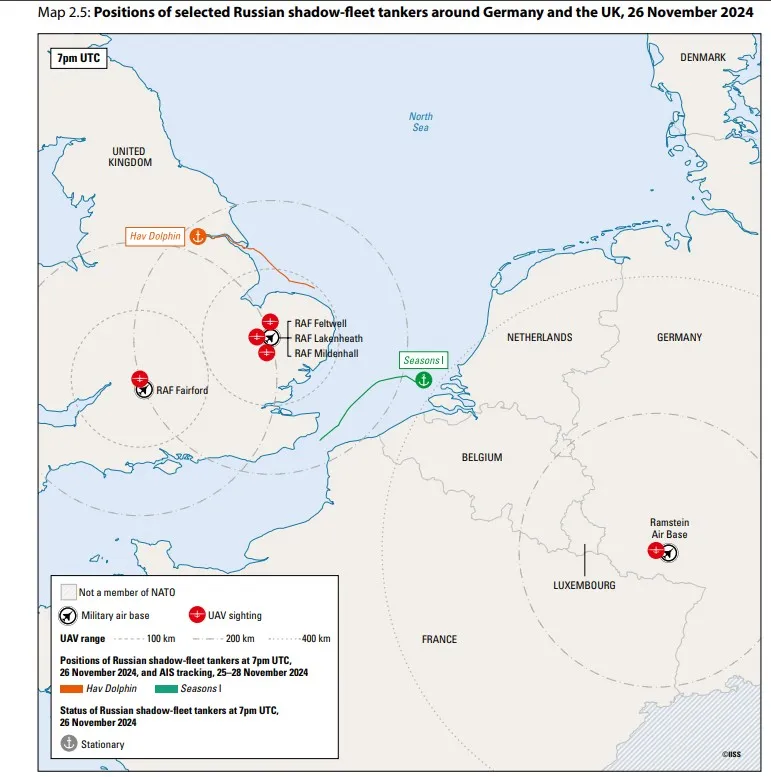
- The vessel Hav Dolphin was specifically linked by IISS to drone incidents in Germany and the Netherlands in 2025, and was berthed in a UK port during RAF base drone intrusions.
- No European government has formally attributed the drone sightings to Russia, and no drones overflying nuclear facilities have been recovered intact nor operators arrested.
- Europe's fragmented rules of engagement across jurisdictions remain the primary gap enabling continued Russian exploitation, according to the IISS report's conclusion.
Russia Conducted 18-Month Drone Campaign Over Europe, IISS Report Reveals NATO Defence Gaps
Between August 2024 and February 2026, unidentified unmanned aerial vehicles (UAVs) were repeatedly detected over sensitive NATO military installations across Europe — including nuclear weapons sharing sites storing US B61-12 gravity bombs and France's ballistic missile submarine base at Île Longue, Brittany. The drone incursions forced multiple major civilian airports to close on numerous occasions, disrupted military operations, and generated widespread public alarm.
The International Institute for Strategic Studies (IISS), following an in-depth investigation, has assessed that this systematic UAV campaign targeting European military facilities formed part of Russia's broader unconventional warfare effort against Europe, and has published a detailed report outlining its findings.
"We assess that the Kremlin very likely conducted a drone campaign over Europe," the IISS report states, noting the operation began in August 2024 and continued uninterrupted through 2025 and into 2026.
It is worth noting, however, that no European government has formally attributed these drone sightings to Russia. The report also relies primarily on circumstantial evidence and open-source intelligence.
The Shadow Fleet: A Covert Launch Platform on the High Seas
The report concludes that Russia likely used its shadow fleet to launch drones from international waters.
"We assess that Russian-linked vessels and 'shadow fleet' tankers were very likely used as drone launch and recovery platforms, as part of the Kremlin's broader unconventional warfare campaign against Europe."
Since 2022, Russian oil exports have become increasingly dependent on a fleet of ageing, re-flagged tankers acquired through layered holding structures registered in the Marshall Islands, Panama, and Sierra Leone. In a notable irony, the very sanctions that Western nations imposed on Russia — and Moscow's reliance on the shadow fleet to circumvent them — appear to have provided the Kremlin with a ready-made platform for systematic drone operations over Europe.
The number of tankers estimated to be part of Russia's shadow fleet exceeds 1,300 vessels.
"While the primary purpose of these vessels is to obstruct sanctions enforcement and complicate port-state controls, a secondary effect is to hinder intelligence agencies from attributing hybrid operations to specific ships," the report notes.
Technically, the most common method for launching drones involves what is termed "dark sailing" — vessels approach a target coastline with their transponders switched off, bringing onboard drones within strike or reconnaissance range.
"A plausible scenario is that Russian-linked vessels or shadow fleet tankers entered an operational area, switched off their AIS transponders during drone launch or recovery, and resumed normal transmissions upon departure," the report explains.
The IISS report specifically highlights the vessel Hav Dolphin, which was later linked to drone incidents in Germany and the Netherlands in 2025, and was berthed at a UK port during a period when Royal Air Force bases were experiencing drone intrusions.
Russia's Strategic Objectives
The report warns that Russia's systematic drone campaign against European military facilities represented "a tactical success for the Kremlin and a strategic failure for Allied air defences."
Drones were spotted over multiple European military installations, including Ramstein Air Base in Germany and several Royal Air Force bases in the United Kingdom — RAF Lakenheath, RAF Fairford, RAF Feltwell, and RAF Mildenhall.
The report explains how Russia was able to systematically penetrate European airspace for nearly two consecutive years: "The Kremlin's success was built on a fundamental strategic insight — that European air defence systems were designed to detect and counter conventional air threats operating within defined battlespace parameters."
"They were not designed to counter relatively low-cost drones and deniable penetrations intended to expose gaps in detection, decision-making, and legal authorisation, while remaining below the threshold of collective Allied response."
The Russian drone campaign served multiple objectives:
- Probing Allied response times and decision-making thresholds: Testing the reaction times and escalation thresholds of Allied air defence and civil-military command structures
- Mapping critical infrastructure vulnerabilities: Including dual-use civilian hubs, military logistics nodes supporting Ukraine, and facilities linked to Allied nuclear deterrence
- Imposing economic and psychological costs: Disrupting civil aviation and eroding public confidence in airspace security
- Normalising low-level airspace violations: Sustaining operations below the threshold of direct Allied military response to make such incursions routine
The report assesses that the campaign very likely provided Russian planners with intelligence of significant operational value: radar exposure data, response times, intercept corridors, rules of engagement thresholds, and geographic information on NATO's cross-European reinforcement routes and supply lines to Ukraine.
European National Responses
Following multiple drone incursions, many European countries have moved to reform outdated legislation governing counter-drone operations.
In Germany, the Bundeswehr was previously authorised by law to shoot down drones only if they flew directly over military installations, with airspace protection strictly assigned to law enforcement agencies. After a series of incidents, German authorities passed amendments explicitly authorising police to shoot down drones, and established a National Drone Defence Centre (Drohnenabwehrzentrum) to integrate functions across the Federal Police, state agencies, and the Bundeswehr.
The Netherlands held drone and counter-drone exercises in May 2026. Lithuania has explicitly authorised the shootdown of cross-border drones in peacetime, while Romania has established a legal framework explicitly authorising its military to intercept and destroy hostile drones.
The European Union plans to establish a counter-drone Centre of Excellence in Geel, Belgium, in early 2027. In September 2025, a drone incursion into Polish airspace prompted Warsaw to invoke NATO Article 4 — a mechanism allowing member states to request consultations when they feel their territorial integrity is threatened — marking the eighth such invocation in NATO's history.
Critical Gaps Remain in Europe's Collective Response
Despite these measures, significant gaps persist in Europe's collective response and air defence architecture that Russia may continue to exploit.
The report identifies the maritime dimension as the most significant unresolved vulnerability. "If Russian-linked vessels can launch, support, or relay drone operations from the high seas or within European Exclusive Economic Zones (EEZs), they can complicate attribution, exploit commercial cover, and circumvent the early-warning indicators associated with land-border intrusions."
At the same time, Russia's use of drones has exposed limitations in its own intelligence-gathering capabilities. Following the mass expulsion of Russian intelligence officers from European countries since 2022, the Kremlin has been forced to seek workarounds — and this drone campaign has also laid bare shortfalls in Russia's satellite imagery and reconnaissance capacity, particularly when compared with the military and commercial space assets available to Ukraine and NATO member states.
The report's overall conclusion is that Europe's current response remains fragmented, incomplete, and insufficient to deter Russia from continuing to conduct drone operations over sensitive European facilities.
"Foremost, as long as rules of engagement remain fragmented across jurisdictions, the Kremlin will continue to exploit that fragmentation."
The report also underscores that not a single drone overflying nuclear facilities has been recovered intact, and no operator has been arrested for launching drones from shadow fleet vessels. To date, with the exception of an incident involving the aircraft carrier Charles de Gaulle, no other event has been publicly attributed to Russia, and there remains no clear consensus on what constitutes "hostile action" or when a drone incursion should trigger a military response.
The IISS report emphasises that Europe urgently needs clear, legally grounded, and robustly coordinated response mechanisms to address the threat posed by Russia's unconventional and hybrid warfare — conducted via shadow fleet vessels launching drones from international waters.
原文來源: 查看原文
FAQ
Newsletter
Subscribe to our Low-Altitude Industry Newsletter
Daily curated news on low-altitude economy and drone industry, delivered to your inbox.
Reviewed and published by the LAETimes editorial desk ·