MIT Study Reveals How Russia's Nuclear-Powered 'Skyfall' Cruise Missile Works — and Why It Leaves a Radioactive Trail
Two MIT scientists have published a detailed analysis concluding that Russia's Burevestnik cruise missile (NATO designation SSC-X-9 'Skyfall') almost certainly uses a direct-cycle air-breathing nuclear propulsion system. Atmospheric air passes directly through the reactor core before being exhausted, continuously releasing radioactive isotopes of argon, krypton, and carbon along the missile's flight path — posing serious environmental and safety concerns.

Highlights
- MIT professors Jake Hecla and R. Scott Kemp concluded that Russia's Burevestnik cruise missile almost certainly uses a direct-cycle air-breathing nuclear propulsion system, based on open-source analysis of its dimensions (31 ft long, 18 ft wingspan) and Mach 0.75 flight speed.
- In a direct-cycle system, atmospheric air passes directly through the reactor core and is exhausted as thrust, continuously releasing radioactive isotopes of argon, krypton, and carbon along the entire flight path.
- A Burevestnik test flight in October 2024 lasted 15 hours above the Arctic Circle, which the MIT researchers assessed as the first-ever instance of sustained nuclear-powered flight by any vehicle.
- The 2019 explosion near Nenoksa that killed five Rosatom scientists is believed to have been caused by a Burevestnik prototype reactor being recovered from the seabed following a failed 2017 test.
- Former IISS analyst William Alberque argues Burevestnik's slow speed, radiation leakage, lack of stealth, and reactor degradation make it of limited practical military value — the same reasons all Cold War-era nuclear propulsion programmes were abandoned.
MIT Study Reveals How Russia's Nuclear-Powered 'Skyfall' Cruise Missile Works — and Why It Leaves a Radioactive Trail
Russia's mysterious Burevestnik cruise missile (NATO designation SSC-X-9 'Skyfall') very likely leaves a trail of radioactive material in its wake, making this weapon far more alarming than initially anticipated. That is the conclusion of two scientists at the Massachusetts Institute of Technology (MIT), who recently published a detailed analysis of one of the so-called 'superweapons' unveiled by Russian President Vladimir Putin in 2018.
Background
The report, authored by MIT professor of aerospace and nuclear science and engineering Jake Hecla and co-author R. Scott Kemp, provides the most compelling analysis to date of how Burevestnik is actually powered. Previous uncertainty about the weapon had led some observers to question whether Russia's claims of nuclear propulsion were credible at all.
Historical Context: A Brief History of Nuclear-Powered Flight
Before examining Burevestnik in detail, it is worth recalling the history of nuclear-powered aircraft development.
During the 1950s, both the Soviet Union and the United States tested airborne nuclear reactors aboard a B-36 Peacemaker bomber and a Tu-95 Bear bomber respectively, though in neither case did the reactors actually power the aircraft's engines.
The U.S. Project Pluto investigated nuclear-powered cruise missiles and completed ground reactor tests in 1964, before ultimately being cancelled. Project Pluto's concept differed significantly from Burevestnik — it envisioned a missile flying at low altitude at Mach 3.5, dispensing nuclear weapons at various points along its flight path using a 'pop-up' manoeuvre.
Putin's 'Superweapon' Announcement
In 2018, Putin publicly disclosed the existence of Burevestnik, listing it among six 'superweapons' that also included hypersonic weapons and a nuclear-powered nuclear torpedo.
Shortly after Putin's announcement, Norwegian environmental group Bellona noted an anomalous spike in radiation levels in the Arctic that winter, which may have been linked to a missile test. Later in 2018, a U.S. intelligence report described an incident in which Russia lost a nuclear-powered missile during a 2017 test and indicated that Russian forces planned a recovery operation.
In 2019, an explosion aboard a barge near Nenoksa on the White Sea killed five Russian Rosatom scientists and caused radiation levels to spike in the city of Severodvinsk. The explosion was attributed to a Burevestnik prototype reactor — most likely the one lost in 2017 — being recovered from the seabed.
In October 2024, Russian Chief of the General Staff Valery Gerasimov announced the successful completion of a Burevestnik test flight lasting 15 hours above the Arctic Circle, noting that this was 'not the limit.' Hecla and Kemp assessed this test as marking the first time a vehicle had ever achieved sustained nuclear-powered flight.
The Core Question: How Does Burevestnik Convert Nuclear Energy Into Thrust?
Based on data gathered by the researchers, Burevestnik's size, shape, and performance characteristics indicate a propulsion system fundamentally different from what Project Pluto envisioned. The U.S. concept used a ramjet to achieve supersonic performance.
Speaking to NPR, Hecla described Burevestnik as 'clearly a subsonic system.'
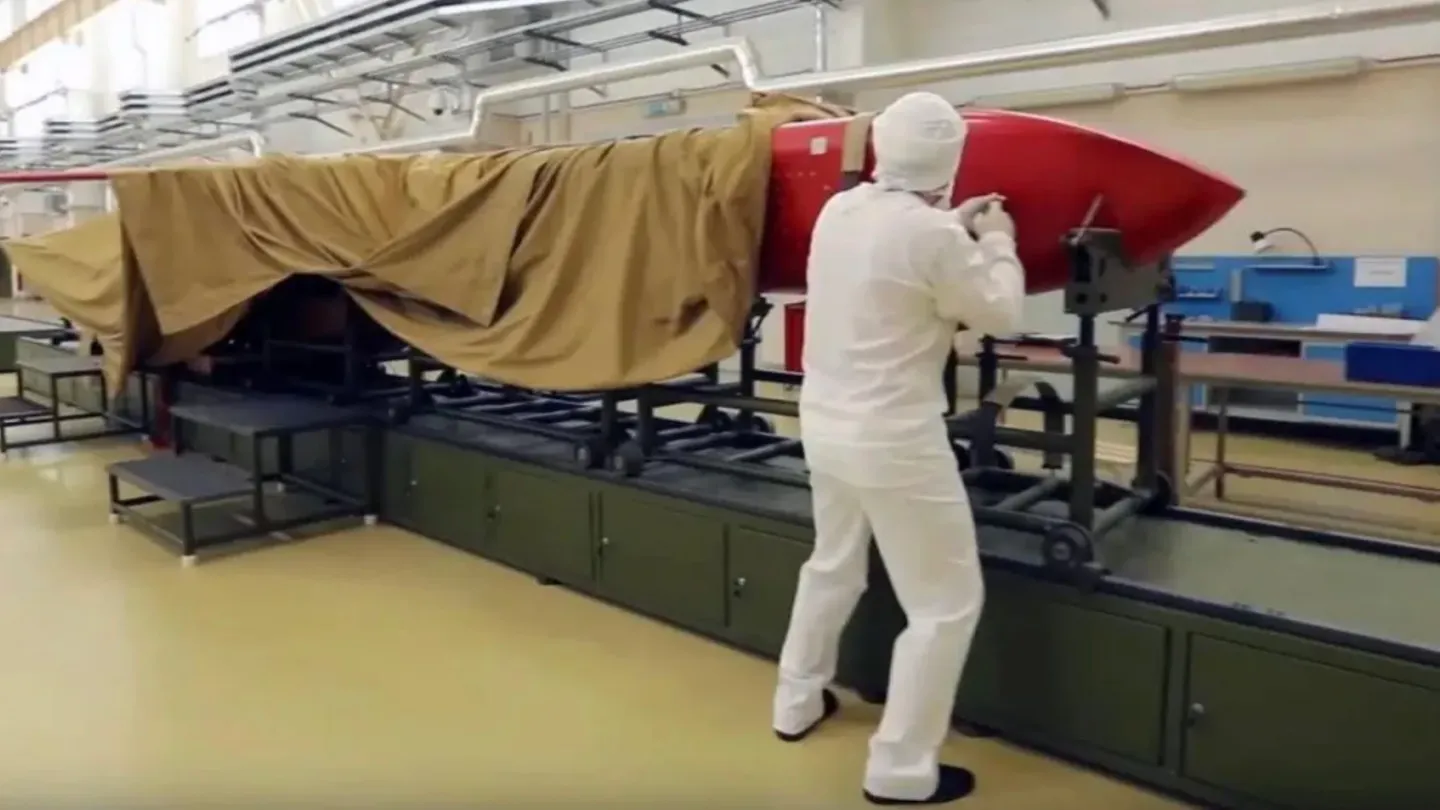
Using open-source imagery analysis, the researchers calculated that Burevestnik is approximately 31 feet (9.5 metres) long with a wingspan of around 18 feet (5.6 metres), and flies at roughly Mach 0.75.
Direct-Cycle Nuclear Propulsion
The researchers concluded that Burevestnik 'almost certainly' employs a direct-cycle air-breathing nuclear propulsion system, most likely driving a turbojet engine.
In a direct-cycle system, atmospheric air is drawn in and passed directly through the reactor core. A compressor forces air through thousands of narrow tube-shaped channels surrounding the nuclear fuel; heat generated by fission causes the air temperature to rise sharply; and the thermally expanded air is expelled from the rear of the engine to generate thrust.
This design is fundamentally different from most nuclear reactors, which use an indirect, closed-cycle arrangement in which a sealed coolant — typically water or another heat-transfer fluid — circulates through the reactor to carry away heat while keeping radioactive material contained.
The researchers noted that while an indirect-cycle design was not impossible, such systems are larger, heavier, and more complex, and could simply not be accommodated within a missile of this size — making direct cycle by far the more probable option.
The Critical Problem: A Radioactively Contaminated Flight Path
While the direct-cycle system is simpler and more compact, it comes with a serious drawback. As Hecla noted: 'Direct cycle is quite likely to result in a lot of radioactive material coming out in the exhaust.'
In essence, as clean atmospheric air passes through the narrow channels in the reactor, it becomes irradiated and mixes with fission decay products from the nuclear fuel. The hot air expelled by the turbojet engine is laden with radioactive isotopes of argon, krypton, and carbon, which are dispersed into the atmosphere and over the terrain below along the entire flight path.
The longer the missile flies, the more hazardous waste it discharges into the atmosphere and onto the ground beneath it.
The researchers also identified a secondary problem: prolonged flight may cause the reactor core to corrode due to the combined effects of high temperature and compressed air, generating additional radioactive particles in the process.
Why Is Russia Pressing Ahead?
Burevestnik's principal advantage lies in its virtually unlimited range. As strategic analysts have observed, the missile could be launched pre-emptively and approach its target from any direction — for example, launched from the Arctic and striking the United States from the south after hours of flight. Once airborne, its flight path is entirely unpredictable, allowing it to exploit gaps in missile defences and early-warning coverage.
However, Burevestnik's disadvantages are equally apparent: it is slow and easy to intercept once detected; Russia has stated it is designed to carry only nuclear warheads, severely limiting its flexibility; and its operational utility is questionable.
William Alberque, former head of the Strategy, Technology and Arms Control programme at the International Institute for Strategic Studies (IISS), told The War Zone: 'It leaks radiation and is easily tracked; it flies slowly and has no stealth, so it can be shot down; and the missile itself degrades during reactor operation, calling its so-called 'unlimited' range into serious question.'
'That's why everyone abandoned this concept during the Cold War, and for more than one reason,' Alberque added.
Looking Ahead: Technology Demonstrator or Putin's Pet Project?
Hecla and Kemp assessed that Russia's primary motivation for developing Burevestnik may be to validate the technology for use in more ambitious future programmes — such as nuclear-powered surveillance drones or space-based nuclear systems — which would offer considerably greater military value.
An alternative explanation is that this is a personal obsession of Putin himself — a leader drawn to the concept of a missile with near-unlimited range, pressing ahead regardless of practical utility.
What the latest analysis makes clear is that the October 2024 test appears to confirm Burevestnik as the first vehicle ever to achieve sustained nuclear-powered flight — a milestone, but one accompanied by grave concerns about safety for those in the vicinity, serious environmental implications, and significant questions about its limited military value.
This article is based on reporting originally published by The War Zone. Contact: thomas@thewarzone.com
原文來源: 查看原文
FAQ
Newsletter
Subscribe to our Low-Altitude Industry Newsletter
Daily curated news on low-altitude economy and drone industry, delivered to your inbox.