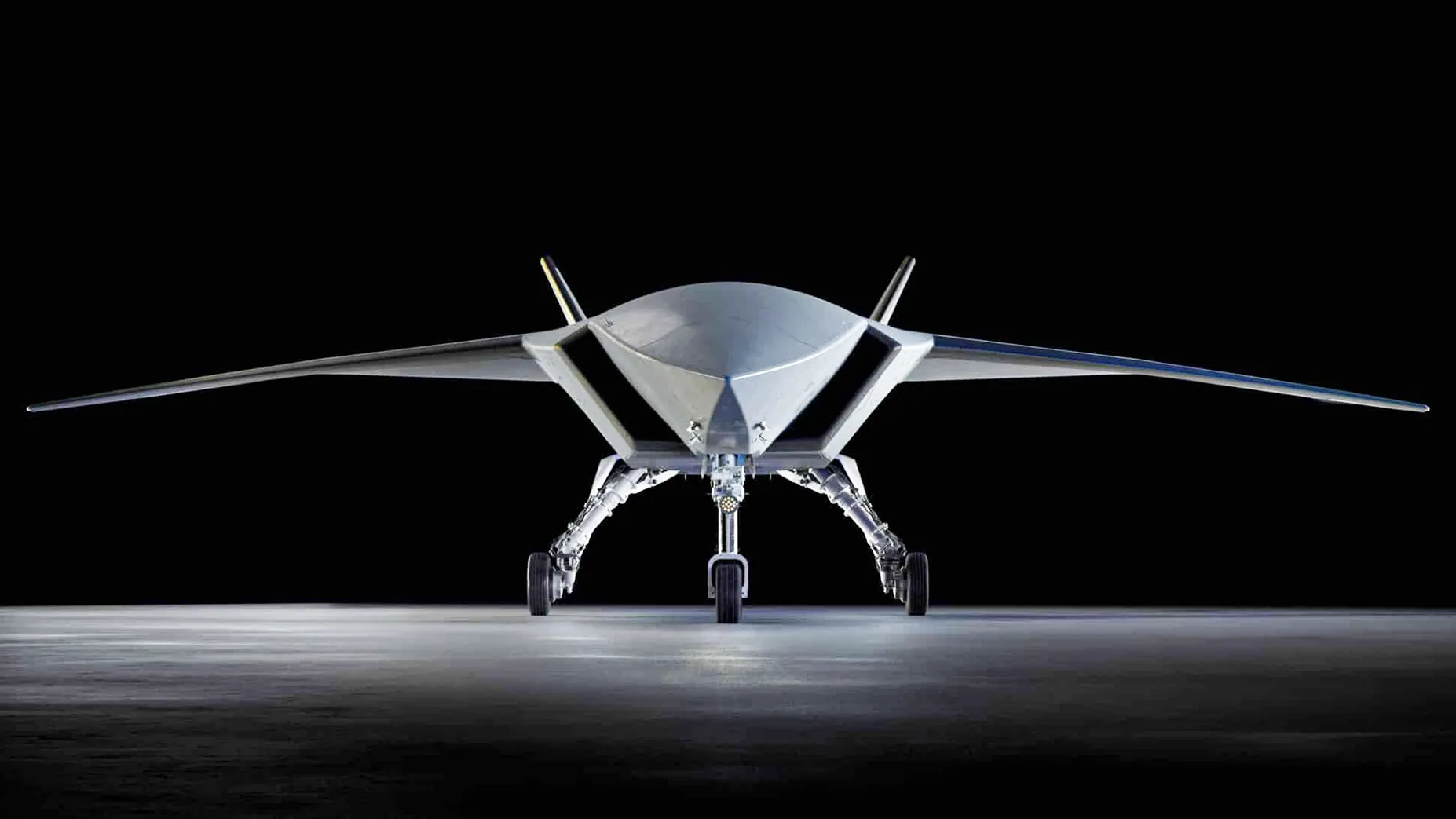
Boeing MQ-28 Ghost Bat Block 3 Debuts at ILA Berlin: 25% Larger Wings, Internal AIM-120 Missile Carriage
Boeing unveiled the MQ-28 Ghost Bat Block 3 at ILA Berlin Air Show, featuring a 25% increase in wing area, thrust upgraded to 12,000 lbs, new internal weapons bays capable of carrying AIM-120 AMRAAM missiles, and beyond-line-of-sight control via satellite link. The Block 3 is expected to enter service with the Royal Australian Air Force in 2028, with potential delivery to Germany by 2029.

Highlights
- Boeing unveiled the MQ-28 Ghost Bat Block 3 at ILA Berlin 2025, with wing area increased by 25% and engine thrust upgraded from 10,000 to 12,000 lbs.
- Block 3 introduces internal weapons bays capable of carrying AIM-120 AMRAAM missiles, making the Ghost Bat the first known loyal wingman drone with internal AMRAAM carriage.
- The aircraft gains beyond-line-of-sight (BLOS) control via satellite link, enabling operation from ground stations or naval vessels without range limitations across its 2,000+ nautical mile range.
- Boeing expects to begin building the first Block 3 aircraft in 2025, with RAAF operational service targeted for 2028.
- Rheinmetall CEO Armin Papperger indicated Germany must enter final contract negotiations by 2025 at the latest to receive the MQ-28 before 2029.
Boeing MQ-28 Ghost Bat Block 3 Makes Major Debut at ILA Berlin
Boeing formally unveiled the latest iteration of its MQ-28 Ghost Bat Collaborative Combat Aircraft (CCA) — the Block 3 — at ILA Berlin Air Show in Germany this week. Already regarded as the world's most mature loyal wingman drone, the Ghost Bat receives sweeping upgrades in its newest configuration, including a larger airframe, increased thrust, and a critical internal weapons bay.
The announcement was made jointly by Boeing Australia and Rheinmetall officials. The German defense giant is partnering with Boeing to market the aircraft to the German armed forces while also targeting the broader European CCA market.
A Bigger, More Powerful, Longer-Reaching Airframe
Glen Ferguson, Boeing's MQ-28 Global Program Director, told attendees: "This is the aircraft we are offering Germany. This is the third design iteration, and we expect to begin building the first Block 3 aircraft next year."
The Block 3 features a 25% increase in wing area and an engine thrust upgrade from 10,000 lbs to 12,000 lbs. These improvements translate into an additional 2,000 lbs of capacity for fuel, weapons, and mission payloads. Ferguson noted: "That extra capacity gives operators the freedom to balance payload against endurance — whether carrying more fuel for long-range missions, increasing weapons load, or a combination of both."
Previous Block 1 and Block 2 variants have already completed more than 150 test flights across Australia and the United States. Australia has procured eight Block 1 aircraft as pre-production prototypes, while the first batch of nine Block 2 aircraft currently in production serves as a transition towards full operational capability.
Internal Weapons Bay: AIM-120 AMRAAM Carriage Confirmed
The standout upgrade is the addition of internal weapons bays, integrated into flat-sided conformal structures on the fuselage. Each bay can carry one AIM-120 Advanced Medium-Range Air-to-Air Missile (AMRAAM), or two Small Diameter Bombs (SDB) — including the GBU-39/B SDB I or the GBU-53/B SDB II (StormBreaker).
The Ghost Bat is the first known loyal wingman drone capable of internally carrying the AIM-120 — a significant milestone in its own right. Internal carriage ensures the aircraft retains its low-observable (stealth) characteristics while armed. Boeing has also recently validated the MQ-28's radar cross-section (RCS), confirming the aircraft is significantly harder to detect in contested environments.
Three external hardpoints are also retained. At least one has already been tested in an end-to-end engagement trial, successfully employing an AMRAAM to destroy a target drone. Combined with internal carriage, Block 3 can theoretically carry up to five AIMRAMs, or a mixed air-to-air and air-to-ground loadout.
Beyond-Line-of-Sight Control and Independent Operations
Block 3 introduces beyond-line-of-sight (BLOS) control capability via satellite communications link, enabling the MQ-28 to be operated from ground stations, naval vessels, or manned aircraft without range limitations. Given the aircraft's range of over 2,000 nautical miles, the BLOS capability also ensures the Ghost Bat can conduct independent operations when operating beyond the range of a controlling manned aircraft — a role long envisioned for the platform. The satellite comms option also improves control resilience in electronic warfare environments.
Modular Sensor Payloads
Boeing is known to be developing three to four alternative sensor payload packages. The entire nose section can be replaced to accommodate different systems, including an Infrared Search and Track (IRST) sensor among other options.
Fierce Competition at ILA Berlin
The Ghost Bat faced stiff competition on the show floor in Berlin. Airbus publicly displayed a full-scale model of its U760 Ravenstorm combat drone for the first time, while also promoting a European variant of the XQ-58A Valkyrie, emphasizing lower cost and runway-independent operations. General Atomics showcased its Gambit family of unmanned systems and confirmed it is in active discussions with Germany regarding CCA requirements. German firm Helsing unveiled an electronic attack variant of its CA-1 Europa, designated the CA-1EA.
Rheinmetall CEO Armin Papperger stated: "We are still in negotiations with the German government, but if they want this aircraft before 2029, I expect we will need to enter final contract negotiations by next year at the latest."
Entry into Service and Outlook
Ferguson confirmed that the MQ-28 is on track to enter service with the Royal Australian Air Force in 2028, stating he is "pretty confident this will be the world's first loyal wingman to enter operational service." When Boeing and Rheinmetall announced their strategic partnership in March of this year, they indicated the MQ-28 could be delivered to Germany before 2029.
Notably, Boeing is also conducting Ghost Bat flight trials at Naval Air Weapons Station Point Mugu in California. While the company states the primary objective is demonstrating design maturity and supporting export sales, the tests may also signal potential interest from the U.S. military.
The Block 3 debut underscores how rapidly the loyal wingman market is maturing — and the MQ-28 Ghost Bat continues to lead the global armed unmanned combat aircraft race.
原文來源: 查看原文
FAQ
Newsletter
Subscribe to our Low-Altitude Industry Newsletter
Daily curated news on low-altitude economy and drone industry, delivered to your inbox.