'The Threat Is Real': Germany to Deploy MQ-9 Drones Alongside P-8 Poseidon Aircraft to Track Russian Submarines
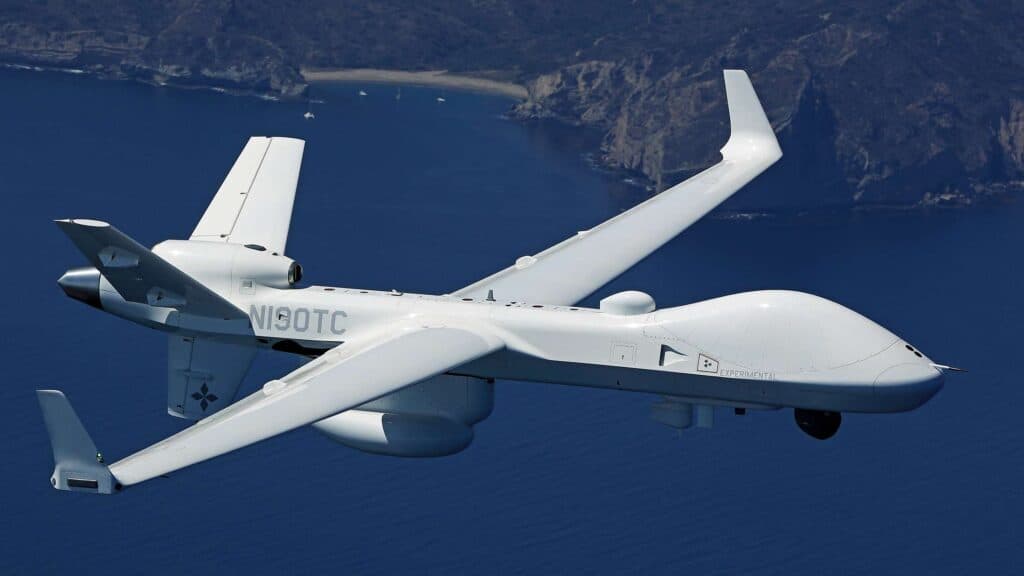
German Naval Aviation Command Commander Colonel Broder Nielsen has confirmed that the MQ-9B will become the first unmanned system to operate alongside Germany's P-8 Poseidon maritime patrol aircraft. The two platforms will be integrated gradually to enhance surveillance and tracking capabilities against Russian submarine activity in the Baltic Sea and North Atlantic.

Highlights
- Colonel Broder Nielsen, Commander of the German Naval Aviation Command, confirmed the MQ-9B will be Germany's first unmanned system to operate alongside the P-8 Poseidon maritime patrol aircraft.
- Integration will follow a step-by-step approach, with full manned-unmanned teaming (MUM-T) capability yet to be established as Germany is currently in the early stages.
- The deployment directly responds to growing Russian submarine activity in the Baltic Sea and North Atlantic, with Nielsen stating 'the threat is real.'
- The P-8 Poseidon (Boeing) will handle command coordination and high-intensity tasks, while the General Atomics MQ-9B provides long-endurance persistent surveillance over target areas.
- Germany's initiative is part of a broader NATO effort to strengthen undersea surveillance capabilities following the outbreak of the Russia-Ukraine war.
'The Threat Is Real': Germany to Deploy MQ-9 Drones Alongside P-8 Poseidon Aircraft to Track Russian Submarines
Colonel Broder Nielsen, Commander of the German Naval Aviation Command, has announced that the MQ-9B will become the first unmanned aircraft system to operate in conjunction with Germany's P-8 Poseidon maritime patrol aircraft. He emphasized that integration will proceed on a "step-by-step" basis.
"The MQ-9B will be the first [unmanned] system we operate alongside the P-8 — the idea is for these drones to work in close coordination with the manned aircraft, but we will take it one step at a time," Colonel Nielsen stated.
Responding to the Russian Submarine Threat
The deployment plan is a direct response to increasing Russian submarine activity in the Baltic Sea and the North Atlantic. Colonel Nielsen was candid about the security environment: "The threat is real." Since the outbreak of the Russia-Ukraine war, NATO member states have continuously strengthened their undersea surveillance capabilities. Germany's move to integrate manned and unmanned platforms for anti-submarine warfare (ASW) is part of this broader effort.
The P-8 and MQ-9B Combined Operations Concept
The P-8 Poseidon, developed by Boeing, is a multi-mission maritime patrol aircraft widely used for ASW, surface warfare, and intelligence gathering, and has been adopted by numerous NATO allies. The MQ-9B, manufactured by General Atomics, is a long-endurance unmanned aerial vehicle capable of extended loitering, sensor carriage, and weapons employment.
Combining the two platforms significantly extends the reach of maritime patrol operations: the P-8 handles command coordination and high-intensity mission requirements, while the MQ-9B provides persistent surveillance over a target area for extended periods — creating a complementary manned-unmanned teaming (MUM-T) operational model.
A Phased Integration Plan
According to Colonel Nielsen, the German Navy is still in the early stages of integration, and the full operational capability of combined manned-unmanned missions has yet to be established. Experience will be built through exercises and training, with the drone's role in maritime surveillance missions expanded incrementally based on results.
The move signals Germany's continued commitment to strengthening maritime security on NATO's eastern flank and in the Baltic region, while actively advancing the operational application of manned-unmanned teaming (MUM-T) concepts.
原文來源: 查看原文
FAQ
Newsletter
Subscribe to our Low-Altitude Industry Newsletter
Daily curated news on low-altitude economy and drone industry, delivered to your inbox.