NATO Selects Saab GlobalEye to Replace Aging E-3 AWACS Fleet
NATO announced at the Ankara Summit in Turkey that it will procure up to 10 Saab GlobalEye airborne early warning and control (AEW&C) aircraft to replace its fleet of 14 Boeing E-3A Sentry aircraft. After abandoning plans for the Boeing E-7A Wedgetail last year, GlobalEye emerged as the only viable alternative. Saab's CEO confirmed the system can achieve initial operational capability by 2031, with formal contract negotiations set to begin immediately.

Highlights
- NATO announced at the Ankara Summit plans to procure up to 10 Saab GlobalEye AEW&C aircraft to replace its 14 aging Boeing E-3A Sentry jets, with formal contract negotiations starting immediately.
- NATO abandoned its earlier plan to buy six Boeing E-7A Wedgetail aircraft in November 2024, citing lost strategic and financial foundations, leaving GlobalEye as the only viable Western jet-powered AEW&C candidate.
- Saab CEO Micael Johansson confirmed GlobalEye can achieve NATO initial operational capability before 2031.
- GlobalEye is built on a Bombardier Global 6500 airframe and integrates Saab's Erieye Extended Range radar, with customers including France, Sweden, and Canada, and interest from Denmark, Finland, Germany, and Poland.
- The NATO Ankara Summit also saw announcements covering up to five MQ-4C Triton HALE drones for four member states, Danish P-8A Poseidon procurement, a seven-nation A400M fleet, Finnish A330 MRTT tanker fleet accession, and European ATACMS and PAC-3 production initiatives.
NATO Selects Saab GlobalEye to Replace Aging E-3 AWACS Fleet
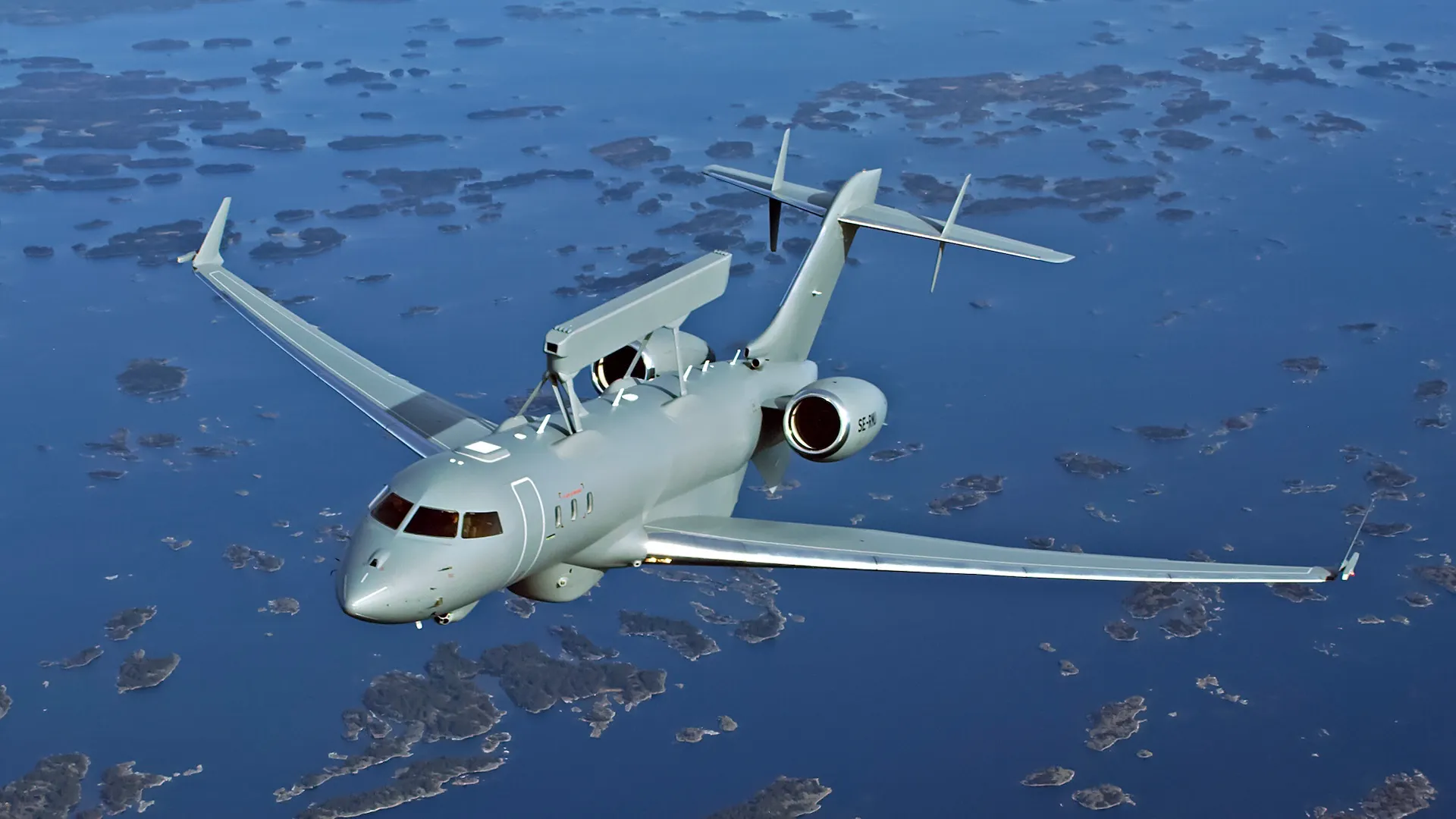
NATO announced at its summit in Ankara, Turkey today that it has selected the Saab GlobalEye as its next-generation airborne early warning and control (AEW&C) platform, with an order of up to 10 aircraft. The announcement came as NATO member states rolled out a sweeping series of major defence procurement decisions, spanning drones, maritime patrol aircraft, air-to-air refuelling tankers, and transport aircraft.
Formal Negotiations to Begin
NATO Secretary General Mark Rutte announced today that the Alliance will enter formal procurement negotiations with Saab for the GlobalEye. No contract has been signed, and no formal order has yet been placed.
The GlobalEye integrates Saab's Erieye Extended Range radar, multiple sensor suites, and a command-and-control (C2) system, all mounted on a Bombardier Global 6500 business jet airframe.
Saab President and CEO Micael Johansson said: "We are honoured to support NATO in building its next-generation AEW&C capability. We believe GlobalEye is the best choice for NATO, offering proven capabilities, adaptability, and long-term operational advantages. Today's announcement firmly positions GlobalEye as the world's leading advanced airborne early warning and control solution."
An Urgent Need to Replace the Ageing E-3 Fleet
NATO currently operates 14 Boeing E-3A Sentry aircraft through the NATO Airborne Early Warning and Control Force (NAEW&CF), based at Geilenkirchen Air Base in Germany. The fleet has grown increasingly aged and is expected to reach the end of its service life around 2035.
GlobalEye's path to winning the NATO order was far from straightforward. In 2023, NATO announced plans to acquire six Boeing E-7A Wedgetail aircraft as the first phase of its initial Alliance Future Surveillance and Control (iAFSC) programme. At the time, NATO deemed the E-7 "the only known system capable of meeting the core operational requirements of strategic command within the required timeframe."
However, in November last year, the Dutch Ministry of Defence announced that NATO was abandoning the E-7 procurement, citing a loss of "strategic and financial foundations," compounded by uncertainty over the future of the US Air Force's own Wedgetail programme. GlobalEye subsequently emerged as the only realistic candidate — it is currently the only other jet-powered AEW&C aircraft in Western production (the turboprop, carrier-capable Northrop Grumman E-2D Hawkeye remains in production as well).
Saab has stated that the GlobalEye can achieve initial operational capability for NATO before 2031.
Growing International Demand for GlobalEye
GlobalEye has attracted significant international interest: France has selected it to replace its E-3F Sentry fleet, Sweden has placed orders, and Canada has completed its platform selection. Saab is also marketing the aircraft to Denmark and Finland, and has confirmed that both Germany and Poland have expressed "interest."
Demand for AEW&C platforms has surged as Europe's security environment continues to deteriorate. Russia's ongoing aggression has underscored the necessity of wide-area, persistent surveillance and airspace control. Poland has already taken delivery of two Saab 340 twin-turboprop early warning aircraft equipped with Saab's earlier Erieye radar, while Ukraine has received similar platforms — highlighting the growing importance of such systems on NATO's eastern flank.
Russian drones operating in or near NATO airspace have added further urgency. AEW&C aircraft provide a critical look-down detection capability, particularly well-suited to tracking low-altitude threats — including drones and cruise missiles — that ground-based radars struggle to detect. Saab has specifically highlighted GlobalEye's performance in identifying low-observable and stealth threats, drones, and ballistic and hypersonic missiles, even in complex environments with heavy clutter and electronic warfare.
Summit Accompanied by Sweeping Procurement Announcements
The NATO summit coincided with a series of major defence procurement announcements:
MQ-4C Triton Drones: Denmark, Finland, Germany, and Norway announced the procurement of up to five Northrop Grumman MQ-4C Triton high-altitude long-endurance (HALE) unmanned aircraft to augment NATO's existing Alliance Ground Surveillance (AGS) fleet. In addition to missions over the Mediterranean and Black Sea, the aircraft will be deployed to the strategically vital Arctic and High North regions.
P-8A Poseidon Maritime Patrol Aircraft: Denmark announced an initial procurement of two P-8A Poseidon maritime patrol aircraft — a significant step for reinforcing sovereignty enforcement in the Arctic and Greenland, and for deepening Denmark's interoperability with fellow Poseidon operators including Canada, Germany, Norway, and the United Kingdom in anti-submarine warfare.
A400M Multinational Fleet: Belgium, Croatia, France, Poland, Spain, Turkey, and the United Kingdom announced plans to establish a multinational fleet centred on the Airbus A400M transport aircraft, addressing a strategic airlift capability gap among European allies.
A330 MRTT Multinational Tanker Fleet: Finland joined the existing Multinational MRTT Fleet (MMF), which already includes the Netherlands, Luxembourg, Norway, Germany, Belgium, the Czech Republic, Sweden, and Denmark. Of the 12 aircraft on order, nine are already in service.
Missile Industrial Base Strengthening: Lockheed Martin announced two initiatives: a partnership with Rheinmetall to produce ATACMS missiles locally in Europe, and exploratory work with Germany, the Netherlands, Poland, and Sweden to establish PAC-3 missile maintenance facilities on European soil.
The Rise of Europe's Defence Industry
GlobalEye's selection represents a landmark moment in the broader trend among European allies to reduce dependence on traditional US suppliers and redirect defence spending toward domestic manufacturers. Under the Trump administration, confidence in the United States as a reliable strategic partner has been shaken, prompting European officials to pursue home-grown solutions with greater urgency.
While the GlobalEye contract still requires formal negotiation and signature, today's announcement has effectively confirmed Saab's system as NATO's next-generation airborne early warning platform — and marks another major win for Saab in an increasingly competitive AEW&C market.
原文來源: 查看原文
FAQ
Newsletter
Subscribe to our Low-Altitude Industry Newsletter
Daily curated news on low-altitude economy and drone industry, delivered to your inbox.
Reviewed and published by the LAETimes editorial desk ·