Thales Pitches Armed Schiebel S-301 at Eurosatory 2026, Vying for Apache Loyal Wingman Role
At Eurosatory 2026 in Paris, Thales showcased the Schiebel S-301 armed unmanned helicopter as a multi-mission platform for ISR, precision strike, and counter-drone operations. Capable of carrying up to ten Martlet missiles, the S-301 has been shortlisted as one of four teams competing in the British Army's Project NYX loyal wingman programme, with an initial operational capability target of 2030 and a first demonstration planned for September 2026.

Highlights
- At Eurosatory 2026, Thales presented the Schiebel S-301 armed VTOL drone as a multi-mission platform for ISR, precision strike, and counter-drone operations, with up to 24 hours endurance carrying a 50 kg payload.
- The S-301 can carry up to ten Martlet (LMM) laser-guided missiles; the smaller S-101 carries two, following Schiebel's formal entry into the armed drone market at DSEI in September 2025.
- Thales and Schiebel were shortlisted in May 2026 as one of four teams — alongside Anduril, BAE Systems, and Tekever — competing in the British Army's Project NYX Apache loyal wingman programme, targeting IOC by 2030.
- The S-301's first Project NYX demonstration is scheduled for September 2026, operating in 'directed not controlled' autonomous mode with human-on-the-loop weapons release authority.
- Thales is developing a 'Swarm Master' drone command layer capable of coordinating up to 10 drones under a single operator, with first product delivery expected before end of 2027.
Thales Pitches Armed Schiebel S-301 at Eurosatory 2026, Vying for Apache Loyal Wingman Role
At Eurosatory 2026 in Paris, French aerospace and defence group Thales used the occasion to showcase the Schiebel S-301 — a large, high-performance unmanned helicopter built around Thales payloads, effectors, avionics, and mission systems — positioning it as a single-airframe multi-mission platform capable of conducting intelligence, surveillance and reconnaissance (ISR), precision strike, and counter-drone operations.
The S-301 is the largest member of a rotorcraft family whose lineage traces back to the Camcopter S-100 — Austrian firm Schiebel's vertical take-off and landing (VTOL) drone sold to more than 25 operators since 2005, having accumulated hundreds of thousands of flight hours in maritime and land-based operations.
The new variant is derived from the heavier Camcopter S-300, which first flew in 2022, and is produced and marketed by Schiebel Defence — a subsidiary established by the Austrian parent group in 2025 in Wiener Neustadt specifically for armed unmanned systems.
Compared with the S-100, which weighs around 200 kg, the S-301 offers a significant step up in size and payload capacity. In ISR configuration, Thales cites figures showing an endurance of up to 24 hours with approximately 50 kg of payload, reducing as heavier sensors or weapons are fitted.
Overall payload capacity across the family is roughly three times that of the original S-100, enabling it to carry electro-optical/infrared (EO/IR) turrets, laser designators, small radars, and the guided weapons required for the armed configuration introduced in 2025.
Multi-Mission Armed Configuration
In September 2025 at DSEI in London, Schiebel simultaneously unveiled two armed Camcopter variants — the smaller S-101 and the larger S-301 — marking the company's formal entry into the armed tactical drone market.
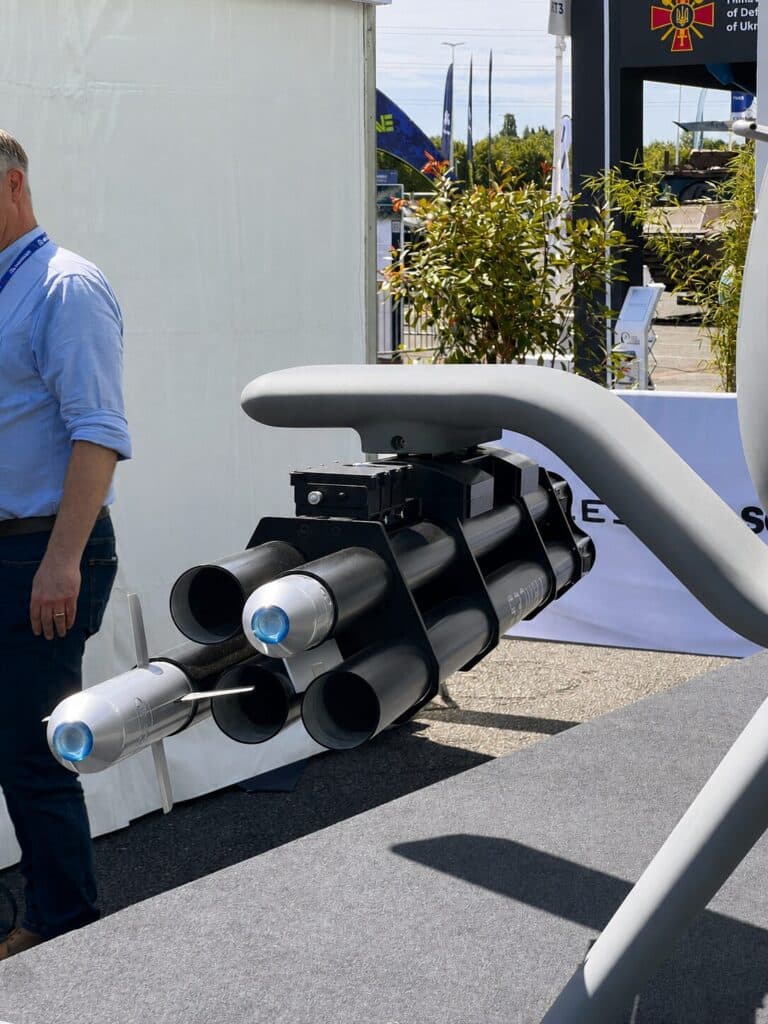
At Eurosatory, Thales presented a multi-mission effector suite spanning loitering munitions, missiles, and rockets. Candidate weapons include the Thales Toutatis loitering munition, the Lightweight Multirole Missile (LMM, known as "Martlet" in Royal Navy service), and laser-guided rockets. The S-101 has been demonstrated carrying two Thales Martlet missiles, while the S-301 has the capacity to carry up to ten.
The LMM and S-301 are a natural pairing. The 13 kg, 76 mm laser-guided missile is already cleared for use on the Camcopter S-100 and reached full operational capability with the Royal Navy in October 2025, having been combat-proven in Ukraine and the Red Sea.
For rockets, Thales' Belgian rocket business unit's 70 mm (2.75-inch) FZ275 laser-guided rocket is the obvious in-house option. This year Thales has also been actively promoting the weapon as a low-cost counter-drone effector.
Toutatis represents the more forward-looking option. This short-range loitering munition, fitted with a swappable 1 kg warhead and a range of approximately 30 km (18 miles), has been ordered by the French Army for testing. At Eurosatory, Thales also announced a partnership with Renault Group to mass-produce the munition from 2027 at a rate of up to 1,000 units per month.
However, Thales has not yet fired Toutatis from the S-301 and is seeking customer funding to complete integration. Company representatives noted that the first air-launch of Toutatis is more likely to come from a crewed platform first — with the Airbus Helicopters Tiger as the primary candidate — before the S-301, partly due to the more complex regulatory approval process involved in having one autonomous system launch another.
UK Loyal Wingman Competition
The S-301's most concrete near-term opportunity may lie in the United Kingdom. Thales and Schiebel were shortlisted in May 2026 as one of four teams competing in Project NYX — the British Army's programme to develop an unmanned "loyal wingman" to operate alongside the AH-64E Apache attack helicopter.
The other three shortlisted teams are Anduril, BAE Systems, and Tekever. The UK Ministry of Defence has stated it will evaluate all four designs before selecting up to two to proceed to the prototype phase this autumn, targeting initial operational capability by 2030.
According to Thales, the S-301's first demonstration in this role is planned for September 2026. The aircraft will conduct reconnaissance, target acquisition, strike, and electronic warfare missions in what the MoD describes as "directed not controlled" mode — meaning the drone operates with a high degree of autonomy, but with humans retaining ultimate authority over weapons release.
This approach relies on autonomous software that Thales is currently developing. For the S-301 specifically, the company has announced it is developing an onboard mission autonomy software stack: software agents capable of accepting high-level taskings, autonomously planning routes, and operating sensors during missions — rather than relying on continuous operator remote control.
At the fleet level, Thales is separately developing "Swarm Master" — a platform-agnostic drone command layer designed to allow a single operator to simultaneously direct multiple homogeneous or mixed drone types. The system is being refined with the French military and a first product delivery is expected before the end of 2027, with the system reportedly able to coordinate up to 10 drones under a single operator.
Both efforts are designed for contested electromagnetic environments — identified as a priority by both Thales and the UK MoD — which is itself the primary driver for pursuing autonomous collaborative operations.
Built on the Peregrine Partnership
The Thales–Schiebel relationship is not new. The two companies already supply the Royal Navy's Peregrine system together, integrating the Camcopter S-100 with Thales' I-Master radar and EO/IR sensors for maritime surveillance. The Peregrine system completed factory acceptance testing and was cleared for service in 2025, deployed aboard Type 23 frigates.
The larger S-300 has already been selected by South Korea. Schiebel, in partnership with Hanwha Systems and UI Helicopter, won a contract in 2024 to supply three aircraft to the Republic of Korea Navy and Marine Corps for ISTAR missions, with delivery scheduled by 2027. The same type also serves as the dedicated air vehicle in SEACURE — a Thales-led, European Defence Fund-backed anti-submarine seabed warfare programme.
Schiebel currently has three S-301 pre-production prototypes undergoing test flights. Against a market backdrop shaped by the lessons of the war in Ukraine and Europe's drive for sovereign drone capability, Thales and Schiebel are betting that a VTOL airframe with a proven shipborne and field record — now equipped with autonomous capability and armed configurations — can meet the urgent demand for armed, persistent, and relatively low-cost unmanned helicopters.
原文來源: 查看原文
FAQ
Newsletter
Subscribe to our Low-Altitude Industry Newsletter
Daily curated news on low-altitude economy and drone industry, delivered to your inbox.