Saudi Arabia Approves $1.96 Billion Purchase of 20,000 APKWS II Laser-Guided Rockets for Anti-Drone Role
The U.S. State Department has approved a potential $1.96 billion arms sale to Saudi Arabia comprising 10,000 APKWS II air-to-air guidance kits and 10,000 air-to-ground kits — totaling 20,000 laser-guided rockets. The deal is intended to give the Royal Saudi Air Force a cost-effective counter-drone capability against Houthi and Iranian one-way attack drones, equipping its F-15SA and Eurofighter Typhoon fleets with a low-cost precision weapon.
Highlights
- The U.S. State Department approved a $1.96 billion arms sale to Saudi Arabia on July 15, covering 10,000 APKWS II air-to-air guidance kits and 10,000 air-to-ground guidance kits — 20,000 rounds in total.
- Each APKWS II round costs approximately $35,000, achieving rough cost parity with Shahed-136 one-way attack drones ($20,000–$30,000), compared to over $1 million for a conventional air-to-air missile.
- The Royal Saudi Air Force is expected to integrate APKWS II onto its F-15SA and Eurofighter Typhoon fleets, following precedents set by the U.S. Air Force and UK Royal Air Force.
- Ukraine's F-16s first deployed APKWS II in December 2025 and have since used the rockets extensively to intercept Russian drones, validating the weapon's counter-UAS effectiveness in combat.
- The Houthis attacked Abha International Airport and Saudi military bases with ballistic missiles and drones on July 13, underlining the ongoing threat that motivated the purchase.
The proliferation of low-cost drones has fundamentally upended the economics of traditional air-defense operations, pushing nations worldwide toward more cost-effective laser-guided rocket solutions. Saudi Arabia is the latest country to follow suit, having secured U.S. approval to procure 20,000 APKWS II laser-guided rockets.
Deal Details
According to an official notification published on July 15, the U.S. State Department approved a potential $1.96 billion foreign military sale to Saudi Arabia. The package includes 10,000 Advanced Precision Kill Weapon System II (APKWS II) air-to-air guidance kits and up to 10,000 APKWS II air-to-ground guidance kits.
The sale also covers a range of non-primary defense equipment, including LAU-131 A/A launchers, Mk-152 high-explosive warheads, MK66 rocket motors, proximity fuzes, WTU-1/B training warheads, and inert MK66 rocket motors.
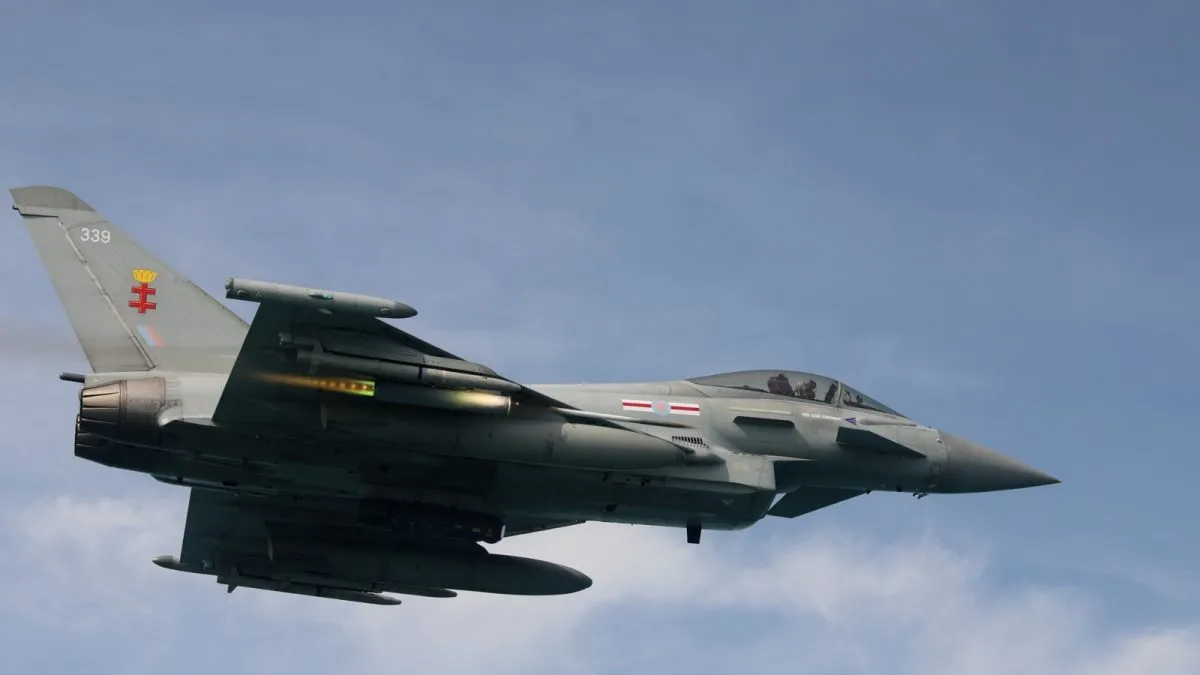
Saudi Arabia has not yet publicly specified which aircraft will carry the APKWS II. However, the U.S. Air Force (USAF) and Royal Air Force (RAF) have already integrated the weapon onto F-15s and Eurofighters respectively, providing a reference model for other operators. The Royal Saudi Air Force (RSAF) may ultimately deploy the system on both its F-15SA and Typhoon fleets.
The U.S. State Department stated: "This proposed sale will support the foreign policy and national security objectives of the United States by improving the security of a major non-NATO ally that is an important force for political stability and economic progress in the Gulf region."
Regional Security Context
During the most recent escalation cycle, attacks by Iran's Islamic Revolutionary Guard Corps (IRGC) were directed primarily at Kuwait and Jordan, with Saudi Arabia largely spared. Nevertheless, Prince Sultan Air Base — which hosts U.S. personnel and equipment on Saudi soil — came under multiple attacks during the early stages of the 40-day U.S.-Iran conflict.
The latest round of tension between Saudi Arabia and Yemen's Houthi movement has further complicated Riyadh's security calculus. Since 2015, the Saudi- and UAE-led coalition supporting Yemen's internationally recognized government has been locked in a protracted war of attrition with the Houthis, who control large swaths of northern Yemen, including the capital Sanaa.
A ceasefire reached in 2022 provided a brief respite but remained fragile, and now appears under renewed strain. On July 13, for instance, the Houthis launched ballistic missiles and drones at Abha International Airport in southern Saudi Arabia and at several military bases, citing the blocking of Iranian aircraft from landing at Sanaa airport by the Yemeni government and Saudi Arabia.
Both Iran and the Houthis maintain large inventories of cheap one-way attack drones that pose a significant threat to military and civilian infrastructure. Intercepting such drones with advanced precision munitions is prohibitively expensive — making the APKWS II acquisition a direct effort to rebalance the cost equation of modern warfare.
APKWS II: The Low-Cost, High-Precision 'Drone Flyswatter'
Low-cost laser-guided rockets like the APKWS II give pilots a proportionate counter-drone option while preserving expensive interceptor missiles for faster, more advanced threats in dynamic combat environments. This is especially critical when facing mass drone attacks or drone swarms — expending costly missiles against cheap targets rapidly depletes stockpiles and is economically unsustainable, as ongoing regional conflicts have demonstrated.
Laser-guided rockets also provide fighter aircraft with critical magazine depth. Saudi jets carrying multiple rocket pods can bring dozens of rounds on a single sortie, maintaining prolonged presence over a designated area and engaging multiple drones per mission — making them highly efficient counter-drone platforms.
APKWS II: Technical Overview
The Advanced Precision Kill Weapon System (APKWS), formally designated AGR-20 or APKWS II, is a laser-guided rocket system developed primarily by BAE Systems in cooperation with the United States. It upgrades the standard unguided Hydra 70 (2.75-inch / 70 mm) rocket into a precision-guided munition by adding a mid-body guidance kit.
The APKWS II originated from a U.S. Army requirement in the late 1990s and early 2000s to fill the capability gap between cheap unguided rockets and expensive missiles such as the AGM-114 Hellfire.
Initially designed for helicopter and fixed-wing air-to-ground attack missions, the system can precisely strike lightly armored targets with minimal collateral damage. It subsequently evolved into a ground-launched counter-drone weapon and an air-to-air combat munition.
The U.S. later introduced the AGR-20F — designated FALCO (Fixed-wing Air-Launched Counter-UAS) — an air-to-air optimized variant featuring a proximity fuze and refined guidance and sensing algorithms engineered specifically to engage fast-moving aerial targets such as drones.
A key innovation of the APKWS II mid-body guidance kit is the addition of folding control fins for stability and maneuverability, giving it roughly one-third the weight and cost of comparable precision-guided missiles. For precision strike, the system uses semi-active laser guidance with a low circular error probable (CEP), making it suitable for point targets and providing a low-cost, low-collateral-damage solution against lightly armored targets and cheap drones — bridging the gap between unguided rockets and expensive missiles.
The core technological innovation is the Distributed Aperture Semi-Active Laser Seeker (DASALS). The APKWS II guidance kit positions the laser seeker on the leading edges of the forward control fins, located between the rocket motor and the warhead.
The APKWS II can down one-way attack drones such as the Shahed-136 (estimated unit cost: $20,000–$30,000) at a fraction of the cost of an air-to-air missile. At approximately $35,000 per round, the APKWS rocket achieves rough cost parity with the cheap drones it targets.
In a protracted conflict, this cost symmetry is critical. Expending air-to-air missiles priced at over $1 million per round to destroy drones costing tens of thousands of dollars is not only economically unsustainable but rapidly depletes missile inventories.
Combat Record and International Adoption
In Ukraine, APKWS II rockets have been employed in air-defense roles — most notably via the VAMPIRE ground-launch system — proving far more economical than conventional air-to-air missiles in countering Russian-operated one-way attack drones.
The U.S. military has led the way in integrating the APKWS II onto combat and attack aircraft for counter-drone missions, fielding the system on F-16 Fighting Falcons, F-15E Strike Eagles, and A-10 Thunderbolt IIs (Warthogs). The Air Force Test Center completed APKWS II integration onto the F-15E Strike Eagle on an accelerated timeline in mid-September 2025.
The APKWS II has become the primary air-to-air weapon employed by the USAF against drone threats in the Middle East. U.S. Air Force A-10 Thunderbolt IIs armed with APKWS II were deployed to Iraq for drone-hunting operations during Operation Epic Fury, for example.
Ukrainian F-16s were first observed carrying LAU-131/A seven-tube rocket pods loaded with APKWS II in December 2025, and open-source intelligence has since documented their extensive use in combat — swatting down Russian drones with flyswatter-like efficiency.
This success has prompted other nations to follow. The United Kingdom, for instance, deployed APKWS-equipped Eurofighter Typhoons to the Middle East for air-defense duties in May 2026, while France has integrated 68 mm laser-guided rockets onto its Dassault Rafale multirole fighters as a counter-drone weapon.
Saudi Arabia's Strategic Rationale
For Saudi Arabia — operating in an acutely volatile geopolitical environment and facing non-state actors armed by Iran with large quantities of cheap drones — seeking low-cost weapons to neutralize cheap threats while maintaining cost parity is a pragmatic and logical strategic choice, particularly as regional tensions continue to escalate.
原文來源: 查看原文
FAQ
Reviewed and published by the LAETimes editorial desk ·