Penn State's Amy Pritchett Calls for 'Team Autonomy' to Safeguard Global Airspace
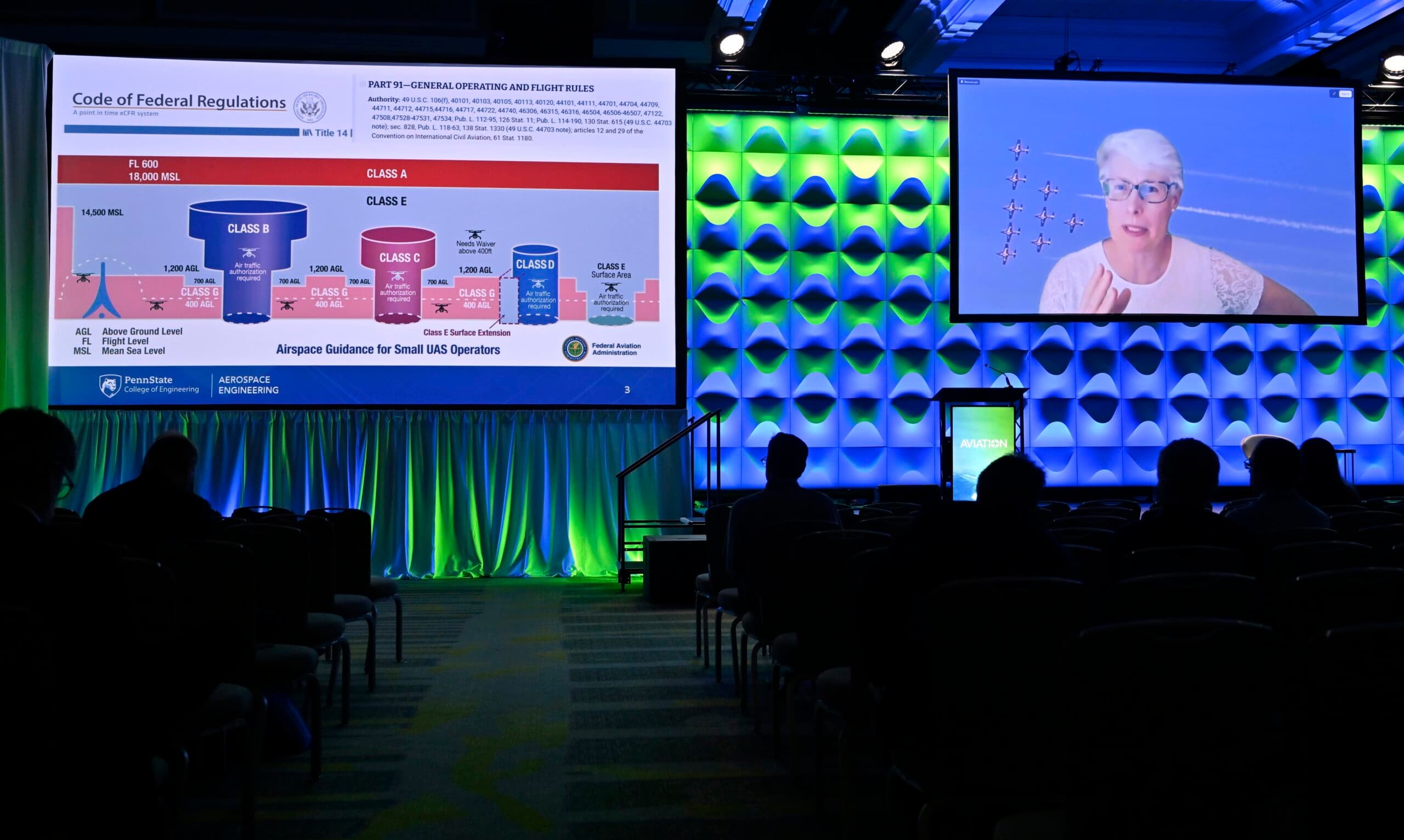
At the AIAA AVIATION Forum 2026, Penn State aerospace engineering department head Professor Amy Pritchett challenged the global aerospace community to move beyond the 'humans vs. autonomous systems' paradigm. She advocated for a 'Human-Autonomy Teams' model grounded in interdependence, shared responsibility, and explainable behavior as the foundation for next-generation airspace management.
Highlights
- Professor Amy Pritchett, aerospace engineering head at Penn State University, presented the 'Team Autonomy' concept at the AIAA AVIATION Forum 2026.
- Pritchett argues the industry must shift from an adversarial 'humans vs. autonomous systems' model to a 'Human-Autonomy Teams' approach built on interdependence, shared responsibility, and explainable behavior.
- The framework has direct implications for UAV, Advanced Air Mobility (AAM/UAM), and autonomous aircraft sectors as low-altitude airspace traffic density continues to rise.
- Pritchett called on engineers, policymakers, and regulators to treat human-machine collaboration capability as a primary design objective in next-generation airspace management systems.
Penn State's Amy Pritchett Calls for 'Team Autonomy' to Safeguard Global Airspace
At the AIAA AVIATION Forum 2026, Professor Amy Pritchett, head of the Department of Aerospace Engineering at Penn State University, issued a significant challenge to the global aerospace community, urging the industry to fundamentally rethink how autonomy should be designed into the world's airspace systems.
From Adversarial Thinking to Collaboration
Pritchett argued that the aviation industry has long framed the question of airspace autonomy as a contest between humans and automated systems — a mindset she contends is no longer adequate for the increasingly complex demands of global airspace. The real solution, she said, lies in building Human-Autonomy Teams, underpinned by three core principles:
- Interdependence: Humans and autonomous systems complement each other, each contributing distinct strengths
- Shared Responsibility: Accountability for decisions and safety is distributed between human and machine, rather than assigned unilaterally to either party
- Explainable Behavior: The decision-making logic of autonomous systems must be transparent and interpretable to human operators
Implications for Future Airspace Management
Pritchett's perspective carries significant weight for the rapidly evolving sectors of unmanned aerial vehicles (UAVs), Advanced Air Mobility (AAM/UAM), and autonomous aircraft. As lower-altitude airspace opens up and traffic density continues to grow, ensuring that human supervisors and autonomous flight systems can work together effectively has become a central challenge for both aerospace engineering and air traffic management.
Her concept of 'Team Autonomy' is a direct call to engineers, policymakers, and regulators: when designing next-generation airspace management systems, human-machine collaboration capability must be treated as a primary design objective — not an afterthought to full automation.
The forum was organized by the American Institute of Aeronautics and Astronautics (AIAA) and is one of the most influential annual gatherings for academic and industry exchange in the global aerospace field.
Source: AIAA – Shaping the future of aerospace
原文來源: 查看原文
FAQ
Reviewed and published by the LAETimes editorial desk ·