Three Illinois Agricultural Spray Drone Operators Share Real-World Equipment Choices
Prairie Farmer interviewed three Illinois custom application operators to find out which drone models and support equipment they rely on. All three entered the market in 2023 or later and collectively operate DJI Agras T50s, T40s, and the EAVision J-150. Their fleets have scaled rapidly, with one operator projected to cover 15,000 acres this season.

Highlights
- Three Illinois custom spray operators entering the market in 2023 or later collectively fly DJI Agras T50s, T40s, and the EAVision J-150 across operations targeting over 35,000 combined acres in 2024–2025.
- Klaytin Hunsinger transitioned from the DJI Agras T40 to the EAVision J-150 by 2026, citing its 20-gallon tank, LiDAR sensing suite, and mid-flight spray direction adjustment as key advantages.
- The DJI Agras T50 features a 40-liter spray tank, dual-atomizer system with up to 24 L/min flow via optional centrifugal nozzles, and phased-array radar plus binocular vision sensing.
- Hunsinger's custom 'Drone Deck' trailer — with 20-foot lower and 32-foot upper decks — sells for $18,000–$22,000 and is currently sold out due to excess demand.
- The Wenger family is targeting approximately 15,000 acres this season with three T50s, up from a two-drone fleet in 2023, using a custom 22-foot gooseneck trailer with dual 400-gallon tanks and an eight-battery setup.
Agricultural spray drones have evolved from novelty technology into a reliable revenue stream across the U.S. Corn Belt, and the operators flying them have strong opinions about which platforms hold up through an entire season. Prairie Farmer recently spoke with three Illinois-based custom application operators to learn which aircraft and trailer systems they actually use. Their answers converged on two brands and three primary models: the DJI Agras T50, the older T40, and the EAVision J-150.
Three Operators, Three Business Models
Klaytin Hunsinger runs Hunsinger Ag Solutions out of Rossville, Illinois, offering spray services, aerial scouting, drone dealership, and seed sales. Gary and Alec Wenger operate No Trax Precision Ag in Rushville, Illinois, alongside their retail business, Wenger Ag Solutions, which sells seed, feed, fungicides, and seed treatments. Ben Bremmer co-founded Spring Valley Aviation LLC in Pearl City, Illinois, together with two brothers and two cousins.
All three entered the industry in 2023 or later — meaning they all came in during the same window when spray drones were becoming a mainstream custom-application option. Each arrived at a different aircraft for different reasons.
The Three Drones Carrying the Business
Hunsinger started with the DJI Agras T40 in 2023 and had transitioned to the EAVision J-150 by 2026. His reasons for choosing the J-150 include parts availability, a 45,000 mAh main battery, a LiDAR sensor suite, and a 20-gallon (75.7 L) tank. He also highlighted a field-critical feature: the J-150 allows the pilot to stop mid-flight and immediately adjust spray direction when wind conditions change.
The Wenger family currently operates three DJI Agras T50s. They upgraded from the T40 after the T50 launched, citing resolved software issues, improved efficiency, and a more operator-friendly workflow. Bremmer also flies two T50s. He wanted a thoroughly proven platform and chose the T50 after approximately six months of field testing.
Actual Specs of the Three Platforms
DJI Agras T50 is the most widely used model in this group. It uses DJI's coaxial dual-rotor design and carries a 40-liter (10.5-gallon) spray tank along with a spreading hopper capable of holding 50 kg (110 lb) of granular fertilizer. Its dual-atomizer spray system delivers a maximum flow rate of 16 liters per minute; an optional centrifugal nozzle kit raises total flow to approximately 24 liters per minute. Droplet size is adjustable between 50 and 500 microns. The sensing suite includes front and rear phased-array radar plus a binocular vision system.
Image credit: DJI
DJI Agras T40 is still in service with operators like Hunsinger and remains common across the region. It shares the T50's 40-liter tank and coaxial dual-rotor architecture but uses an older spray and sensing configuration. DJI's official figures put the T40 at roughly 52 acres per flight hour, with an active phased-array radar range of approximately 164 feet (50 m).
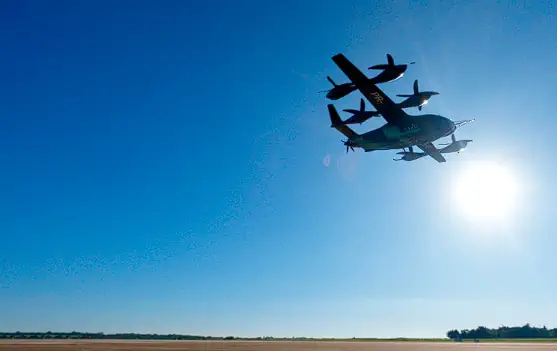
EAVision J-150 takes a notably different approach. It carries a 20-gallon (75.7 L) tank — the largest of the three — and delivers a peak flow rate of 40 liters per minute. Its sensing suite is LiDAR-primary, combining dual forward-facing LiDAR units, dual phased-array radars, and a 360-degree millimeter-wave radar that supports night operations.
Image credit: EA Vision
The 45,000 mAh battery Hunsinger mentioned pairs with a 13,000-watt charger; EAVision states it can charge from 20% to full in under nine minutes.
"LiDAR is excellent technology and useful for any type of pilot. Vision sensors need some level of light to function, but LiDAR emits its own laser light, so it works under any lighting condition — or lack thereof. When your aircraft is worth more than $20,000, avoiding accidents isn't optional; it's the top priority."
Trailer Systems and Acreage Are the Real Differentiators
As reported by Farm Progress, Hunsinger designed a trailer system he calls the "Drone Deck," which Hunsinger Ag Solutions now manufactures and sells commercially. The trailer features a 20-foot lower deck and a 32-foot upper deck in a detachable configuration, allowing the trailer to serve other purposes in the off-season. The composite-deck version is priced at $22,000; the wood-deck version at $18,000. Hunsinger says demand currently exceeds supply.
Image credit: Klaytin Hunsinger
The Wenger family built two trailers themselves. The primary unit is a 22-foot custom gooseneck with a top deck, two 400-gallon water tanks (one for clean water, one for mixed chemical), a generator, eight battery sets, and a three-person crew of two pilots and one visual observer.
Image credit: Gary and Alec Wenger
Operating drones and support equipment at deck level significantly reduces turnaround time for landing, battery swaps, and tank refills. A smaller secondary trailer with a single 400-gallon tank handles remote fields and work along drainage ditches.
Bremmer uses a 26-foot double-deck gooseneck trailer with 7-foot drone landing wings on each side. After purchasing the trailer, he completed the electrical and plumbing work himself, installing separate clean-water and chemical tanks along with an agitation system tuned for fungicide applications.
Image credit: Ben Bremmer
The acreage numbers tell the story clearly. Hunsinger covered 5,500 acres with one drone in 2023, is on track for approximately 10,000 acres this year with two aircraft, and expects to move roughly 20 units through his dealership channel. The Wenger family grew from two drones in 2023 to three, with a target of approximately 15,000 acres this season, primarily in fungicide applications. Bremmer's team covered 7,500 acres last year with two T50s and is targeting 10,000 acres this year.
Industry Perspective
Is the agricultural drone sector heading toward a genuine brand competition analogous to Skydio challenging DJI in the commercial market? Just a year ago, few serious spray operators would have moved away from DJI Agras. Today, one of these three operators has done exactly that — and has no regrets.
Another notable takeaway: custom drone application services represent one of the most economically viable small businesses currently accessible in the United States. Entry barriers exist but are not insurmountable, and the unit economics work once sufficient time is invested.
The broader point that often goes unnoticed: these aircraft allow the same fields to be treated faster, with less chemical input, while the operator's feet never leave the ground. That kind of progress is difficult to illustrate in a horsepower specification sheet, but it is genuinely moving agriculture forward.
Image credits: EA Vision, DJI, Ben Bremmer, Gary and Alec Wenger, Klaytin Hunsinger
原文來源: 查看原文
FAQ
Reviewed and published by the LAETimes editorial desk ·