Could Drone Delivery Routes Hurt Property Values? Experts Warn of Noise and Privacy Concerns
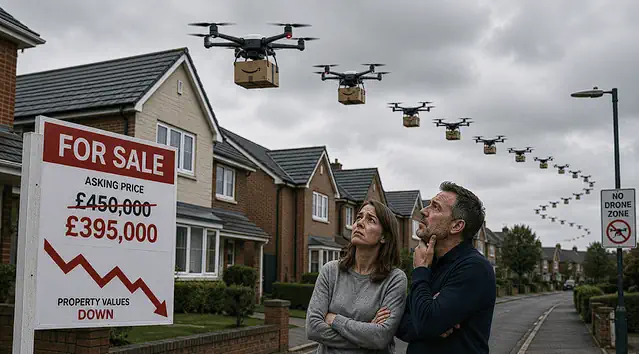
As drone delivery services expand, concerns are mounting over whether fixed low-altitude flight corridors could negatively impact property values along their routes. Experts point to noise pollution and privacy risks—particularly from camera-equipped drones—as potential headwinds for residential real estate, drawing parallels to the well-documented effects of airports and highways on nearby home prices.
Highlights
- Fixed drone delivery corridors could suppress residential property values along their routes, according to emerging industry and academic concern, mirroring the well-documented price discounts seen near airports and highways.
- Persistent low-altitude noise and privacy risks from camera-equipped drones are identified as the two primary negative variables that could affect real estate valuations beneath active flight corridors.
- The FAA and UK CAA are developing UTM frameworks for low-altitude airspace, but specific noise and privacy protections remain inconsistent across jurisdictions.
- Operators including Wing, Zipline, and Amazon Prime Air must balance delivery efficiency with community acceptance to sustain long-term operations and avoid regulatory backlash.
- Routing drone corridors over commercial or industrial zones rather than residential areas is highlighted as a key planning measure to reduce the potential impact on home prices.
Drone delivery services are typically marketed on convenience—faster parcel drops, fewer delivery trucks on the road, and a smaller carbon footprint. On paper, it sounds like a straightforward win for modern logistics. Yet as the technology moves from pilot programs to permanent infrastructure, a question that has largely flown under the radar is gaining attention: could fixed drone flight corridors drag down property values for residents living beneath them?
The Hidden Cost of Convenience
Advocates for drone delivery tend to focus on consumer-facing benefits: shorter wait times, reduced urban congestion, and lower emissions. For residents directly below a high-traffic flight route, however, the experience may be far less appealing.
Frequent low-altitude drone flights can generate persistent noise and raise legitimate privacy concerns—especially when the aircraft are equipped with cameras. Both factors have historically served as negative variables in property valuations.
What Real Estate History Tells Us
Research on noise pollution and property values offers a cautionary precedent. Studies of homes near airports and major highways consistently show that properties exposed to elevated noise levels trade at a discount compared with quieter locations in the same area.
Whether drone corridors will replicate that effect remains an open question—long-term data are still scarce—but both the industry and academia are beginning to take the risk seriously.
The Critical Role of Regulation and Route Planning
How flight corridors are designed will largely determine their impact on residential neighborhoods. Regulators that prioritize routing drone traffic over commercial or industrial zones—and minimize prolonged overflight of densely populated residential areas—could significantly reduce any adverse effect on home prices.
Authorities including the U.S. Federal Aviation Administration (FAA) and the UK Civil Aviation Authority (CAA) are actively developing Uncrewed Traffic Management (UTM) frameworks for low-altitude airspace. However, specific rules governing noise limits and privacy protections vary considerably across jurisdictions, and many remain works in progress.
An Industry Challenge That Cannot Be Ignored
For operators such as Wing, Zipline, and Amazon Prime Air, which are all aggressively scaling their delivery networks, striking the right balance between operational efficiency and community acceptance will be essential to long-term viability. Dismissing residents' legitimate concerns risks not only regulatory pushback but also broader public opposition that could slow the entire sector's momentum.
The future of drone delivery should not be a story told solely in terms of speed. It needs equally to be a story about coexistence.
原文來源: 查看原文
FAQ
Reviewed and published by the LAETimes editorial desk ·