Old EV Batteries Get a Performance Upgrade: UC San Diego Develops Novel Recycling Technology
Researchers at UC San Diego have developed an innovative battery recycling process that upcycles spent lithium iron phosphate (LFP) cathode materials into higher-energy lithium manganese iron phosphate (LMFP), retaining LFP's safety and longevity while boosting energy density. The findings, published in the journal Joule, could significantly increase the residual value of retired EV battery packs.
Highlights
- UC San Diego researchers published a process in Joule that upcycles spent LFP cathode material into higher-energy LMFP, rather than simply regenerating it back into LFP.
- LFP batteries currently represent nearly half of the global lithium-ion battery market, making scalable end-of-life recycling an urgent industry priority.
- The process uses a lithium manganese phosphate (LMP) intermediate to ensure atomic-level uniformity in the final LMFP structure, overcoming crystal-lattice incompatibility.
- Production was successfully scaled to kilogram-level batches, and the recycled material performed well in pouch cells comparable to those used in EVs and energy storage systems.
- The method avoids high-temperature smelting and aggressive chemicals used in conventional recycling, reducing energy consumption, waste, and emissions.
Old EV Batteries Get a Performance Upgrade: UC San Diego Develops Novel Recycling Technology
As millions of electric vehicle batteries approach the end of their service lives, researchers have found a way to do more than simply recycle them — they can make them perform better than before. Scientists at the University of California San Diego (UC San Diego) have developed a process that upcycles the cathode material from spent lithium iron phosphate (LFP) batteries into lithium manganese iron phosphate (LMFP). This upgraded material stores more energy while retaining the safety and long cycle life that have made LFP chemistry so widely adopted.
The research introduces a fundamentally different approach to battery recycling: rather than breaking down spent cells into raw materials and remanufacturing cathodes from scratch, the process directly upgrades existing cathode material into a higher-performing form. The method has the potential to reduce waste, cut energy consumption, and increase the residual value of retired EV batteries.
A Greener Process Aimed at Reducing Waste
LFP batteries are among the most commonly used battery types in electric vehicles and large-scale energy storage systems. Because they do not require expensive metals such as cobalt or nickel, they cost less than many other lithium-ion chemistries and currently account for nearly half of the global lithium-ion battery market. As growing numbers of LFP batteries reach end-of-life, efficient recycling has become an increasingly pressing challenge.
Most existing recycling methods rely on high temperatures or aggressive chemical reagents to recover valuable materials. "These processes are not environmentally friendly," said Wei Li, a postdoctoral researcher in Professor Zheng Chen's laboratory at UC San Diego and the study's lead author. "They consume large amounts of energy and generate significant waste and emissions."
Chen's team had previously developed a method to regenerate spent LFP batteries back into fresh LFP material — but the recycled product retained the same chemistry as the original. "After regeneration, it is still LFP," Li explained. The new approach goes further by upgrading the material into LMFP, which can store more energy. "This provides a higher-value end use for spent batteries," Chen added.
Transforming Spent Cathodes into Superior Materials
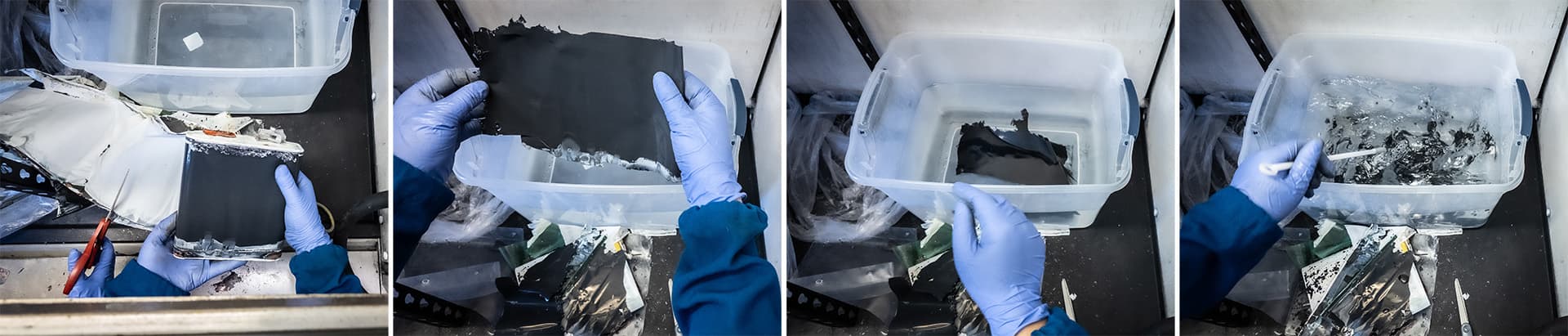
The recycling process begins with disassembling the battery pack to extract the tightly wound internal structure known as the jelly roll. Researchers cut these layers into thin sections, submerge them in water, and use gentle agitation to separate the cathode coating from the aluminum current collector foil.
"The aluminum foil can also be separately recycled," Li noted. The separated cathode material is then dried and ground into a fine black powder. Researchers subsequently introduce lithium salts, manganese salts, and phosphate compounds to provide the precursor elements needed to synthesize LMFP.
A Key Intermediate Enables the Material Upgrade
The team faced a significant challenge: the added salts were structurally incompatible with the original LFP crystal lattice. "Their structures are not compatible," Li explained. "If they are simply mixed together, the resulting product will have a non-uniform atomic distribution and poor electrochemical performance."
To overcome this, the researchers first synthesized an intermediate compound — lithium manganese phosphate (LMP) — whose crystal structure closely resembles that of LFP. The powders are then finely milled together and heated. "This is the step where the exciting chemistry happens," said Chen.
During the heating stage, LMP forms first and mixes uniformly with LFP, allowing manganese atoms to gradually substitute for some iron atoms and produce a homogeneous LMFP structure. Simultaneously, a thin carbon coating forms on the surface of each particle, improving electrical conductivity and protecting the material through repeated charge-discharge cycles.
Experimental Results Demonstrate Scale-Up Potential
The upcycled LMFP material outperformed the original LFP in energy storage while maintaining comparable durability and safety. The researchers tested the process using LFP batteries from multiple manufacturers and successfully scaled production to kilogram-level batches.
The recycled material performed well in both small laboratory-scale coin cells and larger pouch cells — a format similar to those used in electric vehicles and grid-scale energy storage systems.
The research team plans to further optimize process efficiency, improve material recovery rates, and refine the material's composition and structure to enhance performance, laying the groundwork for large-scale commercial deployment of the technology.
The study has been published in the academic journal Joule.
原文來源: 查看原文
FAQ
Newsletter
Subscribe to our Low-Altitude Industry Newsletter
Daily curated news on low-altitude economy and drone industry, delivered to your inbox.
Reviewed and published by the LAETimes editorial desk ·